
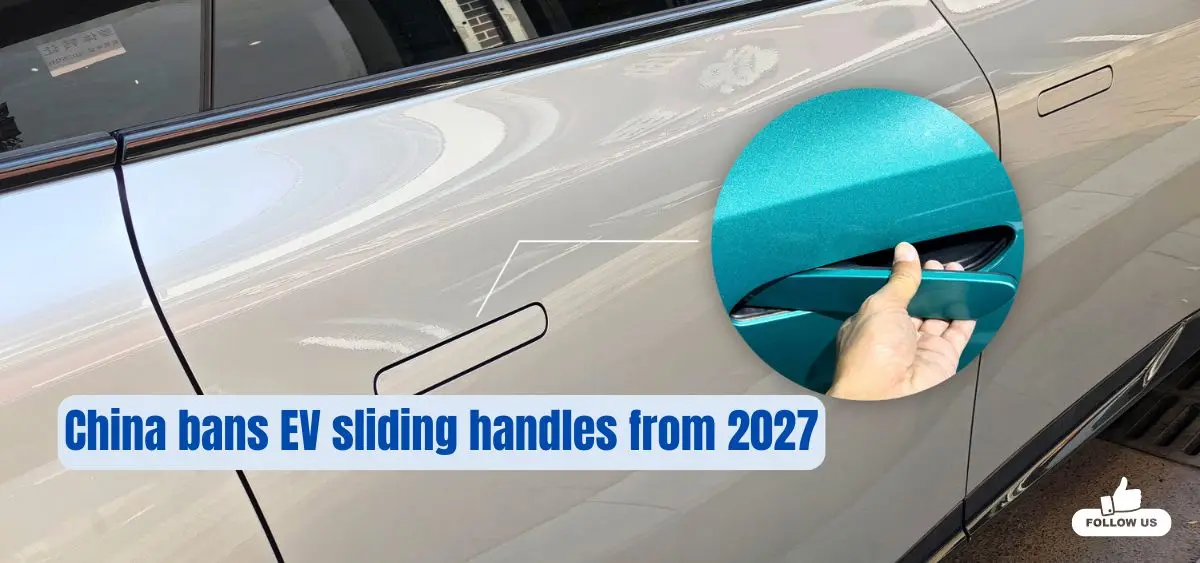

China has announced a major safety-driven shift in electric vehicle design. From January 1, 2027, the country will prohibit the sale of new EVs equipped with fully extendable or hidden door handles. This landmark move—widely discussed as China bans EV sliding handles—signals the end of a design trend once praised for its futuristic appeal and aerodynamic benefits.
Why Are Extendable Handles Being Phased Out?
Extendable or retractable door handles became popular because they reduced drag and enhanced a car’s sleek look. However, real-world accidents revealed a serious flaw: these handles often rely entirely on electrical systems. In crashes, fires, floods, or power failures, doors may not open at all—trapping occupants inside when every second matters.
Several fatal incidents in 2024 intensified public concern, as rescuers and bystanders were unable to open vehicle doors from the outside after electronic systems failed. As a result, China bans EV sliding handles to prioritize occupant safety over aesthetics.
New Safety Rules Issued by MIIT
China’s Ministry of Industry and Information Technology (MIIT) has issued clear requirements for all passenger vehicles weighing under 3.5 tons:
- Mechanical emergency overrides are mandatory for both internal and external door handles.
- Power-independent access must be ensured, even if the battery, wiring, or electrical system is damaged.
- Grip standards require external handles to provide sufficient physical space for hands, ensuring rescuers can operate them easily.
- Visibility and placement rules mandate that internal mechanical releases be clearly marked and positioned close to the door edge.
These measures aim to make door operation intuitive and reliable during emergencies.
Rising Safety Concerns Behind the Decision
Official investigation data showed a sharp rise in handle-related accidents, with hidden designs responsible for the majority of cases. Complaints also surged over frozen handles in cold climates, short-circuiting during floods, and injuries caused by retractable mechanisms pinching fingers. Collectively, these issues explain why China bans EV sliding handles despite their popularity.
Impact on Automakers and Global Design
China is the world’s largest EV market, so the ripple effects will be global. Brands like Tesla, BYD, Mercedes-Benz, Geely, and Lexus will need to redesign models that rely on flush, electronically actuated handles. Traditional handles and semi-retractable designs remain permitted, provided they include mechanical backups.
As China bans EV sliding handles, automakers worldwide may follow suit, shifting back toward simpler, more dependable mechanical solutions—proving that in emergencies, reliability matters more than futuristic flair.

Related Articles:-









