
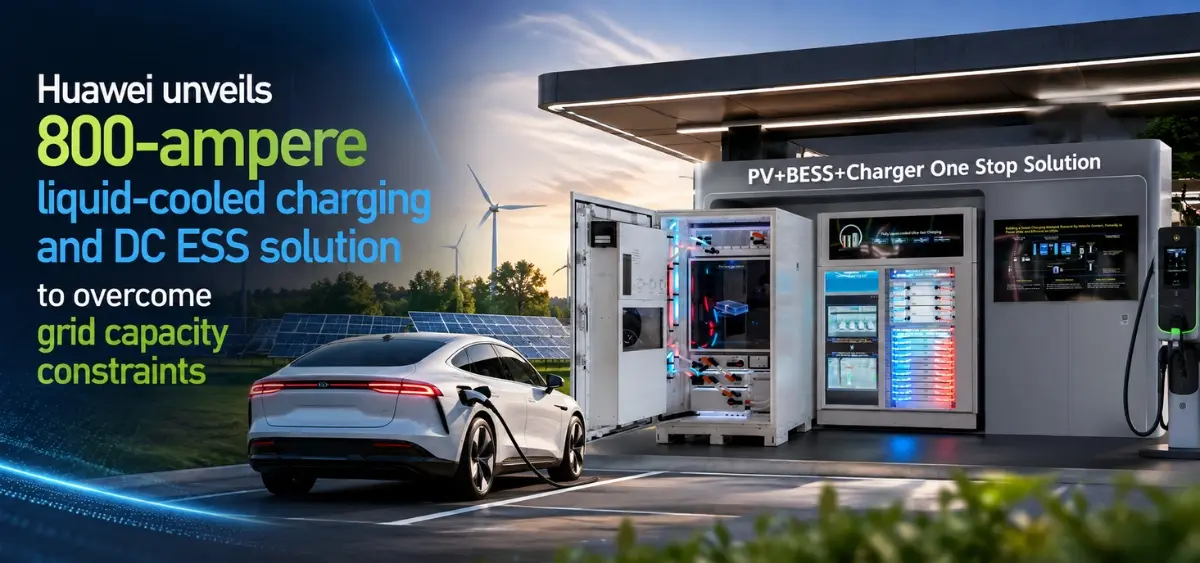

Huawei has unveiled its next-generation FusionCharge ultra-fast charging platform with a DC-coupled Battery Energy Storage System (BESS), targeting one of the biggest obstacles to high-power EV charging: limited grid capacity. The Huawei 800A Liquid-Cooled EV Charging solution integrates charging, energy storage, and solar power to enable faster deployment without expensive grid upgrades.
720kW Charging Adds 200km Range in Five Minutes
The upgraded liquid-cooled DC dispenser supports up to 800A current across a 150–1000V voltage range and delivers total power of up to 720kW. Huawei says this can add around 200km of driving range in five minutes, making the technology particularly relevant for commercial EV fleets.
Full liquid cooling keeps operating noise below 55dB while lightweight charging cables improve usability. Boost DC dispensers support up to 600A.
Huawei claims a 10-year service life, with annual module failure rates below 0.5%. Liquid cooling also protects components against wet dust and salt fog, reducing maintenance requirements.
DC ESS Tackles Weak Grid Infrastructure
A major advantage of the Huawei 800A Liquid-Cooled EV Charging is its DC ESS architecture. The system can operate with only 50kW of available grid capacity by storing electricity and releasing it when vehicles require ultra-fast charging.
Its intelligent peak-shaving capability draws power during lower-demand periods, while dynamic power sharing distributes available energy among as many as 12 vehicles according to charging demand.
Huawei says the DC architecture removes one energy-conversion stage, improving ESS efficiency to 92.1%. The charging system itself can achieve efficiency of up to 96%.
Solar, Storage and EV Charging Combined
Huawei’s PV+ESS+Charger architecture allows solar generation to connect directly with battery storage through a shared DC bus, reducing conversion losses and addressing energy-export limitations.
For new sites, 240–720kW power units can be paired with 1C DC ESS while remaining within typical sub-240kVA grid capacity. Huawei claims this can shorten payback periods by 1.5 years.
For existing stations, a 240kVA connection and existing cabling can be reused to expand four charging spaces to 12, with individual charging output reaching 600kW.
Faster Deployment and Global Expansion
The Huawei 800A Liquid-Cooled EV Charging platform’s modular design allows operators to upgrade from fast to ultra-fast charging without replacing the complete infrastructure. Huawei says DC ESS can also reduce station construction timelines from months to weeks.
Huawei showcased the technology at Power2Drive in Munich and has already launched a megawatt-level charger in China, with testing planned ahead of European deployment. The FusionCharge platform also holds TÜV prime-level safety certification.
Huawei offers FusionCharge across in-transit, destination, fleet, and residential applications.
In Arjeplog, Sweden, Icemakers deployed Huawei’s integrated storage and charging technology at its winter EV testing facility. The system has demonstrated operation at temperatures as low as -33°C.
Overall, Huawei 800A Liquid-Cooled EV Charging combines high-power charging, BESS, and renewable energy integration to make ultra-fast EV infrastructure more practical in grid-constrained locations.

Related Articles:









