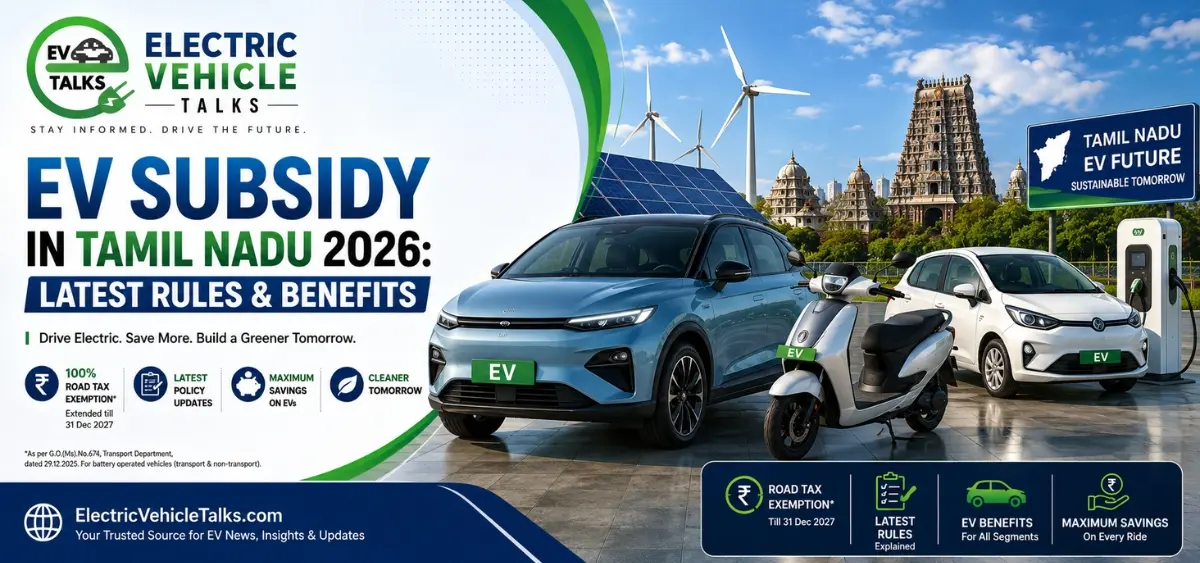

The EV Subsidy in Tamil Nadu 2026 is not a single cash discount that every EV buyer can claim. The most important confirmed state-level benefit is a 100% exemption from motor vehicle tax for battery-operated vehicles, which Tamil Nadu has extended from January 1, 2026, to December 31, 2027.
For buyers, however, the subsidy picture is more nuanced. The Tamil Nadu Electric Vehicles Policy 2023 introduced a combination of tax exemptions, registration and permit concessions, commercial-vehicle incentives, manufacturing support, and charging-infrastructure measures. Some of those benefits were originally time-bound to December 31, 2025, while the latest government order specifically confirms the extension of the motor vehicle tax exemption through 2027.
That means an electric scooter, car, taxi, bus, or ambulance buyer in Tamil Nadu should not rely on old articles claiming a universal ₹10,000, ₹50,000, or ₹1.5 lakh state subsidy. The actual benefit depends on the vehicle category, whether it is private or commercial, the applicable state notification and, where relevant, eligibility under the central PM E-DRIVE scheme.
In this guide, we break down the Tamil Nadu EV subsidy 2026 rules, explain what has changed since the 2023 policy, identify which incentives are confirmed and which older benefits should not be assumed to continue, and show how buyers can calculate the real financial advantage of switching to an electric vehicle.
2026 EV Subsidy at a Glance
This would make the article much stronger for Google Featured Snippets, AI Overviews, and readers.
Something like:
| Vehicle | Tamil Nadu state benefits in 2026 | Central PM E-DRIVE |
|---|---|---|
| Private electric scooter | 100% motor vehicle tax exemption | Eligibility depends on current scheme/model |
| Private electric car | 100% motor vehicle tax exemption | No passenger-car incentive |
| Commercial e-2W | Tax exemption: old 2023 cash incentive requires current confirmation | Eligible category |
| Commercial e-3W | Tax exemption: current state incentive requires confirmation | Eligible subject to category |
| Electric bus | Tax exemption: old TN incentive requires current confirmation | Eligible category |
| Electric ambulance | Tax exemption where applicable | Dedicated PM E-DRIVE incentive |
| Electric truck | Check applicable TN treatments. | PM E-DRIVE category |
What is the current EV subsidy in Tamil Nadu? or EV Subsidy in Tamil Nadu 2026
The simplest way to understand Tamil Nadu’s 2026 EV incentive structure is to separate state tax benefits, state purchase incentives, and central government incentives.
| Benefit | 2026 position | Who should pay attention? |
|---|---|---|
| 100% motor vehicle tax exemption | Extended until Dec. 31, 2027 | Battery-operated EV buyers |
| Private EV cash subsidy from Tamil Nadu | No general private-car cash subsidy established by the 2023 policy | Private buyers |
| 2023 commercial demand incentives | Originally applicable through Dec. 31, 2025 | Commercial operators verify current continuation before purchase |
| PM E-DRIVE | Active for several EV categories, subject to category-specific dates/caps | Eligible e-2W, e-3W, e-ambulance, e-truck, etc. |
| PM E-DRIVE private electric cars | Not an eligible category | Private car buyers |
| Charging infrastructure incentives | Included in Tamil Nadu’s EV policy framework | Charging operators/businesses |
The official 2023 Tamil Nadu EV Policy established a five-year policy framework, subject to revision or replacement by a new policy.
The important point is that a policy framework and an individual incentive’s validity are not necessarily the same thing.
What changed in Tamil Nadu EV policy in 2026?
The most important confirmed change is the extension of the motor vehicle tax exemption.
Tamil Nadu’s December 29, 2025, Government Order says the state had previously extended a 100% tax exemption up to December 31, 2025. Following representations from vehicle manufacturers and the Transport Commissioner, the government decided to extend the exemption for another two years, from January 1, 2026, to December 31, 2027.
The order specifically covers all Battery-Operated Vehicles classified as transport and non-transport vehicles under the relevant Central Motor Vehicles Rules definition.
Why this matters
For an EV buyer, motor vehicle tax can be a significant component of the on-road price.
The benefit becomes particularly meaningful on higher-priced electric cars because the avoided tax is linked to the vehicle’s taxation structure rather than being a small fixed rebate.
However, buyers should not automatically assume that every 2023 benefit has also been extended to 2027.
Important correction: Is EV registration free in Tamil Nadu in 2026?
The Tamil Nadu Electric Vehicles Policy 2023 explicitly stated that the waiver on registration charges/fees for eligible battery-operated vehicles was available until December 31, 2025. The same deadline applied to the 100% road-tax exemption and commercial permit-fee waiver under that section.
The December 29, 2025, G.O. that you supplied extends the 100% motor vehicle tax exemption through December 31, 2027. The order’s text does not say that the registration-fee waiver is extended through 2027.
Therefore, I would not recommend publishing the statement “Tamil Nadu offers zero registration fees until December 31, 2027” as a confirmed policy fact unless a separate, current Transport Department notification establishes that extension.
Some current dealer/on-road price databases continue to show EV registration as exempt in Tamil Nadu, but that is not sufficient to establish the legal validity period of the concession.
For SEO and trustworthiness, this distinction is extremely important.
EV Subsidy in Tamil Nadu for Electric Scooter
For private electric scooter buyers, the situation is quite different from the commercial segment.
The 2023 Tamil Nadu policy provided a battery-capacity-linked incentive for commercial e-2Ws, but the published demand incentive table did not create a general ₹10,000/kWh cash subsidy for every privately purchased electric scooter.
Private electric scooter buyers
A private buyer should primarily check the following:
- Whether the vehicle is a battery-operated EV eligible for the state tax exemption.
- The current motor vehicle tax exemption.
- Whether the model is eligible under any active central incentive.
- The manufacturer’s invoice and RTO treatment.
- Insurance and other mandatory charges.
- Whether the claimed subsidy is actually reflected in the invoice.
The state policy itself identified two-wheelers as an important adoption segment because their relatively smaller batteries make charging easier and their use is strongly connected to everyday urban mobility.
Is there a government subsidy for electric scooters in Tamil Nadu?
There can be a distinction between a Tamil Nadu state subsidy and a central government incentive.
Under PM E-DRIVE, eligible private or corporate registered e-2Ws were included, subject to the scheme’s eligibility requirements.
However, this is particularly important for readers in August 2026: the official PM E-DRIVE model database shows many e-2W approvals with validity ending July 31, 2026.
So an article published in 2026 should not simply tell readers that a PM E-DRIVE scooter subsidy is guaranteed for every scooter purchased today.
Always check the current eligible model and validity date before booking.
EV Subsidy in Tamil Nadu for Electric Cars
This is probably the most searched question.
Does Tamil Nadu give a cash subsidy for private electric cars?
No general direct cash purchase subsidy for private electric cars is established in the Tamil Nadu EV Policy 2023 demand-incentive table.
Instead, the major confirmed state-level 2026 benefit is the 100% motor vehicle tax exemption through December 31, 2027.
The central PM E-DRIVE scheme also does not list private electric passenger cars among its consumer demand-incentive categories. Its eligible categories include e-2Ws, e-3Ws, e-ambulances, e-trucks, and e-buses.
What does this mean for a Chennai EV buyer?
Suppose you are comparing a petrol SUV with an electric SUV.
Do not calculate the EV’s benefit as
Ex-showroom price—”₹1.5 “lakh EV subsidy”
That would be misleading.
Instead, calculate:
EV on-road cost = Ex-showroom + insurance + applicable charges + taxes/fees actually payable – confirmed incentives
Then compare that with the equivalent petrol/diesel vehicle.
The difference can be substantial because Tamil Nadu’s motor vehicle tax exemption removes a cost that would otherwise be payable on the conventional vehicle.
EV Subsidy in Tamil Nadu for Commercial Vehicles
Commercial EVs are where Tamil Nadu’s 2023 policy becomes particularly interesting.
The policy stated that commercial vehicles would receive special demand-side incentives until December 31, 2025.
The published structure was:
| Commercial EV category | Incentive in 2023 policy | Maximum incentive | Annual target |
|---|---|---|---|
| Commercial e-2W | ₹10,000/kWh | ₹30,000 | 6,000 |
| Commercial e-3W | ₹10,000/kWh | ₹40,000 | 15,000 |
| Commercial e-4W | ₹10,000/kWh | ₹1.50 lakh | 3,000 |
| e-Bus | ₹20,000/kWh | ₹10 lakh | 300 |
These figures come directly from the 2023 policy.
But here’s the 2026 Warning!
The 2023 policy clearly placed these special demand incentives within a period ending December 31, 2025.
Therefore, it would be incorrect to present the above amounts as automatically available to every commercial EV purchased in August 2026 without confirming a subsequent extension/order.
This is one of the most important corrections to the supplied pasted material.
EV Subsidy in Tamil Nadu for Electric Bus
Tamil Nadu’s EV Policy 2023 set an ambitious objective of increasing the share of electric buses in the state fleet to 30% by 2030. It also called for phased electrification of State Transport Undertaking fleets and development of bus charging infrastructure.
The 2023 policy’s state demand incentive for commercial e-buses was:
₹20,000 per kWh, capped at ₹10 lakh per bus, with an annual incentive target of 300 vehicles.
Again, that was a policy-period incentive and should not automatically be treated as a live 2026 consumer subsidy without a current state notification.
At the national level, PM E-DRIVE provides significant support for electric buses, but its structure is focused on deployment and eligible public-transport categories rather than a universal retail bus subsidy. The scheme has an allocation of ₹4,391 crore for 14,028 electric buses.
EV subsidies in Tamil Nadu for Electric Ambulances?
This is an area where the 2026 picture has actually become more interesting.
The original Tamil Nadu 2023 EV policy did not provide a dedicated electric-ambulance purchase incentive in the same way it listed e-2Ws, e-3Ws, e-4Ws, and buses.
But the central PM E-DRIVE scheme added a dedicated e-ambulance framework in June 2026.
The official PM E-DRIVE portal states that eligible ambulance categories include:
- Patient Transport Vehicle — Type B
- Basic Life Support — Type C
- Advanced Life Support — Type D
The demand incentive is the lower of ₹30,000 multiplied by battery capacity in kWh or 35% of the vehicle’s ex-factory price.
The central government allocated ₹500 crore for approximately 3,811 e-ambulances.
So for a Tamil Nadu hospital or eligible institutional buyer, the central e-ambulance incentive is much more relevant than trying to apply the old Tamil Nadu commercial e-4W formula automatically.
Tamil Nadu EV Policy 2023 vs Tamil Nadu EV Policy in 2026
There is an important terminology issue here.
There isn’t enough evidence in the supplied documents to call 2026 a completely new “Tamil Nadu Electric Vehicles Policy 2026.”
The better description is:
Tamil Nadu Electric Vehicles Policy 2023 + subsequent government orders and scheme updates applicable in 2026.
| Area | 2023 policy | 2026 position |
|---|---|---|
| Overall EV framework | Five-year policy framework | 2023 framework remains important |
| Motor vehicle tax | 100% exemption through Dec. 31, 2025 | Extended through Dec. 31, 2027 |
| Registration-fee waiver | Through Dec. 31, 2025 | Do not assume extension without separate notification |
| Commercial demand incentives | Listed through Dec. 31, 2025 | Current continuation requires verification |
| EV manufacturing | Strong investment incentives | Remains strategically important |
| Charging infrastructure | 25% equipment/machinery subsidy under specified conditions | 2023 framework remains a reference point |
| Electric buses | 30% fleet-share ambition by 2030 | Still strategically relevant |
| Central incentives | FAME II referenced by 2023 policy | PM E-DRIVE is the current central framework |
The 2023 policy itself said it would remain valid for five years from notification or until a new policy was announced, with scope for periodic revision.
What role did FAME play in Tamil Nadu EV subsidies?
The 2023 Tamil Nadu policy was drafted when FAME II was India’s major central EV incentive framework.
The Tamil Nadu policy explicitly required incentivized EVs to comply with FAME II guidelines.
But buyers searching in 2026 should be careful with old articles that still say “FAME subsidy.”
The central landscape has moved to PM E-DRIVE, which supports e-2Ws, e-3Ws, e-ambulances, e-trucks, e-buses and charging infrastructure.
In other words:
FAME II is historical context. PM E-DRIVE is the relevant central scheme to check in 2026.
How to apply for electric vehicle subsidy in Tamil Nadu
There is no single universal “Tamil Nadu EV subsidy application” because different benefits operate differently.
1. For a private EV buyer
Before making payment:
- Select an eligible battery electric vehicle.
- Ask the dealer for a detailed on-road quotation.
- Check the motor vehicle tax line.
- Ask which state exemption/order is being applied.
- Check whether any registration fee is being charged and why.
- Check central PM E-DRIVE eligibility separately, if applicable.
- Confirm the exact subsidy amount on the invoice rather than relying on advertisements.
The Tamil Nadu government operates the TNEV portal, which provides EV information, policy updates, charging information, and EV registration-related resources.
2. For commercial EV operators
The process can be more complicated because eligibility can depend on the following:
- Transport/non-transport classification
- Vehicle category
- Registration status
- Battery capacity
- Annual incentive quota
- Vehicle certification
- Active policy period
- Applicable state or central scheme
Do not assume that an old dealer brochure showing “Tamil Nadu EV subsidy” automatically applies to a 2026 registration.
Common mistakes EV buyers make in Tamil Nadu
1. Confusing tax exemption with cash subsidy
A tax waiver is financially valuable, but it is not the same thing as a government cheque or purchase discount.
2. Using old FAME-II information
Many SEO articles still combine FAME II, state subsidies, and PM E-DRIVE as if they are one scheme.
They are not.
3. Assuming every 2023 incentive continues in 2026
This is perhaps the biggest mistake.
The 2023 policy lists several benefits ending December 31, 2025. The 2025 government order specifically extends motor vehicle tax exemption through December 31, 2027.
4. Believing a dealer’s “subsidy” label without checking the invoice
Ask whether the amount is:
- State tax exemption
- Central PM E-DRIVE incentive
- Manufacturer discount
- Dealer discount
- Corporate offer
- Festival promotion
They are completely different things.
5. Ignoring charging costs
The cheapest EV to buy is not necessarily the cheapest EV to own.
Battery size, efficiency, home charging availability, and public charging usage can dramatically change the five-year ownership cost.
Charging Infrastructure in Tamil Nadu
Tamil Nadu’s 2023 policy recognized charging infrastructure as one of the most important conditions for EV adoption.
The policy proposed identifying charging sites along national and state highways at 25-km intervals on both sides, while encouraging public and private charging development.
It also proposed support for public charging infrastructure, including a 25% subsidy on equipment and machinery costs for eligible public charging stations under the policy framework.
Tamil Nadu’s current EV portal also provides charging information and describes the state’s growing charging network.
For an EV owner, however, the most important charging station is often the one at home.
If you can charge overnight at home, an electric scooter or car can be significantly more convenient than depending on public fast chargers.
Read this: Government Subsidy for EV Charging Station in India
How much can an EV owner save?
The most useful way to calculate the benefit is not to advertise a fixed subsidy.
Instead, calculate the actual ownership equation.
Example: ₹15 lakh electric car
Assume, purely for illustration, that the comparable conventional vehicle attracts a 10% motor vehicle tax.
| Cost component | EV | Comparable ICE vehicle |
|---|---|---|
| Ex-showroom | ₹1,500,000 | ₹1,500,000 |
| Illustrative motor vehicle tax | ₹0 | ₹150,000 |
| Insurance | Varies | Varies |
| Charging/fuel | Lower running cost potential | Higher fuel cost |
| Maintenance | Generally lower | Generally higher |
| State tax benefit | ₹1.5 lakh illustrative saving | — |
This is an illustrative calculation, not a government-reported saving figure. Actual taxation depends on the applicable vehicle category and rules.
The TNEV portal itself currently promotes the operating-cost advantage of EVs, stating that EV running costs can be around ₹1–₹2 per kilometer compared with ₹7–₹10 for petrol or diesel vehicles, although real-world costs vary by electricity tariff, efficiency, and charging method.
Why Tamil Nadu is becoming even more important for EVs
The policy is bigger than subsidies.
Tamil Nadu’s 2023 EV policy targeted ₹50,000 crore of EV manufacturing investment and 1.5 lakh new jobs during the policy period.
The state’s automotive ecosystem, engineering talent, supplier network, and manufacturing infrastructure make it particularly well suited to electric mobility.
The result is visible in registration data. Tamil Nadu’s EV registrations increased from 90,305 in 2023 to 133,710 in 2024 and 174,477 in 2025, according to Vahan data reported in March 2026. Electric two-wheelers account for the largest share of the state’s EV registrations.
That trend is important because it shows that Tamil Nadu’s EV story is not purely policy-driven.
Consumers are also responding to:
- Lower running costs
- More electric scooter choices
- Better charging availability
- Local manufacturing
- Improving battery technology
- Greater awareness of EV ownership
Expert Insight from Electric Vehicle Talks
The most important takeaway from the EV Subsidy in Tamil Nadu 2026 story is that buyers should stop looking for one magic subsidy number.
Tamil Nadu’s strategy is evolving from simply subsidising EV purchases toward building an EV ecosystem.
The December 2025 government order is a good example. Rather than introducing a completely new consumer subsidy, Tamil Nadu chose to extend the 100% motor vehicle tax exemption for another two years. The government order also directs the Transport Commissioner to analyze the potential impact of future EV taxation compared with other states.
That suggests policymakers are increasingly thinking about what happens after the incentive period ends.
For consumers, our recommendation is straightforward:
Buy an EV because the vehicle makes financial and practical sense for your usage; treat government incentives as a bonus, not the entire business case.
For a commuter travelling 40–60 km every day with reliable home charging, an efficient electric scooter can make compelling economic sense.
For a family travelling primarily within Chennai or Coimbatore, an electric car can work extremely well if home charging is available.
For taxis, delivery fleets, buses, and logistics operators, utilization is even more important. A commercial EV that runs 200 km every day can recover its higher upfront cost much faster than a private car traveling 20 km a day.
That is where India’s EV transition becomes more than a subsidy story.
It becomes an operating-cost story.
For continued EV policy analysis, ownership guides, and charging developments, readers can explore Electric Vehicle Talks at ElectricVehicleTalks.com.
People Also Ask
1. Is there any subsidy for electric cars in Tamil Nadu in 2026?
Tamil Nadu does not have a general private-electric-car cash purchase subsidy established in the 2023 demand-incentive framework. The major confirmed 2026 state benefit is 100% motor vehicle tax exemption, extended through December 31, 2027.
2. Is road tax free for EVs in Tamil Nadu in 2026?
Yes. The December 29, 2025, government order extends a 100% motor vehicle tax exemption for battery-operated transport and non-transport vehicles from January 1, 2026, through December 31, 2027.
3. Is registration free for electric vehicles in Tamil Nadu in 2026?
The 2023 policy’s registration-fee waiver was explicitly valid through December 31, 2025. The December 2025 extension order specifically addresses motor vehicle tax and does not itself state that registration fee exemption is extended to 2027.
Therefore, buyers should verify the current registration treatment with the RTO/dealer rather than assuming a 2027 exemption.
4. What is the Tamil Nadu EV subsidy for an electric scooter?
There is no general Tamil Nadu cash subsidy for every privately purchased electric scooter under the 2023 policy. Commercial e-2Ws were eligible for a ₹10,000/kWh incentive capped at ₹30,000 under the 2023 framework, but that incentive was specified through December 31, 2025, and should not automatically be treated as a live 2026 benefit.
5. Can I get a PM E-DRIVE subsidy on an electric car?
No. Private electric passenger cars are not among the consumer demand-incentive categories listed under PM E-DRIVE. The scheme focuses on categories including e-2Ws, e-3Ws, e-ambulances, e-trucks, and e-buses.
6. Is there a subsidy for electric ambulances in 2026?
Yes, at the central level. PM E-DRIVE’s 2026 e-ambulance framework provides an incentive equal to the lower of ₹30,000/kWh or 35% of the vehicle’s ex-factory price, subject to eligibility.
7. How do I apply for EV subsidy online in Tamil Nadu?
There is no single application process covering every EV benefit. Private buyers should first verify the applicable tax exemption and vehicle eligibility. For central PM E-DRIVE incentives, the scheme uses an e-voucher/e-KYC process through the authorized purchase ecosystem.
EV Subsidy in Tamil Nadu 2026 FAQs
What is the EV subsidy in Tamil Nadu 2026?
The primary confirmed state-level consumer benefit in 2026 is 100% motor vehicle tax exemption for battery-operated vehicles, extended through December 31, 2027. Tamil Nadu does not have a universal cash purchase subsidy for private electric cars.
Does Tamil Nadu give a ₹1.5 lakh subsidy on electric cars?
No. That is an inaccurate generalization. The ₹1.5 lakh figure appeared as the maximum incentive for commercial e-4Ws in the 2023 Tamil Nadu EV policy, not as a universal private-car subsidy.
Is the FAME subsidy available in Tamil Nadu in 2026?
FAME II is no longer the scheme readers should use for current 2026 purchase calculations. PM E-DRIVE is the relevant central EV incentive framework.
Can private electric scooters get a subsidy?
Eligible private/corporate e-2Ws could receive PM E-DRIVE incentives subject to the scheme’s model, registration, and validity requirements. However, buyers must check current availability because the official model database shows category/model-specific validity dates.
Does Tamil Nadu subsidize electric buses?
The 2023 Tamil Nadu policy provided a commercial e-bus demand incentive of ₹20,000/kWh up to ₹10 lakh, with an annual target of 300 vehicles, but the published policy period for those special demand incentives ended December 31, 2025.
Separately, PM E-DRIVE provides substantial support for electric bus deployment, including an allocation of ₹4,391 crore for 14,028 buses.
What is the biggest EV benefit in Tamil Nadu in 2026?
For a private buyer, the most clearly confirmed state benefit is the 100% motor vehicle tax exemption through December 31, 2027. For businesses and fleet operators, the economics can become even more attractive when lower energy and maintenance costs are included.
Conclusion
Yes—but don’t buy one simply because someone tells you there is a huge “Tamil Nadu EV subsidy.”
The real 2026 story is more nuanced.
Tamil Nadu has extended its 100% motor vehicle tax exemption for battery-operated vehicles through December 31, 2027, providing buyers with meaningful upfront savings.
At the same time, several incentives listed in the 2023 policy—including the registration-fee waiver and special commercial demand incentives—were originally time-bound to December 31, 2025. They should not be presented as automatically extended unless a subsequent notification confirms them.
Meanwhile, the central government’s PM E-DRIVE programme has become increasingly important, particularly for electric two-wheelers, three-wheelers, ambulances, trucks, and buses.
For buyers, the smartest approach is simple:
Check the exact vehicle. Check the exact category. Check the exact incentive. Check the invoice. Then calculate total ownership cost.
That approach will protect you from outdated subsidy articles and misleading showroom claims—and help you make a genuinely informed EV decision.
Tamil Nadu’s electric transition is no longer just about incentives. It is about manufacturing, batteries, charging infrastructure, fleet economics, cleaner cities, and a transportation system that is gradually becoming electric.
Read this:
EV Subsidy in Gujarat: Eligibility, Amount & Apply Online
EV Subsidy in Delhi: Complete Guide to All EV Incentives
EV Subsidy in Karnataka 2026: Latest Rules, Benefits & Updates