
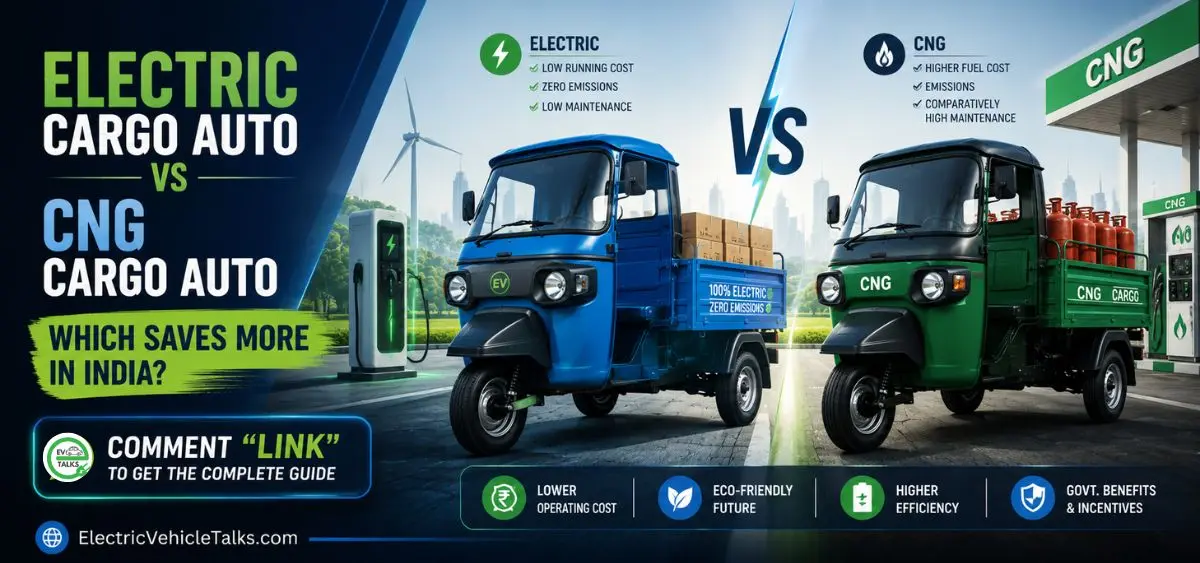

If you’re comparing Electric cargo auto vs. CNG cargo auto, the short answer is simple: electric cargo autos offer significantly lower running costs, reduced maintenance, and better long-term profitability for urban deliveries, while CNG cargo autos remain attractive for buyers seeking lower upfront costs and quick refueling.
For fleet operators, small business owners, logistics companies, and last-mile delivery partners, this decision affects operating expenses, business profitability, sustainability, and future compliance with India’s rapidly evolving clean mobility policies.
India’s commercial transport industry is witnessing one of its biggest transitions in decades. Rising fuel prices, expanding EV charging infrastructure, government incentives, and corporate sustainability goals are accelerating the adoption of electric cargo three-wheelers across cities. Meanwhile, CNG cargo autos continue to serve businesses requiring long-distance operations and minimal downtime.
This comprehensive comparison explains which option delivers better value—not just today, but over the next five years.
Why Is the Electric Cargo Auto vs. CNG Cargo Auto Comparison Important?
India has become one of the world’s fastest-growing markets for electric three-wheelers. According to industry reports, electric three-wheelers account for a rapidly increasing share of commercial vehicle registrations due to their significantly lower operating costs and supportive government policies.
Businesses today are no longer evaluating vehicles solely based on purchase price. Instead, they focus on:
- Total Cost of Ownership (TCO)
- Cost per kilometre
- Maintenance expenses
- Driver productivity
- Fleet uptime
- Environmental impact
- Regulatory compliance
These factors make the Electric cargo auto vs. CNG cargo auto debate more relevant than ever.

Electric Cargo Auto vs. CNG Cargo Auto Price Comparison
| Feature | Electric Cargo Auto | CNG Cargo Auto |
|---|---|---|
| Typical Purchase Price | ₹3.87–₹4.75 lakh | ₹2.71–₹3.60 lakh |
| Government Incentives | Available in some states | Not applicable |
| Road Tax Benefits | Available in many states | Limited |
| Registration Benefits | Often lower | Standard |
Expert Observation
Electric cargo autos generally cost 25–40% more initially. However, lower operating expenses often recover this difference within two to four years for high-mileage users.
Electric Cargo Auto vs. CNG Cargo Auto Mileage and Running Cost
One of the biggest deciding factors is operating cost.
| Parameter | Electric Cargo Auto | CNG Cargo Auto |
|---|---|---|
| Energy Cost | ₹0.60–₹0.90/km | ₹2.50–₹3.00/km |
| Daily Cost Stability | High | Depends on CNG prices |
| Fuel Price Volatility | Low | Moderate to High |
Example
Suppose a logistics vehicle travels:
- 120 km per day
- 26 days every month
Monthly distance:
3,120 km
| Vehicle | Monthly Energy Cost |
|---|---|
| Electric | ₹1,900–₹2,800 |
| CNG | ₹7,800–₹9,300 |
The monthly savings can exceed ₹5,000–₹7,000, making EVs particularly attractive for businesses operating every day.
What Is the Total Cost of Ownership (TCO)?
Purchase price alone never tells the complete story.
A proper Total Cost of ownership includes the following:
- Vehicle price
- Loan interest
- Electricity or fuel cost
- Scheduled servicing
- Repairs
- Insurance
- Battery coverage
- Charging infrastructure
- Downtime
- Resale value
Businesses making fleet decisions should always compare vehicles using TCO rather than showroom prices.
Running Costs & Maintenance: Which Is More Affordable?
1. Electric Cargo Auto
Electric vehicles have a much simpler drivetrain.
There are:
- No engine oil
- No spark plugs
- No clutch
- No gearbox
- No exhaust system
- No fuel injection system
Regenerative braking also reduces brake wear, lowering maintenance costs over time.
2. CNG Cargo Auto
Although cleaner than petrol or diesel, CNG vehicles still require regular servicing, including the following:
- Engine oil changes
- Air filter replacement
- Spark plug servicing
- Clutch maintenance
- Engine tuning
- Exhaust inspections
For businesses operating thousands of kilometres each month, these recurring maintenance costs add up.
Electric Cargo Auto vs. CNG Cargo Auto Performance
1. Electric Cargo Auto
Advantages include:
- Instant torque
- Smooth acceleration
- Quiet operation
- Less vibration
- Better driver comfort
- Easier driving in city traffic
Drivers often report reduced fatigue during long urban delivery shifts.
2. CNG Cargo Auto
Benefits include:
- Familiar driving experience
- Proven engine reliability
- Quick refueling
- Suitable for mixed urban-highway use
However, acceleration under heavy cargo loads may not match an electric motor’s instant torque.
Range and Refueling vs Charging
| Parameter | Electric Cargo Auto | CNG Cargo Auto |
|---|---|---|
| Real-World Range | 90–160 km | 180–250 km |
| Refueling Time | 3–5 hours (overnight AC charging) | 5–10 minutes |
| Fast Charging | Available on select models | Not required |
| Battery Swapping | Expanding in metro cities | Not applicable |
Electric cargo autos work exceptionally well when vehicles return to a depot or warehouse every evening for overnight charging.
Charging Infrastructure in India
India’s EV charging ecosystem is growing rapidly through government and private investments.
Key developments include the following:
- More public charging stations on highways
- Depot charging for commercial fleets
- Battery swapping networks
- Fast chargers in metro cities
- Corporate charging hubs
- Warehouse charging solutions
Businesses can also install chargers at warehouses and distribution centres to reduce operational costs further.
Government Incentives and Policy Support
Electric cargo vehicles benefit from several supportive initiatives:
- State EV policies
- Road tax exemptions in many states
- Registration fee waivers
- Commercial EV financing
- Priority support under various state EV missions
- Expansion of charging infrastructure
While the original FAME-II scheme accelerated adoption, India is now transitioning toward newer incentive frameworks and state-level support for commercial electric mobility, alongside initiatives such as PM E-DRIVE that encourage EV ecosystem growth.
CNG vehicles currently receive far fewer direct ownership incentives.
Sustainability Impact
Electric cargo autos produce the following:
- Zero tailpipe emissions
- Lower urban air pollution
- Reduced noise pollution
- Lower lifecycle emissions when powered by renewable electricity
For companies pursuing ESG targets or corporate sustainability goals, EV fleets also strengthen brand image and improve eligibility for green logistics contracts.
Industry Trends Driving Electric Cargo Adoption
Several sectors are rapidly adopting electric cargo autos:
- E-commerce
- Grocery delivery
- Courier services
- Pharmaceuticals
- FMCG distribution
- Hyperlocal logistics
- Municipal services
Major fleet operators increasingly prefer EVs because lower operating costs improve profitability over the vehicle’s lifecycle.
Common Mistakes Buyers Make
Avoid these common errors:
- Choosing based only on purchase price
- Ignoring charging infrastructure planning
- Underestimating annual maintenance costs
- Not calculating daily kilometres
- Ignoring downtime caused by fuel queues
- Purchasing without evaluating the battery warranty
- Overlooking financing and subsidy options
Electric Cargo Auto Ownership Tips
To maximize returns:
- Charge overnight whenever possible.
- Maintain battery charge within recommended levels.
- Use smart charging during off-peak electricity hours.
- Track vehicle performance using telematics.
- Train drivers in regenerative braking techniques.
- Schedule preventive maintenance instead of reactive repairs.
These practices improve uptime and battery life while reducing operating costs.
Which Businesses Should Choose Electric Cargo Autos?
Electric cargo autos are ideal if:
- Routes are under 150 km daily.
- Vehicles return to a depot every night.
- Operations are within cities.
- Operating cost reduction is the priority.
- Businesses want predictable monthly expenses.
- Sustainability is part of the procurement criteria.
Typical users include:
- Amazon delivery partners
- Blinkit-style hyperlocal delivery
- Courier companies
- Milk distribution
- Vegetable supply chains
- E-commerce logistics
- FMCG distributors
When Does a CNG Cargo Auto Make More Sense?
A CNG cargo auto remains a practical choice when
- Daily routes are long and unpredictable.
- Charging access is limited.
- Vehicles operate continuously across multiple shifts.
- Immediate refueling is essential.
- Electrical upgrades at the depot are not yet feasible.
Expert Insight from Electric Vehicle Talks
From our analysis of India’s commercial mobility market, the conversation has shifted from vehicle price to business profitability.
For urban logistics operators covering 80–150 km daily, electric cargo autos consistently outperform CNG alternatives on total ownership cost. Lower energy expenses, fewer maintenance requirements, and predictable operating costs make them particularly attractive for fleet owners managing multiple vehicles.
However, successful EV adoption depends on proper route planning and charging strategy. Businesses with overnight parking and predictable daily schedules typically realize the greatest financial benefits. Companies should evaluate real-world driving patterns, charging availability, financing options, and battery warranty before making a purchase.
At Electric Vehicle Talks, we recommend calculating total lifecycle costs rather than focusing solely on the initial purchase price. This approach provides a more accurate picture of long-term profitability and operational efficiency.
Future Outlook
The future of India’s commercial mobility is clearly moving toward electrification.
Over the coming years, we can expect:
- Higher battery energy density
- Faster charging
- Lower battery prices
- Expanded battery swapping
- Better financing options
- More government support
- Connected fleet management
- AI-powered route optimization
As charging infrastructure expands and battery technology advances, electric cargo autos are likely to become the preferred choice for most urban freight operations.
People Also Ask
Is an electric cargo auto cheaper to run than a CNG cargo auto?
Yes. Electric cargo autos typically cost around ₹0.60–₹0.90 per kilometre, while CNG cargo autos generally cost ₹2.50–₹3.00 per kilometre, making EVs substantially cheaper for high-mileage commercial operations.
Which has lower maintenance: electric or CNG cargo auto?
Electric cargo autos require significantly less maintenance because they have fewer moving parts and do not need engine oil, spark plugs, clutch replacements, or exhaust servicing.
What is the average range of an electric cargo auto?
Most modern electric cargo autos deliver a real-world range of 90–160 km per charge, depending on battery size, payload, driving conditions, and weather.
Is charging an electric cargo auto practical in India?
Yes. Depot charging, home charging, and the growing public charging network make electric cargo autos increasingly practical, especially for predictable urban delivery routes.
Which is better for last-mile delivery?
Electric cargo autos are generally better for last-mile logistics because of their low running costs, smooth performance, and lower maintenance requirements.
Are government incentives available for electric cargo autos?
Several Indian states continue to offer EV-related incentives such as road tax exemptions, registration fee waivers, and support under state EV policies. Availability varies by state and is subject to change.
How long does it take to recover the higher purchase price of an EV?
For businesses covering high daily mileage, the additional upfront investment can often be recovered within 2–4 years through savings on fuel and maintenance.
FAQs about Electric cargo auto vs. CNG cargo auto
1. Which is more economical: an electric cargo auto or a CNG cargo auto?
For businesses with high daily usage, electric cargo autos are generally more economical because of significantly lower running and maintenance costs.
2. What is the average lifespan of an electric cargo auto battery?
Most commercial EV batteries are designed to last 6–8 years or more, depending on usage, charging habits, and manufacturer warranty terms.
3. Can electric cargo autos carry heavy commercial loads?
Yes. Many modern electric cargo three-wheelers are engineered specifically for last-mile freight and can handle payloads comparable to CNG cargo autos within their rated capacity.
4. Is charging infrastructure sufficient for commercial EV fleets?
Charging infrastructure is improving rapidly in India, particularly in metropolitan areas. Depot charging remains the most practical and cost-effective solution for commercial fleets.
5. Should small business owners buy an electric cargo auto?
If daily operations involve predictable urban routes and access to overnight charging, an electric cargo auto is often the better long-term investment despite its higher initial purchase price.
6. Are electric cargo autos suitable for rural operations?
They can be, provided reliable charging infrastructure is available and daily travel remains within the vehicle’s practical range. For remote areas with limited charging access, CNG may still be more practical.
7. How can businesses reduce the operating cost of electric cargo autos even further?
Businesses can lower costs by scheduling overnight charging, taking advantage of off-peak electricity tariffs, installing rooftop solar at depots, monitoring battery health, and using fleet telematics to optimize routes.
Conclusion
The Electric cargo auto vs. CNG cargo auto debate ultimately comes down to how and where the vehicle will be used. CNG cargo autos still offer advantages in terms of lower upfront cost, longer range, and rapid refueling, making them suitable for certain long-distance or unpredictable operations.
However, for most urban and last-mile logistics businesses in India, electric cargo autos deliver stronger long-term value. Their lower energy costs, minimal maintenance, quieter operation, and alignment with India’s clean mobility goals make them a compelling investment. As charging infrastructure expands and battery technology continues to improve, the economic case for electric cargo autos will only become stronger.
If you’re planning your next commercial vehicle purchase or expanding a logistics fleet, evaluate your daily routes, charging capabilities, and total cost of ownership rather than focusing solely on the sticker price. For more in-depth buying guides, EV comparisons, charging insights, and expert analysis, explore the latest resources available at Electric Vehicle Talks.

Related Article:-









