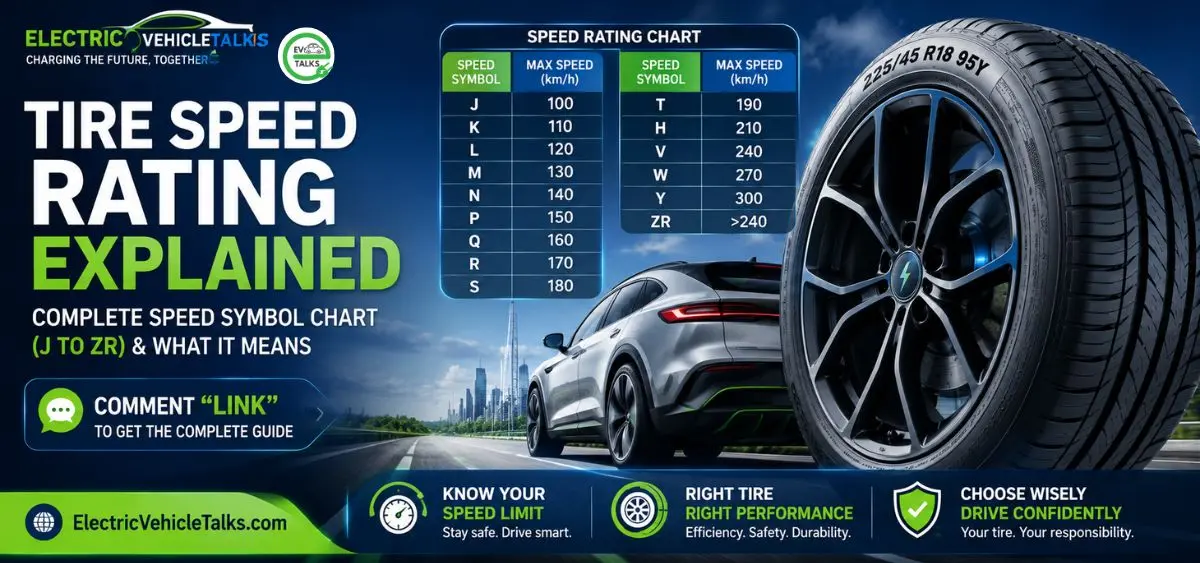

When replacing your vehicle’s tires, most people focus on the brand, size, or price. However, one of the most important markings on a Tyre is often overlooked—the speed rating. Understanding tire speed ratings helps you choose the right tire for your vehicle, ensuring better safety, handling, durability, and performance.
For electric vehicles (EVs), selecting the correct tire speed rating is even more important. EVs deliver instant torque, are typically heavier due to their battery packs, and place greater demands on Tyres during acceleration and regenerative braking.
In this comprehensive guide, Electric Vehicle Talks explains everything you need to know about Tyre speed ratings, including speed symbols, load ratings, EV-specific considerations, and practical buying advice for Indian drivers.
What Is a Tire Speed Rating?
A Tyre speed rating is an alphabetical code printed on the tire’s sidewall that indicates the maximum speed a tire can safely sustain while carrying its rated load, provided it is properly inflated and maintained.
It is not a recommended driving speed. Instead, it represents the tire’s tested performance capability under standardized laboratory conditions.
Example
Consider this tire specification:
205/55 R16 91V
Let’s decode it.
| Marking | Meaning |
|---|---|
| 205 | Tire width (205 mm) |
| 55 | Aspect ratio |
| R | Radial construction |
| 16 | Wheel diameter (16 inches) |
| 91 | Load Index |
| V | Speed Rating |
In this example, the V indicates that the tire has been tested to safely operate at speeds up to 240 km/h.
Although most Indian roads never allow such speeds, manufacturers recommend maintaining the specified speed rating because it also influences handling, heat resistance, braking stability, and durability.

Why Should You Care About Tyre Speed Ratings?
Many drivers assume the speed rating only matters for sports cars.
That isn’t true.
The speed rating influences several aspects of everyday driving.
Benefits of choosing the correct speed rating
- Better high-speed stability
- Improved steering response
- Enhanced braking performance
- Better heat resistance
- Increased safety during emergency maneuvers
- Reduced tire deformation at higher speeds
- Improved compatibility with manufacturer specifications
For EV owners, proper speed ratings also help manage the additional stress created by instant electric torque.
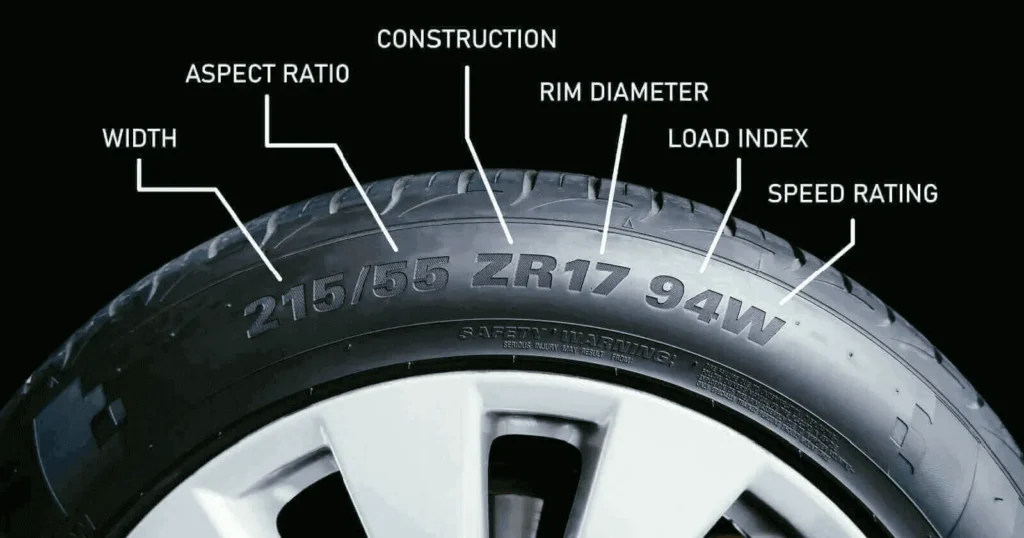
How to Read Tire Sidewall Markings
Every tire/Tyre contains a series of letters and numbers that provide valuable information.
For example: 225/45 ZR18 95Y XL
Here’s what each marking means.
| Marking | Meaning |
|---|---|
| 225 | Tire width (mm) |
| 45 | Sidewall height (% of width |
| ZR | High-speed radial tire |
| 18 | Wheel diameter |
| 95 | Load Index |
| Y | Speed Rating |
| XL | Extra Load (Reinforced Tyre) |
Learning to decode these markings helps ensure you purchase the correct replacement tire. See the image below
Tyre Speed Rating Chart (J to ZR)
Below is the complete tire speed rating chart.
| Speed Symbol | Maximum Speed |
|---|---|
| J | 100 km/h |
| K | 110 km/h |
| L | 120 km/h |
| M | 130 km/h |
| N | 140 km/h |
| P | 150 km/h |
| Q | 160 km/h |
| R | 170 km/h |
| S | 180 km/h |
| T | 190 km/h |
| U | 200 km/h |
| H | 210 km/h |
| V | 240 km/h |
| VR | Above 210 km/h (legacy designation) |
| W | 270 km/h |
| Y | 300 km/h |
| ZR | Above 240 km/h (historical marking; actual maximum depends on accompanying W or Y rating) |
Why Are Tyre Speed Ratings Not in Alphabetical Order?
One of the most common questions people ask is
Why does H come after U?
The answer lies in the history of tire development.
Earlier speed ratings only extended to U (200 km/h). As vehicle technology improved and manufacturers produced faster vehicles, additional categories were introduced.
The H (210 km/h) rating was added later, followed by V, W, Y, and eventually ZR for ultra-high-performance applications.
So the sequence reflects the evolution of tire technology rather than alphabetical order.
What Does ZR Actually Mean?
Many websites incorrectly state that ZR means above 240 km/h.
The reality is slightly different.
ZR is an older high-speed designation indicating that the tire is designed for speeds exceeding 240 km/h. However, the actual maximum speed is determined by the speed symbol that follows, such as W or Y.
Example
| Tyre Size | Maximum Speed |
|---|---|
| 225/40 ZR18 92Y | 300 km/h |
| 255/35 ZR19 96W | 270 km/h |
Therefore, always look at the final speed symbol rather than relying solely on the ZR marking.
What Is a Tire Load Rating?
While the speed rating tells you how fast a Tyre can safely travel, the load rating indicates how much weight a single tire can safely support.
This is represented by a numerical code immediately before the speed rating.
For example: 205/55 R16 91V
Here,
- 91 = Load Index
- V = Speed Rating
A load index of 91 corresponds to a maximum load capacity of 615 kg per tire when inflated correctly.
Common Tire Load Index Chart
| Load Index | Maximum Load (kg) |
|---|---|
| 88 | 560 |
| 89 | 580 |
| 90 | 600 |
| 91 | 615 |
| 92 | 630 |
| 93 | 650 |
| 94 | 670 |
| 95 | 690 |
| 96 | 710 |
| 97 | 730 |
| 98 | 750 |
| 99 | 775 |
| 100 | 800 |
Always ensure both the load index and speed rating meet or exceed the vehicle manufacturer’s specifications.
Tire Load Rating vs Tire Speed Rating
Many buyers confuse these two terms.
Here’s a simple comparison.
| Tire Load Rating | Tyre Speed Rating |
|---|---|
| Indicates maximum weight | Indicates maximum speed |
| Expressed as numbers | Expressed as letters |
| Example: 91 | Example: V |
| 91 = 615 kg | V = 240 km/h |
| Determines carrying capacity | Determines speed capability |
Both ratings are equally important and should never be ignored when purchasing new tires.
What Does XL Mean on Tyres?
Some tires feature an XL marking after the speed rating.
Example:
205/55 R16 94V XL
XL stands for Extra Load.
These tires are reinforced with stronger internal construction, allowing them to carry higher loads than standard tires of the same size.
| Tire | Load Capacity |
|---|---|
| 205/55 R16 91V | 615 kg |
| 205/55 R16 94V XL | 670 kg |
Extra Load tires are commonly used on the following:
- Electric vehicles
- SUVs
- Luxury sedans
- Vehicles carrying heavier payloads
For EVs in particular, XL-rated Tyres can be advantageous because battery packs significantly increase vehicle weight.
Why Do Tire Speed Ratings Matter?
Many vehicle owners assume that if they never drive above 100 km/h, the tire speed rating is irrelevant. In reality, that’s a common misconception.
A tire’s speed rating reflects far more than its maximum speed. It also indicates how well the Tyre manages heat, maintains structural integrity, responds to steering inputs, and performs under demanding conditions such as emergency braking or high-speed cornering.
Even during everyday driving, a properly rated Tyre contributes to the following:
- Better road grip
- Improved steering precision
- Enhanced braking stability
- Lower heat buildup
- Better durability
- Increased safety under heavy loads
Modern vehicles—especially electric vehicles—are engineered with specific Tyre characteristics in mind. Using the correct speed-rated tire helps preserve the vehicle’s intended handling and safety performance.
What Happens When Tyres Rotate at High Speed?
As speed increases, tires experience significant physical forces.
- Heat generated through friction rises rapidly.
- Centrifugal force attempts to expand the Tyre.
- The sidewalls flex more under load.
- Internal components such as steel belts and reinforcement layers are subjected to greater stress.
Higher speed-rated tires are engineered using stronger materials and advanced construction techniques to withstand these conditions while maintaining stability and grip.
This is one reason why premium tires often feel more composed, even during highway driving.
Common Tyre Speed Ratings by Vehicle Type
Different vehicles require different speed ratings based on their design, weight, and intended use.
| Vehicle Type | Typical Speed Rating |
|---|---|
| Small hatchbacks | T, H |
| Compact sedans | H |
| Family sedans | H, V |
| SUVs | H, V |
| Luxury SUVs | V, W |
| Performance sedans | W |
| Sports cars | W, Y |
| Supercars | Y, ZR |
| Commercial vans | J, K, L, M |
| Cargo three-wheelers | J–M (application-dependent) |
The manufacturer’s recommendation should always take priority over choosing a higher or lower rating.
Tire Speed Ratings for Electric Vehicles (EVs)
Electric vehicles place unique demands on tires that conventional petrol and diesel vehicles typically do not.
1. Instant Torque
Unlike internal combustion engines, electric motors deliver maximum torque almost instantly.
This rapid acceleration increases stress on the tire tread and sidewalls.
As a result, many EV manufacturers specify higher speed-rated tires even if the vehicle’s top speed isn’t particularly high.
2. Higher Vehicle Weight
Battery packs can add several hundred kilograms to a vehicle.
For example:
| Vehicle | Approximate Battery Weight |
|---|---|
| Electric scooter | 20–40 kg |
| Electric car | 250–700 kg |
| Electric SUV | 500–900 kg |
This additional weight increases the load each tire must support, making both the tire load index and speed rating critical.
3. Regenerative Braking
EVs frequently use regenerative braking, where the electric motor slows the vehicle while recovering energy.
Although this improves efficiency, it also changes how tires experience braking forces, potentially increasing tread wear if the tires aren’t designed for the vehicle.
4. Low Rolling Resistance
Most EV-specific tires are designed with the following:
- Low rolling resistance
- Stronger sidewalls
- Improved noise reduction
- Reinforced construction
- Optimized tread compounds
These characteristics help maximize driving range while maintaining safety.
Common EV Tire Speed Ratings
Most modern electric cars use the following:
| Vehicle Category | Typical Speed Rating |
|---|---|
| City EVs | H |
| Premium EVs | V |
| Luxury EVs | W |
| Performance EVs | Y |
Examples include premium electric sedans and performance SUVs that require higher-speed-rated tires to match their acceleration and dynamic capabilities.
H vs V vs W vs Y Tire Rating
One of the most searched questions online is
“Which tire speed rating should I choose?”
Here’s a quick comparison.
| Rating | Maximum Speed | Best For |
|---|---|---|
| H | 210 km/h | Family cars, compact SUVs, city EVs |
| V | 240 km/h | Premium sedans, crossovers, and many EVs |
| W | 270 km/h | Luxury vehicles and performance EVs |
| Y | 300 km/h | Sports cars and high-performance electric vehicles |
1. H Rating
Ideal for everyday driving and highway use.
Provides a balance between comfort, durability, and affordability.
2. V Rating
Offers:
- Better handling
- Improved cornering
- Enhanced braking
- Greater heat resistance
Many premium electric vehicles use V-rated Tyres.
3. W Rating
Designed for:
- High-performance driving
- Superior stability
- Faster steering response
Often found on luxury performance vehicles.
4. Y Rating
Typically reserved for:
- Sports cars
- High-performance EVs
- Vehicles capable of extremely high speeds
These tires use advanced rubber compounds and reinforced internal construction.
Can You Install a Higher Speed-Rated Tyre?
Yes, in most cases, upgrading to a higher speed rating is acceptable and often beneficial.
Advantages include:
- Better handling
- Improved braking
- Increased heat resistance
- Stronger construction
- Greater stability
However, higher-rated tires may:
- Cost more
- Wear differently depending on driving habits
- Produce a firmer ride in some applications
For most passenger vehicles, fitting a tire with a higher speed rating than specified is generally safe, provided the tire size and load index remain appropriate.
Can You Use a Lower Speed-Rated Tire?
Generally, no.
Installing tires with a lower speed rating than recommended by the vehicle manufacturer can:
- Reduce handling performance
- Increase heat buildup
- Compromise braking
- Void warranty coverage in some cases
- Affect insurance claims after an accident, depending on local regulations
The only common exception is certain winter or all-season Tyres, where regulations in some regions permit a lower speed rating if the driver does not exceed the tire’s maximum rated speed.
Always follow your vehicle manufacturer’s recommendations and local regulations.
What About Winter Tires?
Winter tires use specialized rubber compounds that remain flexible in cold temperatures.
Because of their design, they may have a lower speed rating than the vehicle’s original summer tires.
Although this is accepted in many countries with harsh winters, drivers must ensure they never exceed the tire’s rated speed.
For most parts of India, dedicated winter tires are unnecessary except in mountainous regions experiencing snow or prolonged freezing conditions.
Common Mistakes People Make When Buying Tires
Avoid these common errors:
a) Choosing tires based only on price
A cheaper tire may not meet your vehicle’s required speed or load rating.
b) Ignoring the load index
The load index is just as important as the speed rating, especially for EVs and SUVs.
c) Assuming all tires of the same size are identical
Two Tyres with identical dimensions can have completely different
- Load capacities
- Speed ratings
- Tread compounds
- Performance characteristics
d) Mixing different speed ratings
Using different speed ratings on the same vehicle can affect stability and handling.
If replacement of all four tires isn’t possible, consult the vehicle manufacturer or a qualified tire specialist.
e) Forgetting Tire Pressure
Even the highest-rated tire cannot perform safely if underinflated or overinflated.
Check tire pressure at least once a month and before long journeys.
Tyre
Whether you drive an ICE vehicle or an EV, these habits can extend tire life:
- Maintain recommended tire pressure.
- Rotate tires every 8,000–10,000 km (or as specified by the manufacturer).
- Get wheel alignment checked periodically.
- Balance wheels whenever new tires are installed.
- Avoid aggressive acceleration and hard braking.
- Inspect tread depth and sidewalls regularly.
- Replace damaged tires promptly.
For EV owners, smooth acceleration and proper tire maintenance can also help maximize driving range.
Tire Speed Ratings in India: What Every Buyer Should Know
Indian road conditions are among the most diverse in the world. A single journey may include smooth expressways, congested city streets, uneven rural roads, potholes, and varying weather conditions. These factors make selecting the right tire far more important than simply choosing one based on price.
As India’s automotive market evolves—with growing adoption of electric cars, premium SUVs, and high-speed expressways—manufacturers are increasingly recommending tires that meet specific load and speed requirements.
For Indian drivers, using tires with the correct load index and speed rating isn’t about achieving high speeds; it’s about ensuring safety, stability, braking performance, and durability under real-world conditions.
Do Government Policies Affect Tire Selection?
While India currently doesn’t offer direct incentives based on tire specifications, several government initiatives indirectly highlight the importance of using manufacturer-approved tires.
These include:
- Bharat NCAP, which encourages higher vehicle safety standards.
- Bureau of Indian Standards (BIS) regulations for automotive components.
- Central Motor Vehicles Rules (CMVR) that require vehicles to remain roadworthy and comply with approved specifications.
- Ongoing initiatives to improve road infrastructure through national highway and expressway expansion.
For EV owners, government support through schemes such as FAME-II (and future incentive frameworks) has accelerated the adoption of electric mobility. As EV ownership grows, awareness of specialized EV tires and correct speed/load ratings is becoming increasingly important.
Why EV Owners Should Pay Extra Attention to Tire Ratings
Electric vehicles are redefining automotive engineering. Their unique characteristics place greater demands on tires than conventional petrol or diesel vehicles.
1. Instant Torque
Electric motors deliver peak torque from a standstill, placing significant stress on the tire during acceleration.
2. Heavier Vehicles
Battery packs can add hundreds of kilograms to the vehicle’s curb weight. As a result, tires must support greater loads without compromising stability or efficiency.
3. Regenerative Braking
Regenerative braking shifts more braking force through the driven wheels, which can influence tire wear patterns if maintenance is neglected.
4. Driving Range
Low rolling resistance tires help reduce energy consumption, improving overall driving range. Even a small reduction in rolling resistance can translate into additional kilometers on a full charge.
How Tire Choice Impacts EV Range
Many first-time EV buyers don’t realize that tires can directly affect vehicle efficiency.
Factors influencing EV range include:
| Tire Characteristic | Impact on EV |
|---|---|
| Low rolling resistance | Improves driving range |
| Proper tire pressure | Reduces energy consumption |
| Reinforced construction | Supports battery weight |
| Correct load index | Improves stability |
| Appropriate speed rating | Enhances handling and safety |
| Optimized tread compound | Reduces wear and road noise |
Maintaining the recommended tire pressure alone can improve efficiency and extend tire life.
Future Trends in Tyre Technology
The tire industry is undergoing rapid transformation alongside the rise of electric mobility.
Smart Tyres
Next-generation tires are expected to feature integrated sensors capable of monitoring:
- Tire pressure
- Temperature
- Tread wear
- Load conditions
- Road grip
- Real-time performance data
This information can be shared with the vehicle’s onboard systems to enhance safety and predictive maintenance.
Sustainable Materials
Manufacturers are increasingly exploring renewable and recycled materials, including:
- Natural rubber from sustainable plantations
- Recycled steel
- Silica-based compounds
- Bio-based oils
- Renewable polymers
These innovations aim to reduce the environmental footprint of tire production while maintaining performance.
EV-Specific Tire Development
Leading Tyre manufacturers continue to invest in products tailored for electric vehicles, featuring:
- Enhanced durability
- Lower rolling resistance
- Reduced cabin noise
- Improved wet-weather grip
- Stronger sidewall construction
As EV adoption accelerates in India, demand for these specialized tires is expected to grow significantly.
Expert Insight from Electric Vehicle Talks
Choosing the correct tire is about far more than matching the size printed on the sidewall.
From our analysis of evolving EV technologies and ownership trends, three recommendations consistently stand out:
- Always match or exceed the vehicle manufacturer’s specified load index and speed rating. These values are carefully selected to balance safety, efficiency, and handling.
- For EV owners, prioritize tires designed specifically for electric vehicles whenever available. Their reinforced construction and low rolling resistance can improve durability, ride comfort, and driving range.
- Regular maintenance is just as important as tire selection. Proper inflation, wheel alignment, balancing, and timely rotation help maximize tire life and preserve vehicle efficiency.
As India’s electric mobility ecosystem continues to expand, understanding tire specifications will become an essential part of responsible vehicle ownership. At Electric Vehicle Talks, our goal is to simplify these technical topics and help readers make informed decisions backed by industry expertise. Learn more
Practical Buying Checklist
Before purchasing new tires, confirm the following:
- ✔ Correct tire size
- ✔ Manufacturer-recommended load index
- ✔ Correct speed rating
- ✔ Tubeless or tube-type compatibility
- ✔ Suitable tread pattern for your driving conditions
- ✔ Manufacturing date (avoid tires stored for extended periods)
- ✔ BIS certification and warranty
- ✔ EV-specific tire options, if applicable
Investing a little time in checking these details can improve safety, reduce long-term costs, and enhance driving performance.
Are “tire speed ratings” the same for EVs and ICE vehicles?
Yes. The tire speed rating system is the same for both electric vehicles (EVs) and internal combustion engine (ICE) vehicles.
The speed rating letters—J, K, L, M, N, P, Q, R, S, T, U, H, V, W, Y, and ZR—are part of internationally recognized tire standards and apply to all passenger vehicles, regardless of whether they are powered by petrol, diesel, hybrid, or electricity.
What is the difference then?
The speed rating system is identical, but the tire specifications recommended by manufacturers are often different.
| Feature | ICE Vehicles | Electric Vehicles (EVs) |
|---|---|---|
| Speed rating system | Same (J–ZR) | Same (J–ZR) |
| Speed rating letters | Same | Same |
| Load index | Standard for vehicle weight | Often higher due to battery weight |
| Tire construction | Standard | Often reinforced (XL/HL) |
| Rolling resistance | Standard | Lower to maximize driving range |
| Noise reduction | Standard | Enhanced for quieter cabins |
| Torque resistance | Standard | Designed to handle instant motor torque |
Why do many EVs have higher speed-rated tires?
It’s not because EVs use a different rating system. Instead, manufacturers may choose higher-rated tires because EVs typically:
- Deliver instant torque, increasing stress on the tires during acceleration.
- Weigh more due to large battery packs, requiring stronger construction.
- Benefit from improved heat resistance and handling, especially on heavier vehicles.
For example:
- A Tata Nexon (ICE) might be equipped with 215/60 R16 95H tires.
- A Tata Nexon EV could use 215/60 R16 95H or 215/60 R16 99V XL, depending on the variant and manufacturer specifications.
The EV version may have a higher load index, reinforced construction (XL), or a higher speed rating, but it still uses the same H, V, or W speed-rating system.
Key takeaway
Tire speed ratings are not different for EVs and ICE vehicles. The rating system is universal. What differs is the manufacturer’s recommended Tyre specification, which may include a higher load index, reinforced construction, lower rolling resistance, and sometimes a higher speed rating to meet the unique demands of electric vehicles.
Why Do Many EVs Use Higher Speed-Rated Tires?
The reason isn’t necessarily because EVs have higher top speeds—it’s because higher speed-rated tires often offer better overall performance characteristics, including the following:
- Stronger internal construction
- Better heat resistance
- Improved cornering stability
- Enhanced grip during rapid acceleration
- Better handling under the higher loads common in EVs
For example:
| Vehicle | Typical Tire Rating |
|---|---|
| Maruti Suzuki Swift | H or V |
| Hyundai Creta | H or V |
| Tata Nexon EV | H or V |
| MG ZS EV | V |
| Hyundai Ioniq 5 | W |
| Kia EV6 | W |
| Porsche Taycan | Y |
Notice that mainstream EVs often use similar H or V ratings as comparable ICE vehicles, while high-performance EVs may require W or Y ratings due to their acceleration and top-speed capabilities.
The Bigger Difference: Load Index
For EVs, the load index is often more critical than the speed rating because battery packs significantly increase vehicle weight.
For example:
- ICE SUV: Tire size 215/60 R17 96H
- Equivalent EV SUV: Tire size 215/60 R17 100V XL
Although the tire size is the same, the EV version may have:
- A higher load index (100 vs. 96) to support the extra battery weight.
- An XL (Extra Load) designation for reinforced construction.
- A higher speed rating (V vs. H), reflecting improved structural performance and handling.
EV-Specific Tyres
Many manufacturers now produce EV-specific tires, but these do not use different speed rating letters. Instead, they are engineered with features such as the following:
- Reinforced sidewalls
- Lower rolling resistance for better range
- Improved resistance to instant torque
- Reduced road noise
- Higher load capacity
- Enhanced durability
Examples include Michelin e. Primacy, Bridgestone Turanza EV, Continental EcoContact 6, Goodyear ElectricDrive, and Pirelli P Zero Elect.
People Also Ask
What do Tyre speed ratings mean?
A tire speed rating is an alphabetical code indicating the maximum speed at which a tire can safely carry its rated load under specified conditions. It also reflects the tire’s ability to manage heat, maintain stability, and perform safely at higher speeds.
Can I install Tyre with a higher speed rating?
Yes. Using a higher speed-rated tire is generally acceptable, provided the tire size and load index remain appropriate for your vehicle. Higher-rated tires may offer improved handling and heat resistance but can also be more expensive.
Can I use a lower speed-rated tire?
In most cases, no. Using a lower speed-rated tire than recommended by the manufacturer may reduce safety, handling, and braking performance. Exceptions may apply to certain winter tires where local regulations permit.
Are EV tires different from regular tires?
Yes. EV tires are often designed with reinforced construction, lower rolling resistance, enhanced durability, and reduced road noise to accommodate the higher weight and instant torque of electric vehicles.
What is the difference between tire load rating and speed rating?
The load rating indicates the maximum weight a tire can support, while the speed rating specifies the maximum speed at which the tire can safely carry that load.
What does XL mean on a Tyre?
XL stands for Extra Load. These tires are reinforced to carry greater loads than standard tires of the same dimensions, making them suitable for heavier vehicles such as SUVs and many electric cars.
Why is H placed after U in the speed rating chart?
The sequence reflects the historical evolution of tire standards. As vehicles became faster, new speed categories such as H, V, W, and Y were introduced, resulting in a non-alphabetical order.
FAQs about Tire Speed Rating Explained
1. Where can I find the tire speed rating?
The speed rating appears on the tire sidewall immediately after the load index. It is also listed in the vehicle owner’s manual and often on a sticker inside the driver’s door.
2. Is a higher speed-rated tire always better?
Not necessarily. While higher-rated Tyres can offer better handling and heat resistance, the best choice is the one that matches or exceeds the manufacturer’s specifications without compromising ride comfort or cost.
3. Do tire speed ratings affect insurance or warranty?
Using tires that do not meet the manufacturer’s specifications could affect warranty claims and, in some cases, insurance assessments after an accident. Always follow the recommended ratings.
4. How often should tires be replaced?
Replacement depends on tread depth, age, wear patterns, and driving conditions. Even if tread remains, many manufacturers recommend inspecting tires closely after six years and replacing them if signs of aging or damage appear.
5. Do EVs require special tires?
Many EVs benefit from tires specifically engineered for electric vehicles. These tires are optimized for higher loads, instant torque, lower rolling resistance, and quieter operation.
6. Can incorrect tire pressure affect speed rating performance?
Yes. Underinflated or overinflated tires generate additional heat, reduce grip, and can compromise the tire’s ability to perform safely within its rated speed and load limits.
7. Does a higher speed rating increase fuel efficiency or EV range?
Not directly. Rolling resistance, tread design, and tire pressure have a more significant impact on efficiency. However, choosing the correct tire for your vehicle contributes to optimal performance.
8. Are all tires of the same size identical?
No. Tires with identical dimensions may have different load indexes, speed ratings, tread compounds, and construction, making it essential to check all specifications before purchasing.
Conclusion
Understanding tire speed ratings is about much more than decoding a letter on the sidewall. The speed rating, together with the load index, provides critical information about a tire’s ability to perform safely under specific conditions.
Whether you drive a compact hatchback, a premium SUV, or a modern electric vehicle, selecting the correct tire specifications helps ensure better safety, handling, durability, and overall driving confidence. As EV adoption grows and vehicles become more technologically advanced, informed Tyre selection will play an increasingly important role in maximizing efficiency and ownership satisfaction.
For more expert insights on electric vehicles, charging infrastructure, buying guides, maintenance tips, and the latest developments in sustainable mobility, explore Electric Vehicle Talks and stay informed about the future of transportation.

Related Articles: