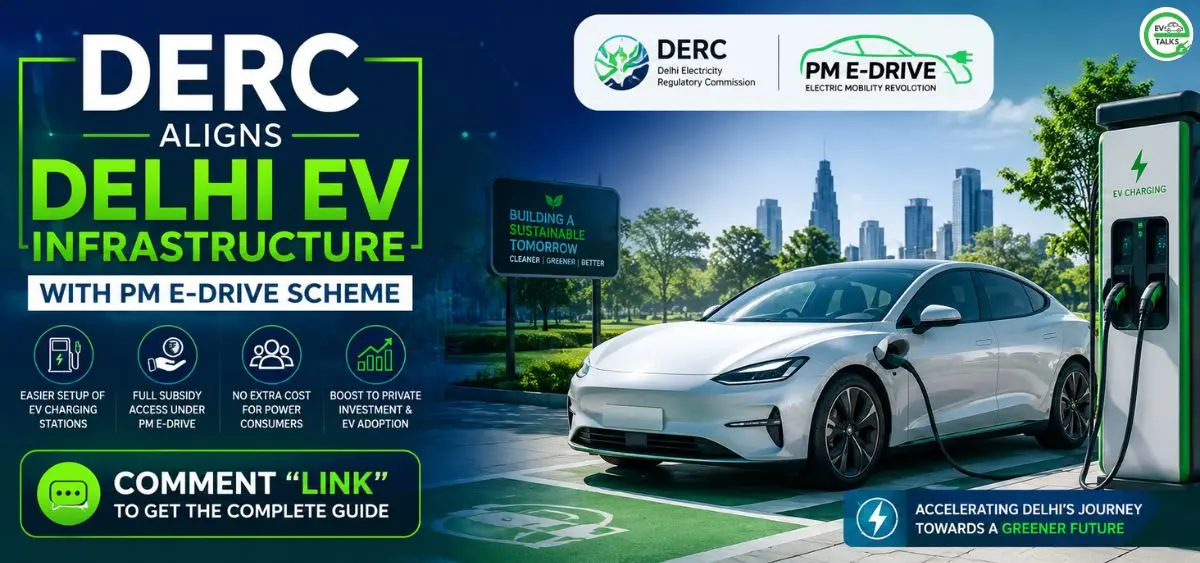

Delhi has taken a major step toward accelerating electric vehicle (EV) adoption by introducing regulatory changes that simplify the process of setting up public EV charging stations. In a landmark order issued on July 1, 2026, the Delhi Electricity Regulatory Commission (DERC) amended its electricity supply regulations to support the Central Government’s PM E-DRIVE scheme. This move removes a key financial bottleneck that had delayed charging infrastructure projects and makes it easier for developers to access government incentives. DERC aligns Delhi EV infrastructure
Delhi tweaks rules to boost EV charging station infra
The latest decision, where DERC aligns Delhi EV infrastructure with the PM E-DRIVE scheme, revises the DERC (Supply Code and Performance Standards) Regulations to ensure charging station developers can claim the full financial assistance available under the Centre’s EV infrastructure program.
Earlier, developers received demand notes from power distribution companies (discoms) that included only basic connection charges such as service line costs, security deposits, and road restoration fees. The much larger expenses involved in strengthening the electricity network—including transformers, high-tension cables, and other upstream infrastructure—were not reflected in these demand notes.
Full Infrastructure Cost Now Included in Demand Notes
With the revised regulations, DERC aligns Delhi EV infrastructure by directing all Delhi discoms to include the complete cost of electricity infrastructure required for eligible public EV charging projects in the initial demand note. The calculation will be based on officially approved infrastructure cost data.
Charging station developers or the designated state nodal agency will initially pay these costs. Since the complete infrastructure expenses will now appear in the demand note, they can subsequently claim reimbursement under the PM E-DRIVE scheme, which has allocated ₹2,000 crore for developing public EV charging infrastructure across India.
Consumers Protected from Higher Electricity Tariffs
One of the biggest highlights of the revised framework is consumer protection.
Previously, discoms recovered the cost of strengthening the electricity network through electricity tariffs, meaning ordinary consumers indirectly funded commercial EV charging infrastructure.
The new DERC order clearly prohibits discoms from including these infrastructure costs in their Aggregate Revenue Requirement (ARR). As a result, regular electricity consumers will no longer bear the financial burden of expanding Delhi’s EV charging network.
Strong Boost for Private Investment
Industry experts believe the revised framework significantly improves the financial viability of public charging projects.
By eliminating procedural and financial hurdles, DERC aligns Delhi EV infrastructure with national policy objectives, giving charging point operators greater certainty over project costs and subsidy eligibility. This is expected to encourage more private investment in public charging stations, battery swapping stations, and battery charging facilities across Delhi while accelerating infrastructure deployment.
Delhi Transco Ltd Appointed as State Nodal Agency
To ensure smooth implementation, Delhi Transco Ltd (DTL) has been designated as the state nodal agency for the PM E-DRIVE scheme in Delhi.
DTL will be responsible for:
- Identifying eligible EV charging locations.
- Coordinating with discoms and charging point operators.
- Maintaining centralized records of projects and payments.
- Managing payment reconciliation.
- Submitting quarterly progress reports to DERC.
Supporting Delhi EV Policy 2.0
The regulatory reform also complements Delhi’s recently announced EV Policy 2.0, which aims to rapidly expand the city’s charging ecosystem. Supported by a ₹1.27 billion central grant, the policy targets the installation of approximately 32,000 public EV charging points by 2028, strengthening Delhi’s transition toward clean and sustainable mobility.
Conclusion
The decision where DERC aligns Delhi EV infrastructure with the PM E-DRIVE scheme marks a significant milestone in Delhi’s electric mobility journey. By allowing developers to claim full central subsidies, protecting consumers from additional electricity costs, and improving investment confidence, the new regulatory framework is expected to speed up the rollout of public charging stations across the capital. Together with EV Policy 2.0, these reforms lay a strong foundation for a larger, more accessible, and future-ready EV charging network in Delhi.

Related Articles: