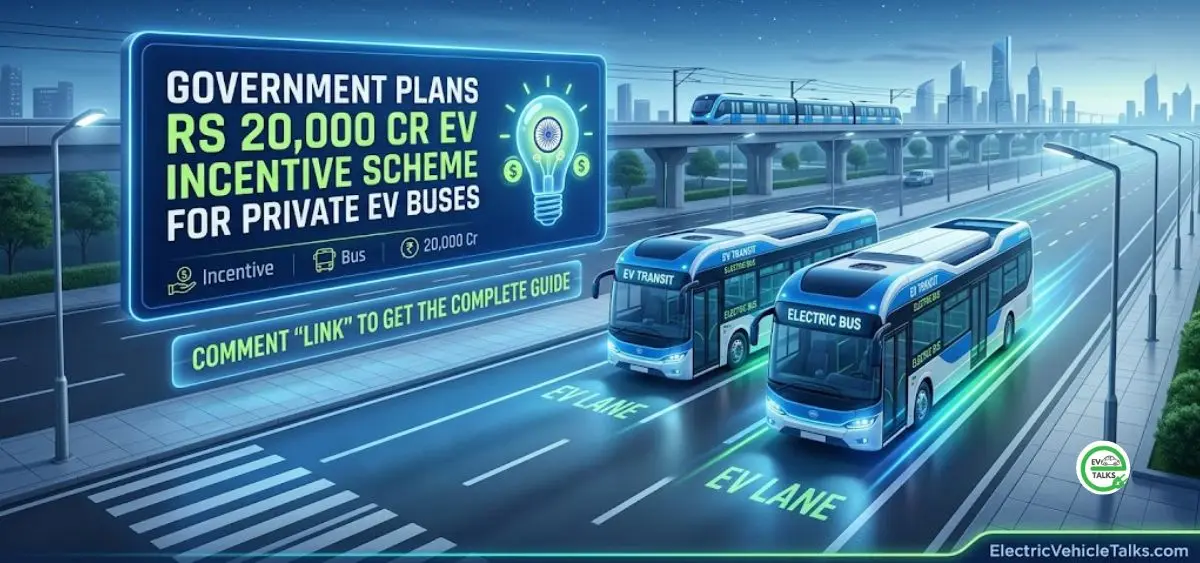

The government plans a Rs 20000 cr EV incentive scheme to accelerate the adoption of electric buses by private fleet operators, marking a significant expansion of India’s electric mobility strategy. Unlike existing initiatives that primarily support State Road Transport Undertakings (SRTUs), the proposed framework aims to encourage private operators, who own nearly 87% of the country’s bus fleet, to transition to cleaner and more sustainable transportation.
The proposed scheme is being developed with an estimated outlay of up to Rs 20,000 crore over an initial five-year period. Depending on its performance and industry response, the programme may be extended for another two years.
Why the Government Is Introducing the New EV Incentive Scheme
The Govt plans up to Rs 20000 cr EV incentive scheme amid growing concerns over India’s dependence on imported fossil fuels, especially following geopolitical tensions in West Asia. By promoting electric buses, the government aims to improve fuel security, reduce operating costs, cut emissions, and strengthen India’s long-term public transport ecosystem.
Officials believe that large-scale electrification of buses cannot be achieved without bringing private operators into the EV ecosystem, as they dominate the country’s passenger transport sector.
Special Focus on Reducing Financial Risks
The proposed policy is designed as a private e-bus de-risking framework, making the shift to electric buses more financially viable for fleet owners.
The incentive package is expected to include two major components:
- Financial incentives, such as interest subvention, viability gap funding, and other measures to improve access to affordable loans.
- Administrative support to simplify adoption, reduce operational challenges, and encourage faster deployment of electric buses.
The government may initially allocate part of the proposed budget and release additional funds as the scheme progresses.
Charging Infrastructure and Localisation
Charging infrastructure is unlikely to be included under the proposed framework because dedicated government schemes already support EV charging networks across the country.
However, officials are examining localization requirements, which could become an important part of the policy to encourage domestic manufacturing and strengthen India’s EV supply chain.
NITI Aayog Recommendations Support the Move
The Govt plans up to Rs 20000 cr EV incentive scheme closely align with recommendations made by NITI Aayog in its report on India’s electric vehicle opportunity.
According to the report, electric buses typically cost two to three times more than conventional diesel buses, making financing difficult for private operators. Financial institutions also face challenges due to limited long-term performance data and concerns over repayment capacity.
To overcome these barriers, NITI Aayog recommended blended financing models, lower-interest loans, and pooled funding involving government budgets and multilateral development banks.
What This Means for India’s EV Future
If implemented, the Govt plans up to Rs 20000 cr EV incentive scheme could become one of India’s biggest policy initiatives for private electric bus adoption. By reducing financing risks, supporting fleet operators, and encouraging large-scale electrification, the scheme has the potential to significantly increase EV adoption, reduce fuel imports, and help India move closer to its clean mobility and net-zero transportation goals.

Related Articles: