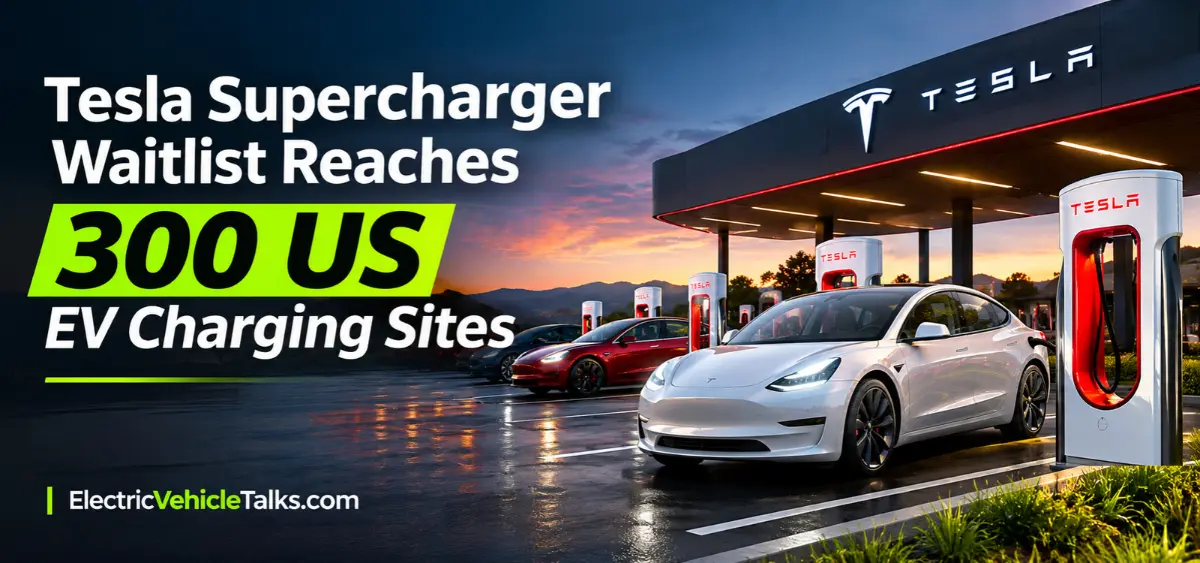

Tesla is transforming the electric vehicle charging experience by expanding its virtual queuing system to 300 Supercharger locations across the United States. Announced on November 19, 2026, the expansion comes just ahead of the busy Thanksgiving holiday travel season, when charging demand is expected to increase. The Tesla Supercharger Waitlist allows electric vehicle owners to secure their position digitally instead of forming physical queues in parking lots.
The initiative aims to reduce charging congestion, prevent disputes among drivers, and improve the overall charging experience. It also represents another significant step towards smarter, more efficient, and digitally connected electric vehicle charging infrastructure.
What Is Tesla’s Supercharger Waitlist?
Tesla’s virtual Supercharger waitlist is a digital queuing system available at 300 US charging locations. It allows Tesla and non-Tesla EV drivers to join a virtual queue, monitor waiting times, and receive charging stall assignments.

Tesla Expands Digital Charging Queues Across the US
The latest expansion covers approximately one in every eleven Supercharger stations in the United States.
Tesla originally introduced the pilot programme on May 11, 2026, across five high-traffic charging locations:
- Los Gatos, California
- Mountain View, California
- San Francisco, California
- San Jose, California
- Bronx, New York
The Tesla Supercharger Waitlist remains exclusive to the United States. Although Tesla has not published a complete list of participating locations, drivers can check availability through the Tesla mobile app or in-car navigation system.
How Does Tesla’s Virtual Charging Queue Work?
The digital system simplifies the charging process through several automated features:
- Join digitally: Tesla owners can join through their vehicle touchscreen or mobile app, while non-Tesla EV owners can use the Tesla app.
- Location verification: The system confirms that drivers are physically present at the charging location.
- Real-time tracking: Drivers can monitor their queue position and estimated waiting time.
- Automatic stall assignment: Once a charging stall becomes available, the system assigns it and highlights its location on the map.
- Charging window: Drivers typically receive two to three minutes to reach the assigned stall and plug in.
- Additional time: Users can request a 30-second extension when necessary.
If an assigned charging stall is blocked, drivers can select the “Can’t Charge” option to receive another available stall without losing their queue position.
Can Tesla Prevent Charging Queue Disputes?
Despite its advanced digital capabilities, the system primarily depends on driver cooperation rather than physical enforcement.
Tesla can flag situations where drivers occupy available charging stalls without joining the virtual queue. However, the technology does not physically prevent vehicles from accessing those stalls.
The system aims to encourage fair charging practices while reducing confusion and unnecessary arguments between electric vehicle owners.
What This Means for the Future of EV Charging
As electric vehicle adoption continues to grow, efficient charging management is becoming increasingly important.
The Tesla Supercharger Waitlist highlights how digital technology can address infrastructure challenges without necessarily installing additional charging equipment.
By combining virtual queues, real-time updates, and automated stall assignments, Tesla is working towards a more organized charging ecosystem that could improve convenience, accessibility, and customer satisfaction during peak travel periods.

Related Articles: