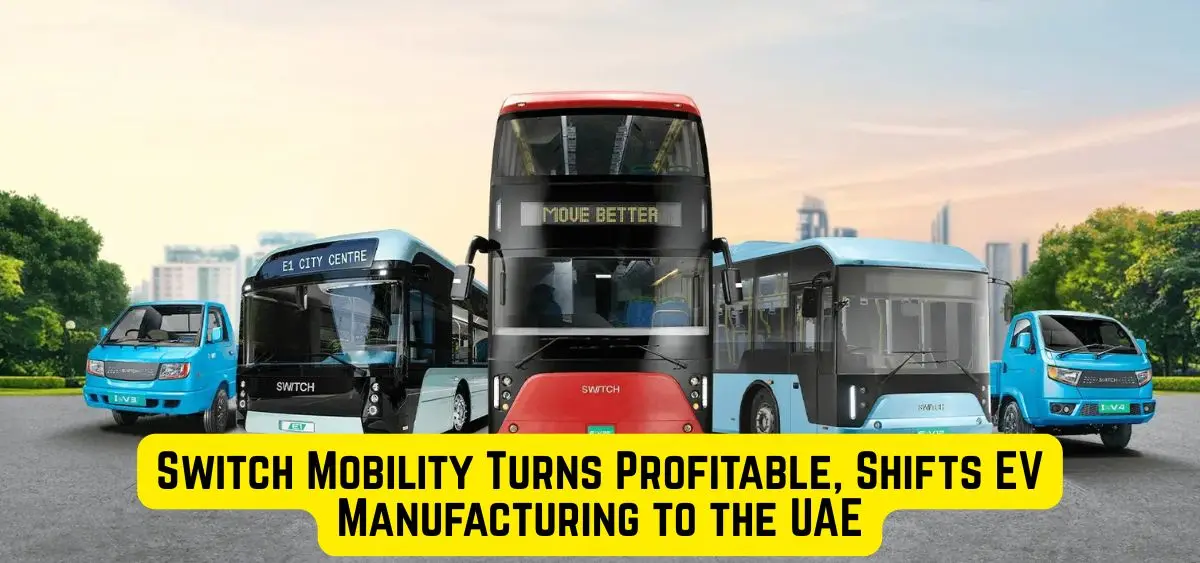

As Switch Mobility Shifts EV Manufacturing to UAE, the company has stunned the industry by turning profitable in the first half of FY 2025–26—a milestone many didn’t see coming. This unexpected turnaround raises a big question: what strategic moves powered this rapid transformation? With Ashok Leyland’s EV arm transitioning away from traditional commercial vehicles and embracing a global electric future, the company’s bold restructuring and cost-focused strategy are now reshaping its entire growth trajectory.
Shift in Manufacturing & New Operational Strategy
One of the company’s biggest operational decisions has been shifting its electric bus manufacturing from the United Kingdom to the United Arab Emirates, specifically Ras Al Khaimah (RAK). This relocation is designed to significantly cut production costs, streamline operations, and enhance logistical efficiency. The UAE’s strategic location will help Switch Mobility serve GCC and European markets more swiftly and cost-effectively.
Furthermore, the company has successfully leveraged synergies with its parent firm, Ashok Leyland. Shared technology platforms, integrated supply chains, and unified administrative systems have played a crucial role in reversing earlier losses. These collaborative efficiencies have helped Switch Mobility scale faster while maintaining tighter cost control.
₹5,000 Crore Battery Manufacturing Plan in India
To strengthen localisation and reduce dependency on external suppliers, Switch Mobility is preparing a massive ₹5,000 crore investment in India for setting up a dedicated battery manufacturing facility. The project will be executed in phases—starting with battery pack assembly in the initial stage and gradually advancing towards full-scale cell manufacturing.
This move towards vertical integration will not only improve cost efficiency but also provide the company with greater control over its EV supply chain. It aligns perfectly with India’s growing push for indigenous EV component manufacturing.
Market & Strategic Impact
Switch Mobility’s profitability signals rising demand for electric buses and commercial EVs in both domestic and international markets. The new UAE manufacturing hub positions the company to expand its global footprint more aggressively while maintaining competitive pricing.
Meanwhile, the battery manufacturing project underscores Ashok Leyland’s long-term commitment to strengthening India’s EV infrastructure and reducing reliance on imports. Together, these strategic decisions support the broader EV roadmap of Ashok Leyland, which focuses on accelerating the adoption of electric commercial vehicles globally.
Industry Outlook
This milestone proves that electric commercial vehicle production can be both sustainable and profitable in emerging markets. Switch Mobility’s progress reinforces Ashok Leyland’s leadership in India’s EV commercial segment and sets a strong foundation for the future of electric buses, cargo vans, and last-mile mobility solutions.
Related Articles:-