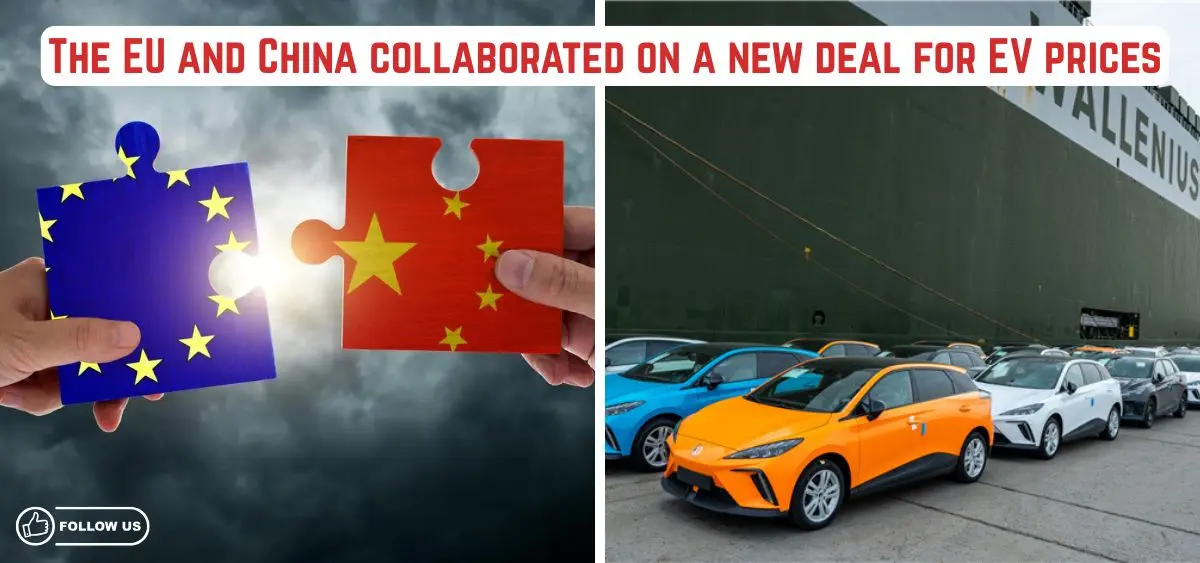

On January 12, 2026, global trade dynamics took a notable turn as the EU and China collaborated on a fresh agreement focused on the pricing of Chinese electric vehicles (EVs in Europe. This deal marks a significant shift away from the trade tensions that escalated in recent years and introduces a more cooperative framework for managing competition in the fast-growing EV market.
Background: Why Tariffs Were Introduced
To understand the importance of this agreement, it is essential to revisit 2024. During that year, the European Union imposed steep anti-subsidy tariffs on Chinese-made battery electric vehicles. EU authorities argued that extensive government support in China allowed manufacturers to sell EVs at prices European automakers could not match.

As a result, the EU added tariffs of up to 35.3 percent on top of the standard 10 percent import duty. Brands such as BYD faced an additional 17 percent levy, SAIC encountered the maximum rate, and even Tesla’s Shanghai-produced models were subject to a special 7.8 percent tariff. These measures strained EU–China trade relations considerably.
The 2026 Breakthrough: A Price-Based Solution
In January 2026, relations began to ease as the EU and China collaborated on an alternative system known as a “price undertaking.” Rather than paying high anti-subsidy duties, Chinese EV exporters can now commit to selling vehicles in Europe above a set minimum price.
This approach, described by industry experts as a “soft landing,” allows fair competition without abruptly restricting market access. By agreeing to these price commitments, eligible companies can avoid the additional tariffs entirely.
Clear Rules and WTO Alignment
To ensure transparency, the European Union will issue a formal Guidance Document outlining how Chinese manufacturers can submit their price offers. The EU has pledged to evaluate all applications fairly, objectively, and in line with World Trade Organization standards. This clarity is especially valuable for companies like Geely, Nio, and XPeng, which rely heavily on European markets.
What This Means for Automakers and Consumers?
Under the new framework, the EU will set a specific minimum import price for each Chinese New Energy Vehicle manufacturer, based on vehicle type and features. While existing tariffs may not disappear overnight, approved price undertakings can effectively replace them.
This is the third time the EU and China collaborated on de-escalating EV trade tensions, and it carries global significance. It stabilizes the market, protects European manufacturers, and preserves consumer choice across Europe.
Looking Ahead: Investment and Cooperation
The agreement also hints at deeper collaboration. Future investments, such as Chinese EV factories within the EU, may strengthen companies’ eligibility under the new system. As 2026 unfolds, the EU and China shook hands once again to demonstrate that dialogue can reshape global trade more constructively than confrontation.

Related Articles:-