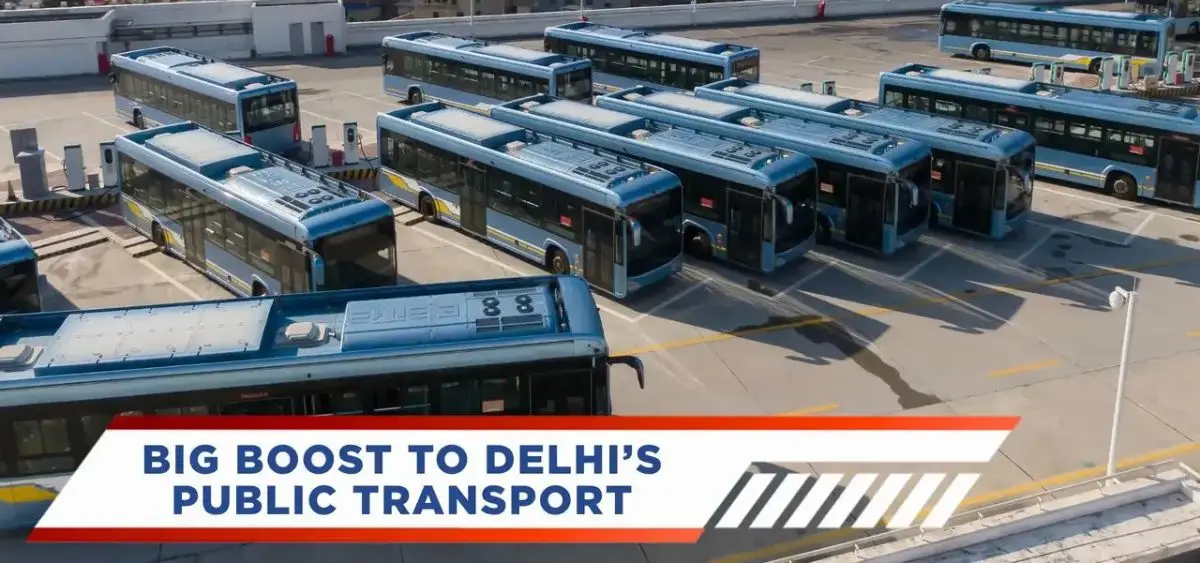

Can Delhi truly transform into India’s electric vehicle capital within the next year? With the bold announcement of Delhi to add 8000 EV Buses by February 2026, the city has sparked curiosity and excitement across the nation. From just 400 buses a few years ago to a massive target of 8,000, this rapid expansion is more than a transport upgrade—it’s a glimpse into the future of sustainable mobility. But how will Delhi achieve such a milestone, and what does it mean for daily commuters and India’s EV journey? Let’s explore the big picture behind this historic shift.
Bold Expansion Timeline
The EV bus fleet is projected to rise to 6,000 by the end of 2025, reaching the 7,000–8,000 target shortly thereafter. This scale-up stems from thorough route rationalisation, which estimates Delhi’s true public transport needs within that range.
A key addition to the fleet will be the “Devi” feeder buses, which bolster last-mile connectivity in underserved neighborhoods.
EV Policy 2.0: Infrastructure and Incentives
Alongside fleet expansion, Delhi is preparing to unveil EV Policy 2.0, expected by February 2026—possibly even sooner. At its core, the revised policy will:
- Develop charging infrastructure in housing societies, under flyovers, and on vacant land in outer Delhi.
- Involve Resident Welfare Associations (RWAs) and explore public-private partnerships for infrastructure build-out.
- Offer vehicle scrappage schemes, road-tax rationalisation, and consumer incentives, in a package described by Singh as “a policy the public will love.”
Additional reports suggest that EV Policy 2.0 may include benefits such as subsidies for electric two-wheelers, tax waivers, road-tax relief for hybrids, and possibly limitations on household ownership of gasoline vehicles—though details await the official announcement.
Further, the government plans to roll out 3,500 new charging stations this year, targeting 13,000 by 2030.
International Collaboration: Delhi–Oslo Smart Transport Initiative (DOSTI)
Delhi is synergizing with Oslo under the Delhi–Oslo Smart Transport Initiative (DOSTI). The objective is to absorb insights from Norway’s successful EV transition, particularly in charging infrastructure strategies.
Audun Garberg, Vice-Director and Head of the Climate Department in Oslo, recounted how limited charging stations in 2006–07 hampered adoption—but now, with infrastructure strongly in place, Oslo is focusing on electric trucks and integrating housing cooperatives into their EV ecosystem.
Setting the Standard for India
By mobilizing thousands of electric buses, strengthening charging networks, and crafting forward-looking EV policy, Delhi is not merely transforming its own mobility landscape—but also setting a benchmark for the country. As Pankaj Singh emphasised, Delhi aims to become India’s EV capital, showcasing large-scale electrification as both achievable and scalable.
Related Articles:-