
Rising Fuel Prices Trigger a Policy Shift
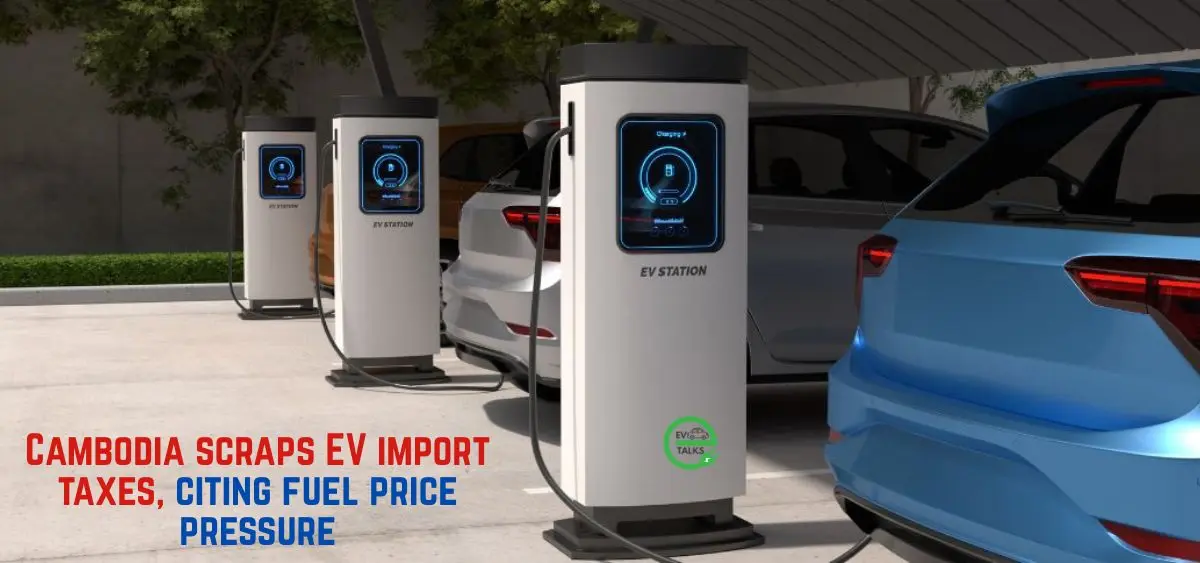
In a decisive move to cut fossil fuel dependence, Cambodia scraps EV import taxes starting 1 April. The government introduced this sweeping tax reform as global oil prices surged sharply due to the ongoing Middle East conflict. Brent crude jumped over 50% in March, while disruptions through the Strait of Hormuz pushed oil prices above US$100 per barrel. The International Energy Agency has described the situation as one of the biggest supply shocks in oil market history. Amid this pressure, Cambodia aims to shield its economy from fuel volatility while accelerating its clean-energy transition.

Zero Duties on EVs, Batteries, and Clean Appliances
According to the General Department of Customs and Excise, Cambodia has removed import duties on a wide range of electric vehicles and energy-efficient goods. The announcement on 26 March confirmed that tariffs on nine categories, including EVs, electric rice cookers, and solar lamps, have been slashed from 7% to 0%.
Import taxes of 15% have also been eliminated on EV motors, lithium batteries, solar systems, and energy-storage devices like power banks. Additionally, 179 tariff lines covering HEVs, PHEVs, EV passenger/freight vehicles, and electric stoves were reduced from 15% to zero.
Some PHEV family cars saw duties fall from 35% to 7%, while several EV family cars and electrical appliances dropped from 35% to zero. Export taxes on bauxite were lowered from 25% to 10%.
This comprehensive policy overhaul reflects the broader national shift as Cambodia scraps EV import taxes to promote sustainable transportation.
EV Adoption Remains Small but Growing
Cambodia’s EV market is still at an early stage. Out of 8.3 million vehicles registered by February 2026, only 14,534 were electric. Yet officials say adoption will increase steadily as prices drop and infrastructure improves.
The government’s climate roadmap targets a 41.7% emissions reduction by 2030 and aims for EVs to make up 40% of cars and the majority of motorcycles and urban buses by 2050.
Infrastructure, Incentives, and Global Partnerships
As Cambodia scraps EV import taxes, it continues expanding its ecosystem. The government has revised traffic laws, enabled EV registration, encouraged private charging networks, and held discussions with major manufacturers like BYD. International partners such as UNDP, ESCAP, and GGGI are supporting feasibility studies, pilot projects, and electric-bus plans.
Challenges Ahead
Despite progress, EV costs remain high—around US$29,000 compared to US$16,000 for new fuel vehicles and US$6,500 for used cars. Charging stations are limited, and concerns persist about battery performance.
Still, with rising fuel prices, strong renewable energy capacity, and a young population, the future looks promising as Cambodia scraps EV import taxes and moves toward a cleaner transport system.

Related Articles: