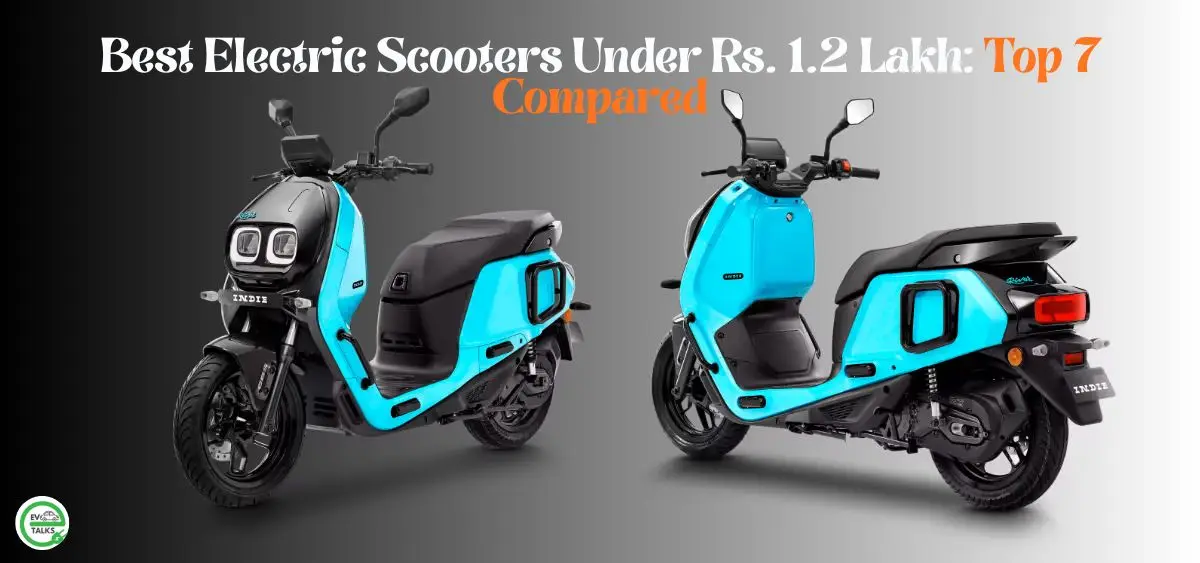

Electric scooters have become smarter, more practical, and significantly more affordable over the past few years. If your budget is around ₹1.2 lakh (ex-showroom), you’re entering one of the most competitive segments in India’s EV market. Whether you’re a daily commuter, a college student, a family rider, or someone looking to reduce fuel expenses, choosing the Best Electric Scooters Under Rs. 1.2 Lakh can help you enjoy lower running costs, quieter rides, and a more sustainable lifestyle without compromising on features.
Today, buyers no longer have to settle for basic models. Modern electric scooters in this price range offer connected technology, impressive riding range, fast charging, better safety systems, spacious storage, and comfortable ergonomics designed specifically for Indian roads.
In this comprehensive comparison, Electric Vehicle Talks explores seven of the strongest contenders currently available in India, helping you identify which scooter best matches your daily commuting needs and long-term ownership expectations.
Why Buy an Electric Scooter Under ₹1.2 Lakh?
For most Indian buyers, the ₹1.2 lakh segment strikes an excellent balance between affordability and premium features.
Key advantages include the following:
- Lower running costs than petrol scooters
- Minimal maintenance requirements
- Government incentives in selected states
- Smart connectivity features
- Smooth and silent riding experience
- Lower carbon emissions
- Ideal for daily city commuting
With petrol prices remaining volatile, many urban commuters can recover the price difference through fuel savings over a few years of regular use.

Best Electric Scooters Under Rs. 1.2 Lakh: Top 7 Compared
| Scooter | Ex-Showroom Price* | Claimed Range | Top Speed | Best For |
|---|---|---|---|---|
| Ather Rizta (S) | ₹1.21 lakh | 123 km (IDC) | 80 km/h | Families & comfort |
| Honda Activa e: Standard | ₹1.17 lakh | 102 km | 80 km/h | Honda reliability |
| Bajaj Chetak 3001 | ₹99,990 | 127 km | 63 km/h | Premium build quality |
| Vida V2 Plus | ₹1.15 lakh | 143 km | 85 km/h | Technology lovers |
| Ampere Nexus EX | ₹1.10–1.20 lakh | 136 km | 93 km/h | Highway-capable commuting |
| TVS iQube (2.2 kWh) | ₹1.13 lakh | 94 km | 75 km/h | Daily urban rides |
| Ola S1 X (4 kWh) | ₹99,999–1.14 lakh | Up to 242 km | Up to 123 km/h | Maximum range & performance |
Note: Prices may vary depending on state subsidies, insurance, and local taxes.
1. Ather Rizta (S)
The Ather Rizta (S) has quickly established itself as one of India’s most practical family-oriented electric scooters. Rather than chasing aggressive styling, Ather focused on comfort, practicality, and everyday usability.
For buyers who frequently travel with a pillion rider or carry groceries, office bags, or school essentials, the Rizta stands out with its class-leading storage capacity and spacious seating.
Key Specifications
| Feature | Details |
|---|---|
| Battery | 2.9 kWh |
| Claimed Range | 123 km (IDC) |
| Real-world Range | Around 105 km |
| Top Speed | 80 km/h |
| Storage | 56 litres |
| Weight | 125 kg |
What Makes It Special?
The scooter offers one of the widest seats in its category, making longer city rides much more comfortable.
Its 56-liter storage capacity—including under-seat storage and a front storage compartment—is among the best available in the segment.
Ather also includes several premium safety technologies:
- Traction Control
- Hill Hold Assist
- Fall Detection
- Reverse Mode
- Guide-Me-Home Lights
- Bluetooth Connectivity
- OTA Software Updates
Pros
✔ Excellent family comfort
✔ Huge storage space
✔ Premium software experience
✔ Strong safety package
Cons
✘ Slightly exceeds the ₹1.2 lakh mark in some cities
✘ The optional Pro Pack increases the overall cost
2. Honda Activa e: Standard
Few names enjoy as much trust in India as the Honda Activa. The electric version retains that familiar reputation while introducing one of the most interesting technologies in the segment—swappable batteries.
Instead of waiting to recharge, eligible users can exchange depleted batteries for fully charged ones at designated swapping stations, reducing downtime.
Key Specifications
| Feature | Details |
|---|---|
| Motor | 6 kW PMSM |
| Battery | Dual 1.5 kWh Swappable Batteries |
| Range | 102 km |
| Top Speed | 80 km/h |
| Riding Modes | Econ, Standard, Sport |
Standout Features
Honda Smart Key technology adds convenience through the following:
- Smart Unlock
- Smart Find
- Keyless operation
The scooter also includes:
- Front disc brake
- Telescopic suspension
- LCD/TFT display (variant dependent)
- Combined Braking System
- LED lighting
Pros
✔ Trusted Honda quality
✔ Battery swapping convenience
✔ Smooth city performance
✔ Excellent resale potential
Cons
✘ Battery-swapping infrastructure is still expanding
✘ Lower range than some competitors
3. Bajaj Chetak 3001
If build quality is your highest priority, the Bajaj Chetak 3001 deserves serious consideration.
Unlike many scooters that rely heavily on plastic panels, the Chetak continues Bajaj’s legacy with a sturdy all-metal body, giving it a premium feel and enhanced durability.
Its understated styling also appeals to buyers seeking a timeless design rather than a futuristic look.
Key Specifications
| Feature | Details |
|---|---|
| Battery | 3.0 kWh |
| Claimed Range | 127 km |
| Top Speed | 63 km/h |
| Charging | 0–80% in around 3 hr 50 min |
| Storage | 35 litres |
Highlights
The scooter offers:
- Metal body construction
- Colour LCD
- Eco & Sport riding modes
- 35-litre storage
- Optional TecPac software upgrade
TecPac unlocks additional premium features, including:
- Bluetooth connectivity
- Hill Hold Assist
- Reverse Mode
- Auto-flashing indicators
Pros
✔ Premium fit and finish
✔ Reliable engineering
✔ Comfortable ride quality
✔ Competitive pricing
Cons
✘ Lower top speed than rivals
✘ Advanced software features require a TecPac purchase
4. Vida V2 Plus
The Vida V2 Plus represents Hero MotoCorp’s vision for practical urban mobility. One of its biggest advantages is its removable battery system, allowing apartment residents or users without dedicated parking chargers to recharge conveniently at home.
This flexibility makes it especially appealing in densely populated Indian cities.
Key Specifications
| Feature | Details |
|---|---|
| Battery | Removable Lithium-ion |
| Claimed Range | 143 km |
| Top Speed | 85 km/h |
| Display | 7-inch TFT Touchscreen |
| Fast Charging | Around 62 minutes |
Smart Features
The Vida V2 Plus is packed with connected technology:
- Turn-by-turn navigation
- OTA updates
- Bluetooth connectivity
- Keyless access
- Remote tracking
- Geofencing
- Smartphone app integration
The regenerative braking system also improves energy efficiency by recovering power during deceleration.
Pros
✔ Removable battery
✔ Long claimed range
✔ Excellent digital ecosystem
✔ Hero service network support
Cons
✘ Under-seat storage is reduced due to battery placement
✘ Premium features may require app familiarity
5. Ampere Nexus EX
The Ampere Nexus EX is aimed at riders who want stronger performance without stretching their budget beyond ₹1.2 lakh.
Powered by a mid-mounted motor and an LFP battery pack, the scooter combines brisk acceleration with improved battery durability.
Key Specifications
| Feature | Details |
|---|---|
| Battery | 3.0 kWh LFP |
| Claimed Range | 136 km |
| Real-world Range | Around 80–100 km |
| Top Speed | 93 km/h |
| Charging Time | About 3.3 hours |
Why It Stands Out
Unlike conventional lithium-ion chemistry, the Lithium Iron Phosphate (LFP) battery offers the following:
- Better thermal stability
- Longer lifecycle
- Improved safety
- Lower degradation over time
The scooter also offers:
- Five riding modes
- Reverse mode
- Front disc brake
- High ground clearance
- Strong dual-frame chassis
Pros
✔ Excellent top speed
✔ Safe LFP battery chemistry
✔ Strong ride quality
✔ Good ground clearance for Indian roads
Cons
✘ Real-world range is lower than IDC figures
✘ Basic display compared to premium rivals
6. TVS iQube (2.2 kWh)
The TVS iQube (2.2 kWh) has earned a strong reputation among Indian EV buyers for its refined ride quality, dependable performance, and extensive after-sales service network. Instead of focusing solely on performance figures, TVS has designed the iQube to deliver a smooth and stress-free ownership experience.
For commuters covering 20–40 km daily, the iQube offers an ideal combination of comfort, practicality, and reliability.
Key Specifications
| Feature | Details |
|---|---|
| Battery Capacity | 2.2 kWh Lithium-ion |
| Claimed Range (IDC) | 94 km |
| Real-world Range | Around 75 km |
| Top Speed | 75 km/h |
| Charging Time | 0–80% in approximately 2 hr 45 min |
| Storage | 30 litres |
| Seat Height | 770 mm |
Notable Features
- 5-inch TFT display
- Bluetooth connectivity
- Navigation support
- Reverse parking assist
- LED lighting
- Regenerative braking
- 118+ connected features through the TVS SmartXonnect app
The scooter’s low seat height also makes it comfortable for riders of varying heights, making it a popular family scooter.
Pros
✔ Excellent ride comfort
✔ Smooth power delivery
✔ Strong TVS dealership network
✔ Reliable software ecosystem
Cons
✘ Lower range compared to newer rivals
✘ Fixed battery limits charging flexibility
7. Ola S1 X
Among all the scooters in this comparison, the Ola S1 X delivers some of the highest claimed range figures while remaining well within the ₹1.2 lakh budget.
Available with multiple battery options, the S1 X caters to buyers with different commuting needs. The 4 kWh variant is particularly attractive for riders covering long daily distances.
Key Specifications
| Feature | Details |
|---|---|
| Battery Options | 2 kWh, 3 kWh, 4 kWh |
| Claimed Range | 95–242 km |
| Top Speed | 85–123 km/h (variant dependent) |
| Storage | 34 litres |
| Riding Modes | Eco, Normal, Sports |
Features
- Steel tubular frame
- Flat floorboard
- 34-litre boot
- Cruise control
- Navigation prompts
- Smartphone connectivity
- Reverse mode
- OTA software updates
The S1 X also benefits from Ola’s expanding charging ecosystem and continuous software improvements through over-the-air updates.
Pros
✔ Outstanding claimed range
✔ Excellent acceleration
✔ Competitive pricing
✔ Spacious storage
Cons
✘ Real-world range varies significantly based on riding style
✘ Service experience may differ across locations
Comparison of the Top Electric Scooters Under Rs. 1.2 Lakh
| Scooter | Best For | Claimed Range | Top Speed | Battery Type |
|---|---|---|---|---|
| Ather Rizta S | Families | 123 km | 80 km/h | Fixed Li-ion |
| Honda Activa e | Trusted brand | 102 km | 80 km/h | Swappable Li-ion |
| Bajaj Chetak 3001 | Build quality | 127 km | 63 km/h | Fixed Li-ion |
| Vida V2 Plus | Technology | 143 km | 85 km/h | Removable Li-ion |
| Ampere Nexus EX | Performance | 136 km | 93 km/h | LFP Battery |
| TVS iQube | Reliability | 94 km | 75 km/h | Fixed Li-ion |
| Ola S1 X | Long-distance commuting | Up to 242 km | Up to 123 km/h | Fixed Li-ion |
No vehicle data found.
How to Choose the Best Electric Scooters Under Rs. 1.2 Lakh
Buying an electric scooter isn’t just about selecting the highest claimed range. Your daily usage, charging access, and riding environment should guide your decision.
1. Assess Your Daily Travel Distance
- 20–40 km/day: TVS iQube, Bajaj Chetak
- 40–70 km/day: Honda Activa e, Ather Rizta
- 70–100+ km/day: Vida V2 Plus, Ola S1 X, Ampere Nexus
2. Fixed Battery vs. Removable Battery
Fixed Battery
Advantages
- Better structural rigidity
- Larger under-seat storage
- Often lighter
Limitations
- Requires parking near a charging point
Removable Battery
Advantages
- Charge anywhere using a household socket
- Ideal for apartment residents
- Greater flexibility
Limitations
- Slightly heavier battery modules
- Can reduce storage capacity
3. Consider Your Local Service Network
A scooter with a nearby authorized service centre can make ownership significantly more convenient.
Before purchasing, check:
- Service centre availability
- Spare parts availability
- Charging support
- Warranty coverage
4. Evaluate Software Features
Today’s electric scooters are becoming “smart devices on wheels.”
Useful connected features include:
- Navigation
- Ride analytics
- Theft alerts
- Geofencing
- OTA software updates
- Vehicle diagnostics
- Smartphone connectivity
These features enhance convenience and improve long-term ownership.
Estimated Charging Cost Comparison
One of the biggest advantages of electric scooters is their low operating cost. Assuming an average residential electricity tariff of ₹8 per unit, here’s an approximate cost per full charge:
| Scooter | Battery Capacity | Approx. Cost per Full Charge |
|---|---|---|
| Ather Rizta | 2.9 kWh | ₹23 |
| Honda Activa e | 3.0 kWh | ₹24 |
| Bajaj Chetak | 3.0 kWh | ₹24 |
| Vida V2 Plus | 3.4 kWh (approx.) | ₹27 |
| Ampere Nexus | 3.0 kWh | ₹24 |
| TVS iQube | 2.2 kWh | ₹18 |
| Ola S1 X (4 kWh) | 4.0 kWh | ₹32 |
Even the largest battery costs only around ₹30–35 for a full home charge, making electric scooters far cheaper to operate than petrol-powered alternatives.
Estimated Running Cost Comparison
| Vehicle Type | Approximate Cost per km |
|---|---|
| Electric Scooter | ₹0.20–₹0.35 |
| Petrol Scooter | ₹2.00–₹2.80 |
For someone riding 1,000 km per month, switching to an electric scooter can save ₹20,000–₹30,000 annually on fuel alone, depending on local petrol and electricity prices.
Ownership Tips for First-Time EV Buyers
To maximise battery life and enjoy a hassle-free ownership experience:
- Charge the battery between 20% and 80% whenever practical.
- Avoid exposing the scooter to prolonged extreme heat.
- Use only the manufacturer-approved charger.
- Keep software updated to benefit from performance and security improvements.
- Maintain recommended tyre pressure to improve range.
- Use regenerative braking effectively in city traffic.
- Schedule periodic service inspections, even though EVs require less maintenance than petrol scooters.
Common Mistakes Buyers Make
Avoid these common pitfalls when shopping for the Best Electric Scooter Under Rs. 1.2 Lakh:
- Choosing based only on the advertised range.
- Ignoring the availability of nearby service centres.
- Overlooking charging infrastructure at home or work.
- Focusing solely on price instead of total ownership cost.
- Not checking battery warranty terms.
- Forgetting to compare real-world riding range.
- Buying a high-performance scooter when daily commuting needs are modest.
Choosing a scooter that aligns with your actual usage will deliver a better ownership experience over the long term.
Expert Insight from Electric Vehicle Talks
The Best Electric Scooter Under Rs. 1.2 Lakh is no longer defined solely by price. As India’s electric mobility ecosystem matures, buyers are placing greater emphasis on total cost of ownership, battery reliability, after-sales support, charging convenience, and software experience.
Based on current market trends, here are our observations at Electric Vehicle Talks:
- Family buyers are increasingly prioritizing comfort, storage, and safety over outright performance, making models like the Ather Rizta and TVS iQube attractive options.
- Young professionals and technology enthusiasts are drawn to connected scooters such as the Vida V2 and Ola S1 X, which offer advanced digital features and over-the-air (OTA) updates.
- Long-term ownership costs have become a key decision factor. Scooters equipped with LFP (Lithium Iron Phosphate) batteries, such as the Ampere Nexus EX, are gaining popularity due to their enhanced thermal stability and longer battery life.
- Established automotive brands like Honda, TVS, and Bajaj continue to inspire confidence through their extensive dealer and service networks, which remain a significant advantage for many first-time EV buyers.
Our recommendation is simple: Choose the scooter that best matches your daily commuting distance, charging accessibility, and local service support rather than focusing solely on the highest advertised range.
For more buying guides, EV news, charging tips, and ownership advice, readers can explore Electric Vehicle Talks.
Sustainability Impact
Switching from a petrol scooter to an electric scooter offers several environmental benefits:
- Reduced tailpipe emissions.
- Lower dependence on fossil fuels.
- Quieter urban transportation.
- Improved air quality in cities.
- Support for India’s transition toward cleaner mobility.
When charged using renewable energy sources such as rooftop solar, the environmental benefits become even more significant.
People Also Ask
1. Which is the Best Electric Scooters Under Rs. 1.2 Lakh in India?
The best choice depends on your priorities. The Ather Rizta (S) is ideal for families, the TVS iQube offers dependable everyday commuting, the Bajaj Chetak 3001 excels in build quality, the Vida V2 Plus stands out for smart features, and the Ola S1 X delivers exceptional claimed range and performance.
2. Which electric scooter offers the longest range under ₹1.2 lakh?
Among the scooters compared, the Ola S1 X (4 kWh) offers the highest claimed range, while the Vida V2 Plus and Ampere Nexus EX also provide impressive range figures suitable for longer daily commutes.
3. Are electric scooters cheaper to maintain than petrol scooters?
Yes. Electric scooters generally have fewer moving parts, eliminating the need for engine oil changes, clutch maintenance, or exhaust system repairs. This results in lower routine maintenance costs over the vehicle’s lifespan.
4. Can I charge an electric scooter at home?
Absolutely. Most electric scooters can be charged using a standard 15A household socket with the charger supplied by the manufacturer. Models with removable batteries provide additional flexibility for users without dedicated parking.
5. How long does an electric scooter battery last?
Modern lithium-ion batteries are typically designed to last 6–8 years or several thousand charging cycles, depending on usage patterns, charging habits, and environmental conditions.
6. Are electric scooters suitable for Indian road conditions?
Yes. Many manufacturers now design electric scooters specifically for Indian roads, offering higher ground clearance, reinforced suspension systems, durable frames, and improved water resistance.
7. Is buying an electric scooter in 2026 a good decision?
For most urban commuters, purchasing an electric scooter in 2026 is a practical choice due to lower running costs, expanding charging infrastructure, improved battery technology, and increasing model availability across different price points.
FAQs about the Best Electric Scooters Under Rs. 1.2 Lakh
1. Which electric scooter under ₹1.2 lakh is best for families?
The Ather Rizta (S) is one of the strongest options for family use thanks to its spacious seating, large 56-litre storage capacity, and comfort-focused design.
2. Which electric scooter has the lowest running cost?
Most electric scooters cost approximately ₹0.20–₹0.35 per kilometre, making them significantly cheaper to operate than petrol scooters.
3. What should I check before buying an electric scooter?
Evaluate real-world range, battery warranty, charging options, nearby service centres, build quality, and your daily commuting requirements.
4. Is a removable battery better than a fixed battery?
It depends on your lifestyle. Removable batteries are ideal if home parking lacks charging access, while fixed batteries often offer greater structural rigidity and more storage space.
5. Does fast charging reduce battery life?
Occasional fast charging is generally safe when using manufacturer-approved equipment. However, relying exclusively on fast charging over long periods may contribute to increased battery wear compared to regular charging.
6. Which scooter offers the best balance of features and value?
The Vida V2 Plus, Ather Rizta (S), and Ampere Nexus EX offer an excellent combination of performance, features, and practicality within this price segment.
Conclusion
Finding the Best Electric Scooters Under Rs. 1.2 Lakh has become easier than ever, thanks to the rapid evolution of India’s electric mobility market. Buyers today can choose from a wide range of scooters tailored to different needs—whether it’s the comfort-focused Ather Rizta (S), the trusted Honda Activa e, the premium Bajaj Chetak 3001, the feature-rich Vida V2 Plus, the performance-oriented Ampere Nexus EX, the dependable TVS iQube, or the long-range Ola S1 X.
If you’re planning your next EV purchase or want to stay informed about the latest electric cars, scooters, charging technologies, and industry developments, explore more expert guides and insights at Electric Vehicle Talks. Our goal is to help you make informed decisions and stay ahead in India’s fast-evolving electric mobility landscape.
Related Article: