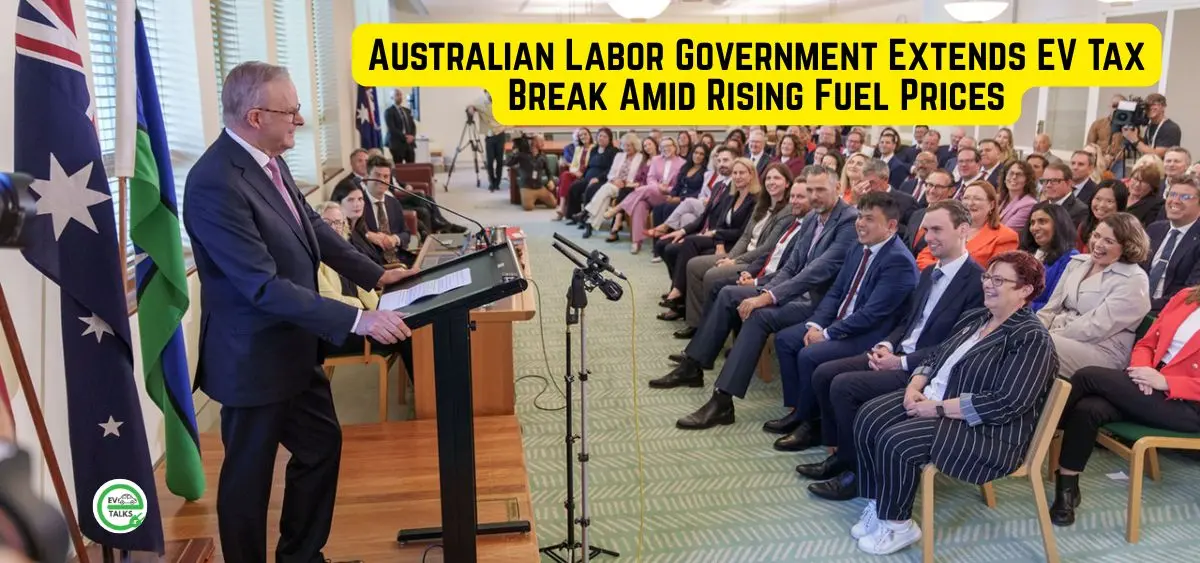

The Labor Government Extends the EV Tax Break to support Australian households grappling with rising fuel costs and to accelerate the shift toward affordable electric vehicles. Announced on 4 May 2026, the policy confirms that the full electric vehicle (EV) tax discount will remain in place until 31 March 2027, giving buyers and manufacturers greater certainty in a rapidly evolving market.
Why the Extension Matters
The decision comes at a time when global fuel prices have surged, partly due to geopolitical tensions linked to the Iran conflict. As petrol and diesel costs climb, more Australians are turning to EVs as a cost-effective alternative. The Labor Government Extends the EV Tax Break to ease this transition by reducing upfront costs through a Fringe Benefits Tax (FBT) exemption, which has already saved buyers thousands of dollars since its introduction in early 2023.

Phased Changes to the EV Incentive
While the full discount remains in place for now, the government has outlined a phased approach to make the scheme more financially sustainable:
- Until 31 March 2027: Full FBT exemption continues for all eligible EVs.
- 1 April 2027 – 31 March 2029: Full discount limited to EVs priced under $75,000. Vehicles priced between $75,000 and the luxury car tax threshold (currently $91,387) will receive a reduced 25% discount.
- From 1 April 2029: A flat 25% FBT discount will apply to all eligible EVs below the luxury tax threshold.
This structured approach ensures the Labor Government extends the EV Tax Break while gradually reducing its fiscal burden.
Encouraging Affordable EV Options
Treasurer Jim Chalmers and Energy Minister Chris Bowen emphasized that the revised policy aims to push automakers to offer more budget-friendly EVs. With brands like BYD already introducing models priced as low as $26,000, the government believes the market is ready to focus on affordability rather than premium offerings.
Rising Costs and Policy Adjustments
The scheme’s popularity has led to significant budget pressures. Initially projected to cost $90 million, it ballooned to an estimated $1.4 billion in 2025–26. Critics argued that the broad tax exemption disproportionately benefited high-income earners, labeling it “upper-class welfare.” In response, the government has refined the policy to better target middle-income households.
A Balanced Approach for the Future
Despite scaling back the incentive over time, the Labor Government extended the EV Tax Break as part of a broader strategy to support families, reduce emissions, and encourage long-term EV adoption. By 2029, the transition to a permanent 25% FBT discount is expected to strike a balance between fiscal responsibility and continued support for cleaner transportation.
As Australia moves toward a more sustainable future, this policy signals a clear commitment to making electric vehicles accessible, affordable, and economically viable for everyday consumers.

Related Articles: