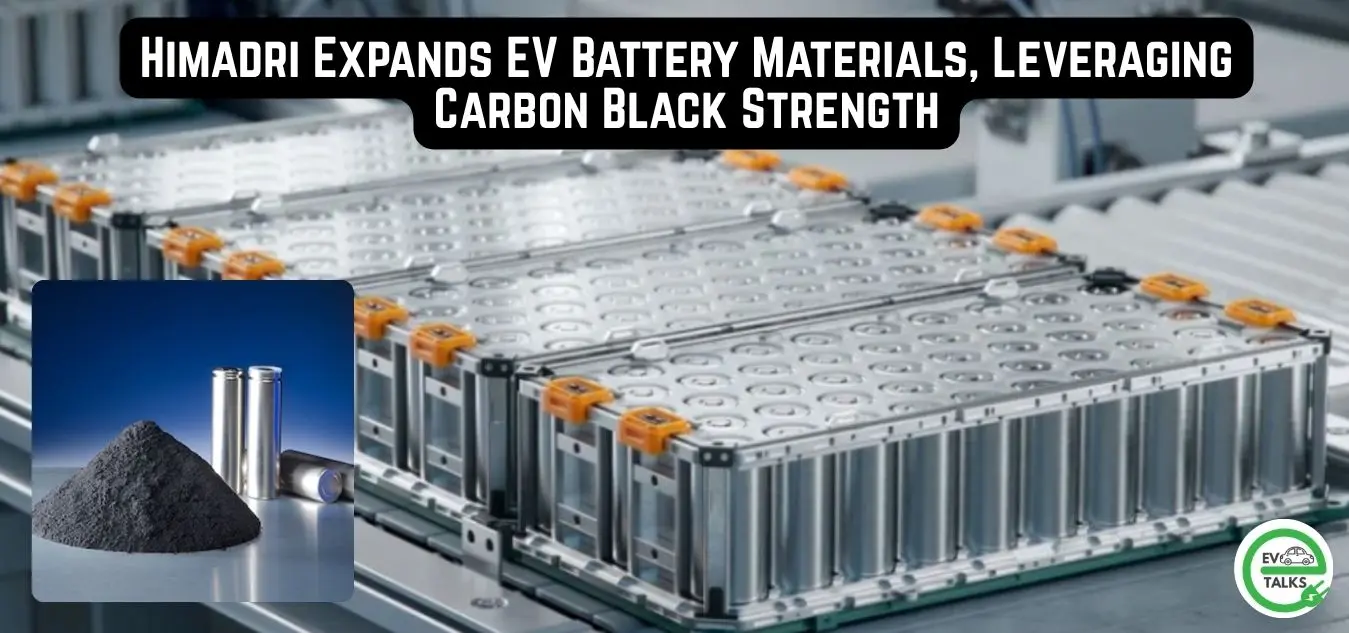

Himadri Speciality Chemicals is taking a decisive step into the electric mobility ecosystem as Himadri Expands EV Battery Materials to tap into India’s rapidly growing lithium-ion battery market. The company has announced plans to enter the lithium iron phosphate (LFP) cathode active material segment, aiming to support nearly 100 GWh of battery demand over the next five years.
Entry into High-Growth EV Battery Market
As Himadri Expands EV Battery Materials, it plans to commission an initial capacity of 2,000 metric tons per annum (MTPA) of LFP cathode active materials by Q3 FY27. While this capacity is modest, it marks the company’s first step into a sector projected to exceed 256 GWh in India by 2032. The move aligns with the country’s broader EV ambitions and increasing demand for localized battery supply chains.

Leveraging Carbon Black Expertise
A key strength supporting this transition is Himadri’s established specialty carbon black business. The company operates the world’s largest single-location carbon black facility at Mahistikry, which plays a crucial role in enhancing battery electrode conductivity. This strong foundation enables Himadri to integrate its chemical expertise into advanced battery materials, ensuring synergy between its legacy and new businesses.
Strong Financial Backing Fuels Expansion
The expansion comes on the back of robust financial performance. Himadri reported a 36% year-on-year rise in net profit to ₹755 crore in FY26, supported by steady revenue streams and a low debt-to-equity ratio of 0.16. As Himadri Expands EV Battery Materials, these strong fundamentals are expected to support the capital-intensive transition into battery components.
Market Opportunity and Competitive Landscape
India’s EV battery market is projected to reach approximately $19.5 billion by 2030, driven by policy support and rising consumer adoption. However, domestic LFP cell manufacturing capacity remains limited at around 8–12 GWh in 2026, with heavy reliance on imports. Himadri’s long-term 100 GWh ambition will require significant scaling, supply chain development, and competition with global leaders, particularly from China. NMC & LFP Battery Difference: Which is Suitable for Whom?
Valuation Concerns and Analyst Outlook
Despite growth optimism, analysts remain cautious. The company’s stock, trading near ₹607.75 as of April 30, 2026, has gained over 31% in a year and carries a high P/E ratio of around 40.8x. The Relative Strength Index (RSI) of 94 signals an overbought condition, raising concerns about a potential correction. Consensus ratings remain ‘Hold,’ with price targets indicating a possible downside.
Future Outlook
As Himadri Expands EV Battery Materials, the company is also focusing on expanding its carbon black portfolio and entering new tire markets. By FY28, it expects full operational capacity across new chemical and battery material segments. While execution risks remain, the strategy positions Himadri for long-term growth in India’s evolving EV ecosystem.

Related Articles: