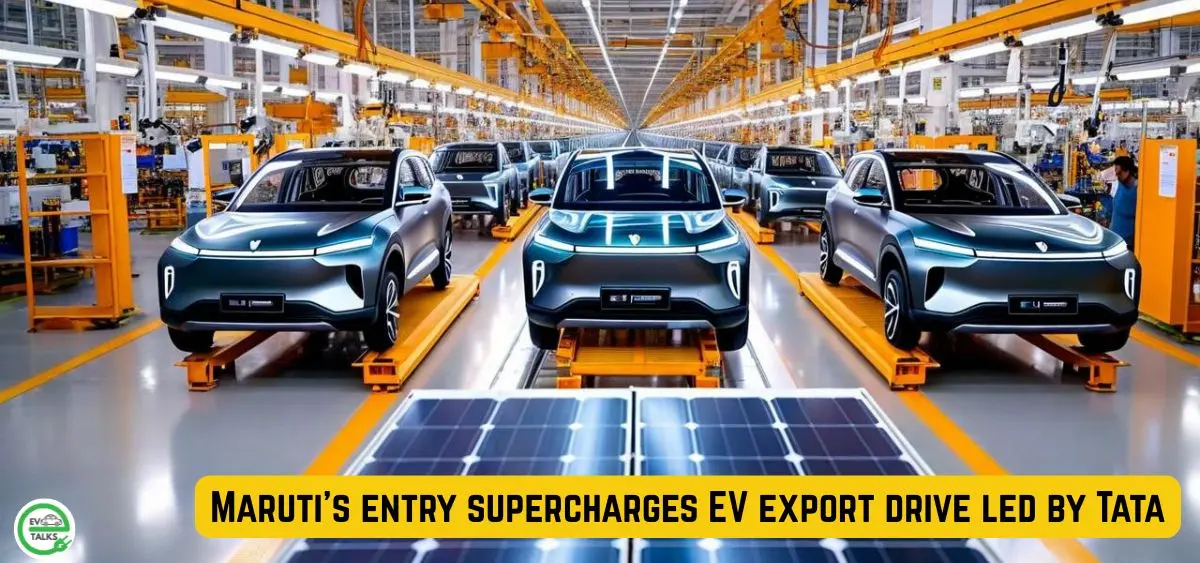

India’s electric passenger vehicle (EPV) export journey is entering a decisive new chapter. Maruti’s entry supercharges EV export momentum at a time when the country is steadily building its reputation as a reliable global EV manufacturing hub. While electric vehicle exports from India still trail conventional passenger vehicle shipments, the entry of the country’s largest carmaker marks a structural shift in scale, ambition, and geographic reach.
e-Vitara Leads the Charge
Maruti Suzuki’s first made-in-India electric SUV, the e Vitara, is already making waves internationally — even before its domestic retail debut. Manufactured exclusively at the company’s Gujarat facility, the model has recorded exports of nearly 16,000 units since shipments began in August 2025.

The SUV has reached 36 countries, with Europe and Japan emerging as key destinations. Major European markets include the United Kingdom, Norway, Denmark, Germany, Switzerland, Belgium, France, Austria, Finland, and Hungary. Europe accounts for the bulk of shipments, reflecting confidence in India’s EV manufacturing standards despite the region’s stringent regulatory environment and mature EV ecosystem.
This rapid global rollout highlights how Maruti’s entry supercharges EV exports by tapping into advanced automotive markets rather than focusing solely on emerging economies.
Strategic Global Execution
Market-specific positioning, customer communication, and charging ecosystem partnerships are handled by Suzuki Motor Corporation and its local distributor networks in respective countries. This structured global approach ensures that the product aligns with regional regulations, infrastructure readiness, and consumer preferences.
Industry experts believe Maruti Suzuki’s vast global network and production scale could materially transform India’s EV export trajectory. The early overseas volumes — achieved even before domestic sales commenced — are providing crucial momentum to India’s EPV export ambitions. Clearly, Maruti’s entry supercharges EV growth by blending manufacturing strength with global strategy.
Tata’s Early Leadership and Expanding Ecosystem
Before Maruti’s arrival, much of India’s electric export activity was driven by Tata Passenger Electric Mobility Ltd (TPEML). Tata has exported nearly 10,000 electric cars and SUVs, including models such as Tiago. ev, Punch.ev, Nexon.ev, Curvv. ev, and Xpres-T. These exports have primarily catered to neighbouring and regional markets like Nepal, Bhutan, Mauritius, and Sri Lanka.
French automaker Citroen, part of the Stellantis Group, has also joined India’s EV export movement. Its Chennai-built ë-C3 has been shipped to ASEAN markets, although shipment volumes remain undisclosed.
Expanding to 100 Countries
Maruti Suzuki aims to expand e-Vitara exports to as many as 100 countries over time. Already India’s largest passenger vehicle exporter for five consecutive calendar years, the company has now emerged as the nation’s leading exporter of electric cars as well.
As India strengthens its manufacturing ecosystem and global supply chain integration, Maruti’s entry supercharges EV ambitions — signalling that the country is poised to become a serious global player in the electric mobility revolution.

Related Articles:-