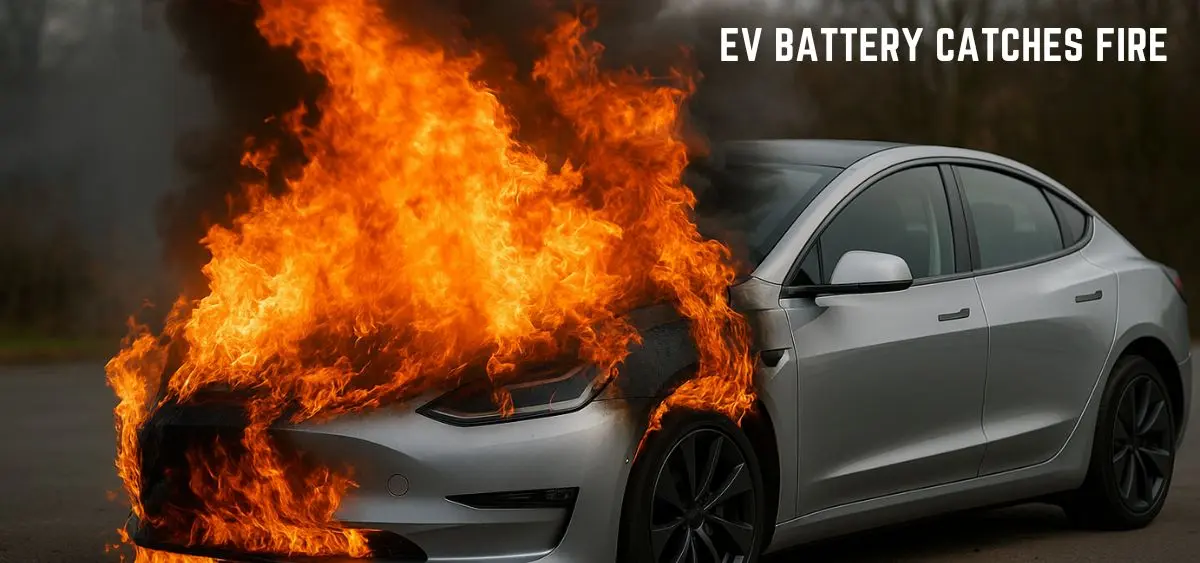

When an EV battery catches fire, the consequences can be serious—but available evidence does not suggest that electric cars are more likely to catch fire than petrol or diesel vehicles. In fact, national fire statistics and specialist research generally indicate a lower fire incidence among electric vehicles.
However, EV battery fires introduce a different challenge: thermal runaway, toxic gases, possible reignition and complicated firefighting operations.
So, how frequently do electric vehicles actually catch fire? Are they dangerous while charging? And what should Indian EV owners do to reduce the risks?
We examined the latest available research, government fire statistics, battery safety studies and emergency-response guidance to separate the evidence from the headlines.
Key Takeaways: EV Battery Fire Safety
- EVs generally show lower reported fire rates than petrol and diesel vehicles, although comparisons depend on fleet age, reporting methods and vehicle exposure.
- Not every EV fire is a battery fire. Electrical components, tyres, interiors and external fires can ignite without the traction battery entering thermal runaway.
- Thermal runaway is the primary mechanism behind lithium-ion traction battery fires, potentially producing flames, toxic gases and repeated ignition.
- Charging is not inherently dangerous. Faulty wiring, damaged batteries, incompatible charging equipment and poor installations create avoidable hazards.
- Battery chemistry matters. Lithium iron phosphate (LFP) generally has better thermal stability than nickel-rich battery chemistries, but no lithium-ion battery is completely fireproof.
- India has tightened EV battery safety requirements, including thermal propagation testing and battery management safeguards.
- Safe charging, genuine components, professional inspections and immediate action after battery damage are among the most practical preventive measures.
The central distinction is between how often a vehicle catches fire and how difficult the resulting fire is to control. These are separate questions, and both matter for EV safety.
Are Electric Cars More Likely to Catch Fire Than Petrol or Diesel Cars?
No. The available evidence indicates that electric passenger cars generally experience fewer fires than conventional petrol and diesel vehicles. However, no single worldwide dataset provides a perfectly comparable annual fire rate across all powertrains.
The Australian Government’s electric vehicle facts page explicitly identifies EV battery fires as rare. As of April 2026, EV FireSafe had recorded 14 EV battery fires in Australia since 2021, against a national fleet exceeding 500,000 EVs. Those incidents included major collisions, external fires, arson and cases under investigation.
This does not mean EVs cannot catch fire. It means the probability of fire and the severity of a particular incident should not be confused.
Car Fire Statistics: EV vs ICE Vehicles
The following table separates different types of evidence instead of combining incompatible datasets into one misleading percentage.
| Source and period | Verified or reported findings | Important limitation |
|---|---|---|
| Australian Government, April 2026 | 14 recorded EV battery fires since 2021 | A cumulative recorded count, not an annual fire probability |
| Sweden, 2025 | 46 electric/hybrid passenger cars involved in fires; approximately 2,800 passenger-car fires across all fuel types | The EV category includes hybrids; the total includes deliberate fires. |
| EV FireSafe, 2010–2024 | Historical database of 511 high-voltage battery-fire incidents, cited in January 2025 research | Non-exhaustive; not the global total |
| India, 2023–2025 | 26 EV accidents involving fire recorded in the eDAR system | Accident-related records, not all EV battery fires |
The Swedish statistics are particularly useful because they come from emergency-service reporting rather than social-media videos.
Sweden recorded 46 fires involving electric or hybrid passenger cars during 2025, compared with approximately 2,800 passenger-car fires across all powertrains. However, proper risk comparisons must adjust for how many vehicles are on the road, their ages and distances driven.
Why Some Popular EV Fire Statistics Are Misleading
You may have encountered these widely circulated figures:
- EV fire probability: 0.0012%.
- ICE vehicle fire probability: 0.1%.
- Petrol cars: approximately 1,530 fires per 100,000 vehicles sold.
- Electric cars: approximately 25 fires per 100,000 vehicles sold.
The first two estimates also appear in the supplied January 2025 Energy Saving Trust report.
However, they should not be presented as universal, verified 2026 annual fire probabilities. The datasets use different vehicle populations, collection periods and definitions.
Similarly, the frequently repeated AutoinsuranceEZ comparison based on fires per 100,000 vehicle sales is not sufficiently robust to establish an accurate real-world vehicle fire risk. Fires involving an existing fleet cannot reliably be compared using new annual sales as the denominator.
The more defensible conclusion: Available national datasets support a lower observed incidence of EV fires, but the exact global difference remains uncertain.
What New 2026 Research Reveals
A significant development came in March 2026, when the US National Institute of Standards and Technology (NIST) published Understanding the Risk of Lithium-Ion Battery Fires – Multi-Source Data Analysis.
Its researchers estimated approximately 5,718 electric and plug-in hybrid vehicle fires in the dataset examined since 2011, with substantial statistical uncertainty and evidence of underreporting.
The researchers also highlighted fragmented fire reporting and inconsistent identification of lithium-ion battery involvement.
This research illustrates why a specialist database of confirmed traction-battery thermal-runaway incidents and a broader statistical estimate of EV-related fires can produce very different totals.
They measure different things.
NIST’s findings also reinforce the need for stronger fire-incident reporting as the EV fleet grows. More absolute fire incidents can occur as millions of additional vehicles enter service, even without an increase in the fire risk per vehicle.
How Many Electric Cars Catch Fire Every Year?
There is currently no reliable, exhaustive worldwide annual count covering every passenger EV fire.
Three categories must be distinguished:
- An EV catches fire, but its high-voltage battery is not involved.
- The traction battery enters thermal runaway and contributes to a fire.
- A charging station or electrical installation catches fire without the vehicle battery igniting.
EV FireSafe primarily investigates the second category: traction battery fires involving battery-electric and plug-in hybrid passenger vehicles. It explicitly states that its database is not exhaustive.
A passenger EV with a burning tyre, damaged electrical component or burning interior does not necessarily have a battery fire.
This distinction matters when reviewing statistics and assessing vehicle safety.
EV Fire Statistics in India: What Do We Know?
In a parliamentary response published on February 10, 2026, India’s Ministry of Heavy Industries acknowledged that the country does not maintain comprehensive centralized data exclusively tracking EV battery-fire incidents.
However, its Electronic Detailed Accident Report (eDAR) system recorded:
| Year | EV accidents reported | Accidents involving EV fire |
|---|---|---|
| 2023 | 5,594 | 8 |
| 2024 | 7,817 | 9 |
| 2025 | 10,454 | 9 |
| Total | 23,865 | 26 |
These figures cover the stated reporting categories and period. They cannot establish that only 26 EV fires occurred in India, because fires unrelated to a recorded road accident may fall outside the dataset.
For Indian consumers, the absence of comprehensive reporting highlights the importance of certification, recalls, servicing and manufacturer accountability.
Why Does an EV Battery Catch Fire?
An EV battery catches fire primarily when an internal battery failure or external damaging event triggers thermal runaway.
Modern EV batteries contain hundreds or thousands of individual cells assembled into modules or larger integrated battery structures.
These cells store substantial energy in a relatively compact space. Under normal operating conditions, the battery management system (BMS), temperature controls and electrical protections maintain safe operation.
Problems arise when a cell is damaged or exposed to conditions outside its designed limits.
What Is Thermal Runaway in an EV Battery?
Thermal runaway is a process in which a battery cell generates heat faster than that heat can escape.
Simplified thermal runaway sequence. Not every battery failure progresses to fire. The process can generate toxic and flammable gases, pressure, smoke and powerful directional flames.
If sufficient heat reaches neighboring cells, thermal runaway can propagate through the battery pack.
The supplied 2020 academic review by Sun and colleagues explains this mechanism in detail. The January 2025 Energy Saving Trust report also illustrates the progression in its diagram on page 5.
Importantly, some failures produce venting without sustained flames. Other incidents can result in gas ignition or explosion.
Common Causes of EV Battery Fires
| Cause | How it can lead to a fire | Practical prevention |
|---|---|---|
| Manufacturing defects | Internal shorts, separator failures, or cell contamination | Buy approved vehicles and address recalls. |
| Collision or underbody impact | Battery casing penetration or cell deformation | Inspect after serious impacts |
| Charging equipment faults | Overheated wiring, connections or charging components | Use compatible equipment and proper installation |
| Battery overheating | Cooling-system failure or severe external heat | Follow warnings and maintain thermal systems |
| Water or flood damage | Corrosion or short circuits in compromised high-voltage components | Obtain professional inspection after flooding |
| Unauthorized modifications | Bypassed protections or incorrectly assembled batteries | Avoid aftermarket BMS and battery alterations |
| External vehicle fire | Heat from another burning vehicle or structure damages the pack | Maintain safe parking and fire protection arrangements |
Does Overcharging Cause EV Battery Fires?
Potentially, but modern EVs are designed with charging protections.
The BMS monitors voltage, current, temperature and state of charge. Under normal operation, it prevents the battery from exceeding prescribed limits.
True electrical overcharging is therefore more closely associated with protection failure, damaged equipment or unauthorized modifications than simply leaving an approved charger connected.
Charging to 100% is not the same as overcharging.
An owner following manufacturer instructions may safely charge to the vehicle’s displayed 100% level. Manufacturers provide appropriate charging buffers and control strategies.
The often-recommended 20–80% charging range primarily concerns long-term battery health for certain chemistries and use patterns—not a universal fire-prevention rule.
LFP vs. NMC Batteries: Which Is Safer From Fire?
Battery chemistry influences how cells respond to overheating, abuse and internal failure.
Two important technologies are lithium iron phosphate (LFP) and nickel manganese cobalt (NMC).
| Feature | LFP battery | NMC battery |
|---|---|---|
| Thermal stability | Generally higher | Generally lower, especially nickel-rich formulations |
| Energy density | Typically lower | Typically higher |
| Thermal runaway severity | Often less severe in comparable tests | Can produce intense thermal reactions |
| Fire possibility | Yes | Yes |
| Performance factors | Often long cycle life | Often advantageous for energy density |
| Overall safety | Depends on complete pack engineering | Depends on complete pack engineering |
A 2021 study published by researchers associated with Oak Ridge National Laboratory found an important nuance: Under the particular overcharging conditions tested, LFP cells entered thermal runaway earlier than certain NMC cells, but produced a less severe thermal response.
Thus, LFP’s better thermal stability should not be confused with immunity to every type of battery abuse.
Is a Solid-State Battery Fireproof?
No.
Solid-state battery research aims to reduce some hazards associated with conventional liquid electrolytes, while improving energy density and performance.
However, solid-state designs can still contain combustible materials, reactive interfaces and stored energy. Safety depends on the complete cell design and its operating conditions.
Similarly, cell-to-pack construction, improved cooling, fire-resistant barriers and thermal propagation protections can reduce the consequences of a failure without eliminating every possible fire scenario.
For buyers, a manufacturer’s battery safety engineering and testing record is more informative than the chemistry label alone.
How Many Electric Cars Have Caught Fire While Charging?
EV FireSafe reports that approximately 15% of the traction battery-fire incidents in its research were charging-connected.
Its definition includes vehicles connected to AC or DC charging, or disconnected within approximately one hour before the incident.
This statistic does not mean 15% of charging sessions cause fires. Nor does it mean charging caused every one of those incidents.
A vehicle can be connected to a charger when a pre-existing battery defect or unrelated event causes thermal runaway.
Is DC Fast Charging More Dangerous Than AC Charging?
There is insufficient evidence to conclude that properly functioning DC fast charging inherently causes more EV battery fires than approved AC charging.
DC charging transfers energy at higher power, making thermal management particularly important. However, charging power is regulated through communication between the vehicle and charging equipment.
In ordinary use, the vehicle’s BMS manages acceptable charging conditions.
Fast charging may increase thermal stress and affect long-term degradation in some circumstances, but battery aging and immediate fire risk are not interchangeable concepts.
The safer recommendation is to use compatible equipment, inspect cables and stop charging when the vehicle or charger reports a significant fault.
Tips for Safe Home EV Charging in India
For Indian consumers, safe home charging deserves particular attention because residential electrical installations differ significantly between buildings.
A professionally engineered home charging connection is preferable to improvised arrangements.
Essential Home Charging Safety Checklist
Home Charging Safety Audit
India’s Central Electricity Authority (CEA) safety regulations address charger earthing, electrical protection, cable arrangements, emergency shutdown and related safeguards.
They also prohibit improvised extension-cord arrangements and unsuitable adapters for EV charging installations.
For homes experiencing voltage fluctuations, repeated tripping or unstable supply, an electrician should investigate the installation before charging continues.
Can You Charge an Electric Car in the Rain?
Yes. Properly installed, compatible EV charging systems are designed for normal outdoor weather conditions within their specified ratings.
Rain alone does not make charging unsafe.
However, damaged connectors, standing floodwater, submerged equipment or compromised electrical installations create a different situation.
Do not operate charging equipment after suspected flood damage until a qualified professional confirms it is safe.
Are Electric Cars More Likely to Catch Fire in a Crash?
There is no sufficiently comprehensive global dataset to establish that electric cars are more likely than petrol cars to catch fire specifically after a collision.
Both types of vehicles can catch fire following serious crashes, although the mechanisms differ.
Petrol and diesel vehicles may experience fuel leakage, damaged electrical wiring or ignition involving hot components.
EVs can experience high-voltage electrical faults, physical damage to battery cells or delayed thermal runaway.
Modern EVs incorporate protective battery enclosures, crash structures, electrical isolation mechanisms and high-voltage disconnect systems.
Nevertheless, severe underbody impacts, battery punctures and flooding remain important hazards.
The 2020 academic review supplied for this article explains that EV battery systems are typically protected inside reinforced vehicle structures. Most crashes do not damage the battery, but sufficiently severe impacts can overwhelm those protections.
Can an EV Battery Catch Fire Hours After an Accident?
Yes. Delayed thermal runaway is possible if damaged battery cells continue deteriorating internally.
An EV may initially appear undamaged before developing abnormal heating, gas venting or fire.
Therefore, after a serious collision or suspected battery impact:
- Stop driving and move occupants to safety.
- Follow any battery or electrical warning instructions.
- Do not inspect exposed high-voltage cables or battery components.
- Contact emergency services if smoke, heat, unusual sounds or other danger signs appear.
- Arrange manufacturer-approved inspection and suitable recovery.
US NHTSA guidance emphasizes that damaged high-voltage systems may remain energized and that fires can occur after the initial incident.
Why Are EV Battery Fires Difficult to Extinguish?
The challenge is not simply that an EV burns hotter than a petrol vehicle.
Full-scale fire research shows that overall vehicle-fire heat release can be comparable between electric and conventional vehicles.
The difference is often where the heat originates, how the battery reacts and how firefighters access the affected cells.
The 2020 review by Sun and colleagues found that limited full-scale testing showed comparable overall fire hazards, but battery involvement made suppression more difficult because cooling water could not easily reach cells inside protected enclosures.
Main Challenges for Firefighters
Thermal runaway propagation: One failing cell may heat others, extending the event.
Toxic and flammable gases: Battery decomposition can release substances including carbon monoxide and hydrogen fluoride, creating respiratory hazards.
Vapour-cloud explosion: Flammable gases may accumulate in enclosed spaces and ignite.
Reignition: Damaged cells may retain enough energy to restart thermal reactions after visible flames disappear.
Battery accessibility: Protective enclosures make direct cooling of affected cells difficult.
The supplied January 2025 Energy Saving Trust report discusses these hazards on pages 5–7, including directional flames, gas accumulation and contaminated firefighting water.
How Much Water Does an EV Battery Fire Require?
There is no fixed amount.
The supplied Energy Saving Trust report describes 4,000–10,000 litres for many incidents and refers to approximately 10,000 litres as a resource-planning figure.
Actual demand can be substantially lower or higher depending on battery size, fire development, access, cooling technique and firefighting strategy.
Claims that every EV requires 160,000 litres are misleading.
Professional responders may use sustained cooling, defensive fire protection, controlled burning or other incident-specific methods.
A vehicle owner should never attempt to apply these specialist procedures personally.
The US Fire Administration’s 2025 EV Fire/Rescue Response Operations Guide highlights the continuing need for specialized training and evidence-based emergency practices.
What to Do in a Roadside Emergency Involving an EV Fire
Emergency Action Plan
- Stop and evacuate. Pull over safely if possible, switch off the vehicle and get everyone out immediately.
- Move away from the vehicle. Keep people well clear, preferably upwind and away from smoke. Increase distance if there are flames, gas venting or unusual noises.
- Call 112 in India. Tell the emergency operator that an electric vehicle or high-voltage battery may be involved.
- Do not touch damaged components. Avoid battery enclosures, exposed wiring, orange high-voltage cables and leaking fluids.
- Do not attempt to extinguish a traction-battery fire. Portable extinguishers are not a reliable solution for internal battery thermal runaway.
- Prevent unauthorized recovery. Inform responders and recovery operators about the battery damage and possible reignition risk.
If the incident happens while charging, do not approach a smoking or burning vehicle to unplug the connector. Charging power should only be isolated from a safely accessible control or by trained personnel.
Never return to a smoking vehicle to collect belongings.
EV Fire Safety in India: What Have Regulations Changed?
Following concerns about battery fires in electric two-wheelers, India strengthened technical requirements for traction battery safety.
Important standards include AIS-156 for applicable light-category EVs and AIS-038 (Revision 2) for other applicable vehicle categories.
The requirements address areas such as overcharge protection, short circuits, battery management, temperature control and thermal propagation.
In particular, Amendment 3 to AIS-156 incorporates thermal propagation testing and audio-visual early-warning provisions linked to qualifying battery events.
The Ministry of Heavy Industries confirmed that the amended technical requirements have been in effect since December 2022.
These regulations are particularly relevant in India, where electric two-wheelers frequently operate in hot weather, congested traffic and challenging road conditions.
Compliance improves the safety framework, but it is not an absolute guarantee against manufacturing defects, misuse or unexpected failures.
Why Electric Scooter Battery Safety Deserves Special Attention
Indian electric scooters and motorcycles introduce additional ownership considerations, particularly where removable batteries or third-party chargers are used.
Owners should pay attention to:
- Manufacturer-authorized battery packs and charging accessories.
- Damage from potholes, falls and underbody impacts.
- Charging in poorly ventilated or obstructed indoor areas.
- Battery swelling, unusual heating or warning indicators.
- Water damage during heavy monsoon conditions.
- Unauthorized battery rebuilding or replacement-cell modifications.
- A key statistical distinction is that specialist passenger-car battery fire databases do not necessarily include electric scooters, e-bikes, or other small mobility devices.
- Consequently, passenger EV fire statistics must not be used as direct proof of electric scooter fire rates.
EV Fire Statistics by Brand Worldwide: Which Brands Are Safest?
There is currently no sufficiently comprehensive, independently standardized global dataset to rank all EV manufacturers by battery-fire probability.
Published incident lists sometimes mention Tesla, BYD, Hyundai, Chevrolet and other automakers, but a brand’s appearance in incident reports does not establish its relative fire risk.
A meaningful comparison would require:
| Required information | Why it matters |
|---|---|
| Verified battery fires by model | Distinguishes actual traction battery incidents |
| Total vehicles operating | Establishes fleet exposure |
| Vehicle age and kilometres driven | Accounts for differences in use and aging |
| Battery chemistry and supplier | Helps identify technical differences |
| Recall and defect information | Provides manufacturing context |
| Consistent reporting period | Makes brands more comparable |
A brand selling millions of vehicles may have more recorded incidents than a small manufacturer even if its per-vehicle risk is lower.
For EV buyers, verified safety recalls, independent crash ratings, battery protection systems and service support are more useful than viral brand-wise fire rankings.
Expert Insight from Electric Vehicle Talks
The most useful change in how we evaluate EV safety is moving beyond one headline-grabbing incident toward examining the complete vehicle and charging ecosystem.
Three developments deserve particular attention.
First, battery engineering is increasingly focused on containing failures rather than assuming every cell will remain healthy forever. Early warning systems, improved battery enclosures, cell separation and thermal monitoring can help reduce escalation.
Second, charging infrastructure needs the same safety scrutiny as vehicles. A certified car connected to a badly installed electrical circuit is not an ideal charging setup. This is especially important in older Indian residential buildings where electrical capacity may not have been planned around EV ownership.
Third, after-sales support is a genuine safety consideration. Buyers should evaluate a manufacturer’s ability to diagnose battery faults, respond to recall notices and safely repair or replace high-voltage components.
For future vehicle purchases, consumers should look beyond advertised driving range and battery capacity. Battery certification, thermal management, diagnostic warnings, crash protection and the quality of the service network belong in the buying decision.
The long-term opportunity for the industry lies in improved cell chemistry, better pack design, safer charging installations and stronger public reporting of incidents.
People Also Ask
1. Can an EV battery catch fire when the car is parked?
Yes. Although uncommon, defects, prior battery damage or external fires can lead to a battery fire while a vehicle is parked. A vehicle does not have to be charging or moving for thermal runaway to occur.
2. Are electric cars safer than petrol cars in terms of fire risk?
Available national fire data generally indicates lower observed fire incidence for electric passenger cars. However, comparing vehicles fairly requires consistent reporting and adjustments for fleet age and exposure.
3. Can an electric vehicle battery explode?
An EV battery can release flammable gases during thermal runaway. If those gases accumulate and ignite, a vapour-cloud explosion may occur. This differs from the entire battery simply exploding like a conventional explosive device.
4. Does charging an EV overnight increase fire risk?
Charging duration alone does not establish fire risk. A properly functioning EV using approved equipment and a compliant installation is designed to manage charging safely. Follow the specific manufacturer’s guidance, particularly for removable electric two-wheeler batteries.
5. Do LFP batteries catch fire?
Yes. LFP batteries generally offer favorable thermal stability compared with some nickel-rich chemistries, but defects, severe damage or electrical abuse can still cause hazardous failures.
6. Does fast charging cause electric car battery fires?
There is no established evidence that normal use of compatible DC fast charging inherently makes EV battery fires common. Proper thermal management, equipment compatibility and fault protection remain essential.
7. Can an EV battery catch fire after flooding?
Yes, if water exposure damages electrical components or compromises battery integrity. Flooded vehicles may present delayed hazards. Do not restart or charge a suspected flood-damaged EV before professional assessment.
EV battery catches fire FAQs
1. What are the early warning signs before an EV battery catches fire?
Warning signs may include unusual heating, sudden battery fault messages, hissing or popping sounds, visible smoke, abnormal chemical odors or gas venting. Some failures occur without obvious warning. If you suspect a battery emergency, stop using the vehicle and move away.
2. Can a damaged EV battery be repaired safely?
Some battery components can be repaired or replaced by qualified professionals following manufacturer procedures. However, a pack affected by significant impact, flooding or thermal runaway may require replacement. Owners should never open high-voltage battery enclosures themselves.
3. Should I keep an EV battery charged between 20% and 80%?
That range can support battery longevity for certain chemistries and usage patterns, but it is not a universal fire-safety requirement. Follow your vehicle’s charging recommendations; some LFP-equipped vehicles have different manufacturer guidance.
4. Can a normal fire extinguisher put out an EV battery fire?
A portable extinguisher may be suitable for some small external fires if the user is trained and evacuation remains safe. It cannot be relied upon to stop thermal runaway inside a large traction battery pack. Evacuation and professional firefighting take priority.
5. Are electric cars dangerous in extreme Indian summers?
Modern EVs are designed to operate within specified temperature conditions, supported by battery controls and, in many models, active thermal management. Extreme heat can increase thermal stress, but hot weather alone does not mean a healthy EV battery will catch fire.
6. Can an EV battery catch fire again after firefighters extinguish it?
Yes. Reignition is possible because damaged cells may retain energy and continue internal reactions. Recovery, storage and monitoring should follow emergency-responder and manufacturer guidance.
7. Is it safe to park an EV in an underground basement?
A properly maintained EV can generally be parked in compliant parking facilities. Building operators should assess fire detection, ventilation, access for emergency services, charging installations and overall fire protection. EV parking is not automatically unsafe simply because it is underground.
Conclusion
The evidence available in 2026 points toward a reassuring but qualified conclusion: EV battery fires are uncommon, and electric passenger vehicles generally do not show a higher fire incidence than conventional petrol and diesel vehicles.
The challenges arise when a high-voltage traction battery enters thermal runaway. Toxic gases, difficult cooling and potential reignition demand specialized emergency management.
For Indian buyers, the most effective approach is practical rather than fearful: choose certified vehicles, follow battery recalls, install charging equipment correctly, avoid unauthorized modifications and take battery damage seriously.
As battery technology, thermal protection and emergency-response systems improve, the EV industry has an opportunity to strengthen both safety and public confidence.
Explore more electric vehicle news, battery technology explainers, charging guides and ownership insights at Electric Vehicle Talks.