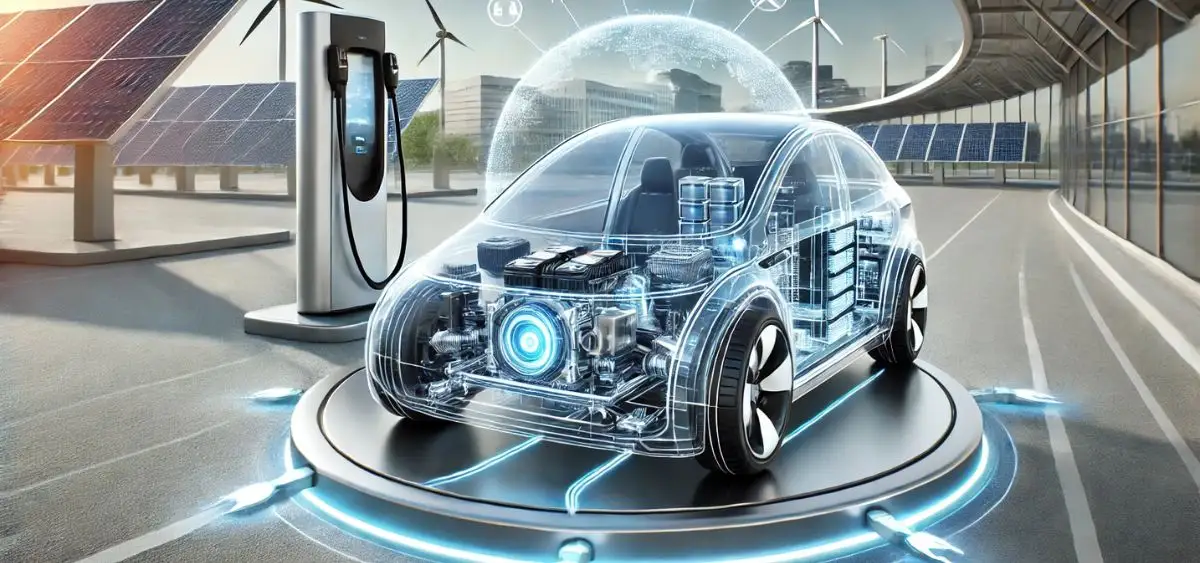

The working concept of EVs is straightforward: a battery supplies electrical energy, power electronics control its delivery, and an electric motor converts that energy into movement. During deceleration, the motor can recover some of the vehicle’s kinetic energy and return it to the battery.
Understanding this process helps explain everyday ownership questions: why highway driving reduces range, why fast charging slows near a full battery, and why an electric car can feel effortless in traffic.
Modern electric vehicle technology combines batteries, motors, software, and thermal management. The basic principle remains simple; the engineering determines how efficiently, safely, and consistently it works.
Key Takeaways
- Battery electric vehicles use electric motors for propulsion and have no petrol or diesel engine.
- Batteries store energy electrochemically and supply direct current, or DC.
- Most modern electric cars use an inverter to supply controlled AC power to their traction motors.
- Regenerative braking recovers some energy during slowing; it cannot recharge the vehicle indefinitely.
- AC charging uses the onboard charger, while DC fast charging bypasses its AC-to-DC conversion stage.
- Real-world range depends on usable battery capacity, speed, temperature, terrain, and driving conditions.
- Charging access and efficiency matter as much as headline battery size.
What Is an Electric Vehicle?
An electric vehicle uses an electric motor for some or all of its propulsion. The term includes battery electric vehicles, plug-in hybrids, and other electrified powertrains.
A battery electric vehicle, or BEV, runs entirely on electricity stored in its traction battery. It has no combustion engine, fuel tank, or exhaust system.
This article mainly explains BEVs—the technology behind fully electric cars, scooters, motorcycles, three-wheelers, and buses. Their layouts differ, but they share the principle of converting electrical energy into mechanical movement.
What Are the 5 Types of Electric Vehicles?
There is no universally fixed five-category classification. A useful consumer explanation includes four widely recognized categories and range-extended vehicles, which overlap with plug-in hybrids.
| Vehicle type | Main energy source | External charging | How it moves |
|---|---|---|---|
| Battery electric vehicle, BEV | Traction battery | Usually plug-in; some support swapping | The electric motor drives the wheels. |
| Hybrid electric vehicle, HEV | Fuel and a battery | Generally no | The engine and motor contribute according to the design. |
| Plug-in hybrid electric vehicle, PHEV | Fuel and a rechargeable battery | Yes. | Electric propulsion, engine propulsion, or both |
| Fuel-cell electric vehicle, FCEV | Hydrogen, with a supporting battery | Generally hydrogen refueling | A fuel cell generates electricity for an electric motor. |
| Range-extended electric vehicle, REEV/EREV | Battery and fuel-powered generator | Typically yes. | In a series layout, the motor drives the wheels, and the engine generates electricity. |
A hybrid’s motor is not necessarily limited to low-speed driving. Its contribution depends on the powertrain architecture and operating conditions.
What Are the Main Electric Vehicle Components?
An electric car needs more than a battery and motor. It also needs systems that control power, manage temperature, charge safely, and operate accessories.
| Component | Main function |
|---|---|
| Traction battery pack | Stores energy for propulsion and other electrical loads |
| Battery management system (BMS) | Monitors cells, estimates battery condition, and sets operating limits. |
| Inverter | Converts battery DC into controlled electrical output for the motor |
| Electric traction motor | Produces rotational force to drive the vehicle |
| Reduction gearbox and differential | Transfers motor rotation to the wheels. |
| Onboard charger | Converts incoming AC electricity into DC for battery charging |
| Charge port | Connects the vehicle to compatible charging equipment |
| DC/DC converter | Supplies lower-voltage electrical systems from the traction battery |
| Auxiliary battery | Supports control systems and low-voltage equipment |
| Thermal management system | Controls temperatures of batteries and other powertrain components |
| Vehicle control unit | Coordinates driver requests, propulsion, braking, and protection systems |
The inverter and DC/DC converter perform different jobs. The inverter supports propulsion; the DC/DC converter supplies lower-voltage equipment such as lighting and control electronics.
How Does the Working Concept of EVs Operate Step by Step?
1. The vehicle prepares its electrical systems.
Pressing the start button wakes the control systems. The vehicle checks relevant safety conditions before connecting the traction battery to the propulsion circuit through electrically controlled switches called contactors.
A “ready” indicator confirms that the vehicle can move. There may be little audible evidence because no engine needs to idle.
2. The accelerator requests torque.
The accelerator pedal sends an electronic request for turning force, or torque.
The control system considers that request alongside battery condition, motor temperature, wheel traction, and driving mode. It then commands the inverter to deliver suitable motor current.
Pressing the pedal does not simply open an unrestricted flow of battery power.
3. The inverter controls the motor’s electrical supply.
The inverter switches electrical current precisely to create the magnetic fields required by the motor.
For common AC traction motors, control involves current, voltage, frequency, and timing. Explaining vehicle speed purely as “changing AC frequency” leaves out much of the process.
4. The motor creates rotation.
Magnetic interaction between the stationary stator and rotating rotor produces torque.
The rotor turns a shaft, which transfers mechanical power through the drivetrain.
5. The drivetrain turns the wheels.
Most electric cars use a fixed reduction ratio and differential. The reduction gearing converts high motor speed into suitable wheel speed and torque.
Some EVs use multiple gears, while others have separate motors for different axles.
6. The vehicle continuously adjusts power delivery.
During driving, control systems balance acceleration, efficiency, traction, and component protection.
If the battery is too hot, too cold, or nearly empty, available power may be reduced. This protects the hardware and helps maintain safe operation.
How Does an EV Car Motor Work?
An electric motor moves electromagnetic forces. Current flowing through stator windings creates a controlled magnetic field. Its interaction with the rotor generates rotation. The rotor may contain permanent magnets or develop its magnetic field through induction or electrical excitation.
| Motor design | How rotor magnetism is produced | Key consideration |
|---|---|---|
| Permanent-magnet synchronous motor | Permanent magnets | High efficiency and power density; material sourcing matters. |
| Induction motor | Induced electrical currents | Avoids permanent rotor magnets; efficiency depends on operating conditions |
| Electrically excited synchronous motor | Electrical excitation | Offers controllable rotor magnetism with additional hardware |
Smaller electric vehicles may use brushless DC or other electronically controlled motor designs.
Why do EVs deliver instant torque?
Electric motors can generate substantial torque at very low rotational speeds. They do not need to build engine revs or wait for a conventional gearbox downshift.
However, acceleration still depends on tyre grip, gearing, battery output, and software limits. Maximum torque is not available without restriction at every speed.
Do EVs have a transmission?
Usually, yes—a simpler one.
Most use a single-speed reduction gearbox because electric motors operate across a broad speed range. They still need bearings, gearing and, in many layouts, a differential.
“Single-speed” does not mean “no drivetrain.”
What Is Energy in EVs? Understanding kW and kWh
Energy describes how much work the battery can supply. Power describes how quickly energy is delivered or received.
| Measurement | Meaning | Example |
|---|---|---|
| kWh | Stored or consumed energy | A battery with 50 kWh usable capacity |
| kW | Rate of energy transfer | A 100 kW motor or charging session |
| kWh/100 km | Energy consumption | 15 kWh used over 100 km |
| State of charge, SOC | Estimated charge remaining | Dashboard showing 60% |
| State of health, SOH | Estimated battery condition | Remaining capacity relative to its original condition |
An approximate range calculation is
Range = usable battery energy ÷ consumption per kilometer
| Illustrative calculation | Result |
|---|---|
| Usable battery energy | 50 kWh |
| Consumption | 15 kWh/100 km |
| Theoretical range | Approximately 333 km |
This is an example, not a model specification. Actual range changes with driving conditions, reserve margins, and battery condition.
Usable capacity is especially important: the full physical capacity of a pack may include buffers that drivers cannot access.
How Does Regenerative Braking Work?
When an EV slows using regenerative braking, the wheels drive the motor, and the motor operates as a generator.
It produces opposing torque, converting some kinetic energy into electrical energy that can return to the battery.
The motor does not need to reverse its physical rotation. The vehicle can continue moving forward while energy flows back towards the battery.
Why can’t regeneration replace charging?
Every energy conversion has losses. Aerodynamic drag and rolling resistance also consume energy that regeneration cannot recover.
Regenerative braking captures part of the energy that conventional friction brakes would otherwise dissipate as heat. It does not create new energy.
The uploaded Electric Vehicle Basics document describes this recovery process clearly, while its US-specific costs and range examples require separate context.
When is regeneration reduced?
Regeneration may be limited when:
- The battery is nearly full.
- Battery temperature is outside the preferred range.
- Traction conditions require intervention.
- Vehicle speed is very low.
- The driver selects a lower regeneration setting.
Friction brakes remain essential. One-pedal driving behavior varies between vehicles, including whether the car can stop completely. For efficiency, avoiding unnecessary acceleration and braking is generally better than accelerating hard and recovering only part of that energy.
How Do AC Charging and DC Fast Charging Work?
Both methods ultimately deliver DC electricity to the battery. The difference is where conversion happens.
AC charging
A home or workplace AC charging point supplies electricity through a controlled connection. The vehicle’s onboard charger converts that AC into DC.
Charging speed is constrained by the electrical supply, charging equipment, and onboard charger.
For example, connecting a car with a 7.2 kW AC limit to a 22 kW AC point will not make it charge at 22 kW.
DC fast charging
The charging station performs the main AC-to-DC conversion outside the car.
DC electricity enters through the compatible charging connection, bypassing the onboard charger’s AC conversion stage. Vehicle electronics and the BMS still control what the battery can accept.
| Charging method | Conversion location | Typical application | Important limitation |
|---|---|---|---|
| Portable AC charging | Inside the vehicle | Suitable domestic connection | Circuit capacity and vehicle limits |
| Dedicated AC charging | Inside the vehicle | Home, office or destination parking | Onboard charger rating |
| DC fast charging | Mainly inside the station | Highway stops and rapid top-ups | Battery acceptance and charger compatibility |
US “Level 1” and “Level 2” terminology should not be copied directly into an Indian guide without explaining the different supply context.
How long does charging take?
A useful starting formula is
Charging time ≈ energy added ÷ average charging power
| Illustrative scenario | Energy added | Average power | Approximate time |
|---|---|---|---|
| AC session | 30 kWh | 7 kW | 4.3 hours |
| DC session | 30 kWh | 50 kW | 36 minutes |
These simplified calculations exclude some losses and overheads. Actual charging power varies throughout a session.
Use average power, rather than the charger’s advertised peak, for realistic estimates.
Why does charging slow near 100%?
As charge rises, the system generally reduces current to keep cells within voltage and temperature limits.
Consequently, charging from 80% to 100% can take disproportionately longer than an earlier charging interval.
For road trips, compare verified charging curves and charging-window times rather than peak power alone.
How Do Batteries and Thermal Management Affect EV Performance?
Lithium-ion remains the central battery family in modern electric cars. LFP and NMC are two important chemistries within that family.
| Chemistry | General strengths | General trade-offs |
|---|---|---|
| Lithium iron phosphate, LFP | Good cycle durability and thermal stability; avoids nickel and cobalt in the cathode | Typically lower cell energy density; cold performance needs attention |
| Nickel manganese cobalt, NMC | Typically higher cell energy density | Durability, material costs, and thermal requirements vary by formulation. |
These are tendencies, not guarantees. Pack construction, cooling, software, and cell quality can be as consequential as chemistry.
What does the BMS do?
The battery management system monitors cell voltages and temperatures, estimates SOC and SOH, helps balance cells, and establishes charging and discharge limits.
The supplied 2022 review, Overview of Batteries and Battery Management for Electric Vehicles, explains why state estimation and temperature management are fundamental to battery performance. Its emerging-technology forecasts should be read as research outlooks rather than proof of current availability.
Why does cooling matter in India?
Hot ambient temperatures, sustained highway driving, and repeated fast charging can increase thermal demands.
Cooling helps maintain suitable operating temperatures, but it also consumes energy. Different vehicles use different approaches, so identical battery capacities do not guarantee identical performance in summer.
Follow the manufacturer’s charging recommendations. There is no single daily charge limit suitable for every battery and vehicle.
Which Technology Developments Matter in 2026?
The useful developments are those that improve everyday operation.
- Higher-voltage platforms: Some vehicles use 800-volt-class architectures. At a given power, higher voltage allows lower current, potentially reducing resistive losses. Fast-charging results still depend on the complete system.
- More efficient power electronics: Silicon-carbide components can improve conversion efficiency in suitable designs, particularly at higher voltages.
- Integrated drive units: Combining motors, inverters, and reduction gearing can reduce packaging requirements and mechanical complexity.
- Bidirectional charging: Supported vehicles may power appliances through vehicle-to-load, or V2L. Supplying a home or grid requires additional compatible equipment and appropriate arrangements.
- Battery swapping: Compatible vehicles exchange depleted packs for charged ones. This changes how energy is replenished, not how the motor propels the vehicle.
None of these features should be assumed across every EV. Confirm equipment and capability for the exact variant being considered.
Why Are EVs Important—and What Are Their Limitations?
Electric cars’ advantages and disadvantages become clearer when connected to how the technology works.
| Area | Potential advantage | Practical limitation |
|---|---|---|
| Energy conversion | Avoids the large combustion heat losses of an engine | Charging and drivetrain losses still occur. |
| Urban driving | Smooth response and energy recovery during slowing | Air conditioning and congestion still consume energy. |
| Maintenance | Fewer engine-related service items | Tyres, suspension, brakes, and other systems still need care. |
| Running costs | Home charging can be economical. | Frequent public fast charging can raise costs. |
| Local air quality | No combustion exhaust from a BEV | Tyre particles and upstream emissions remain. |
| Convenience | Charging while parked can save dedicated refueling trips | Requires dependable charging access |
| Long-distance travel | Suitable vehicles can cover substantial distances. | Stops depend on charger availability and charging performance. |
EVs are quieter, rather than completely silent. They also do not have inherently low top speeds; performance depends on vehicle design.
Environmental comparisons must consider electricity generation, manufacturing, and end-of-life treatment. Zero tailpipe emissions do not mean zero lifecycle emissions.
What Does an EV Cost to Run in India?
Electricity cost per kilometer depends on wall-energy consumption and the tariff paid.
The following figures are illustrative assumptions, not current tariff or fuel-price quotations.
| Input | Home-charged EV | Public-charged EV | Petrol car |
|---|---|---|---|
| Consumption or economy | 16 kWh/100 km | 16 kWh/100 km | 15 km/liter |
| Assumed energy price | ₹8/kWh | ₹20/kWh | ₹100/liter |
| Energy cost per km | ₹1.28 | ₹3.20 | ₹6.67 |
| Energy cost over 1,000 km | ₹1,280 | ₹3,200 | Approximately ₹6,667 |
The EV examples assume consumption measured at the electricity supply, including charging losses.
A complete ownership comparison should also include purchase price, finance, insurance, charger installation, maintenance, and resale value.
Battery replacement is a possible major expense, not an automatic scheduled event. Warranty duration, kilometre limits, capacity protection and transferability vary by manufacturer.
What Should Indian Buyers and Owners Check?
Charging access comes first.
Confirm parking rights, installation permissions, and an electrically suitable supply before relying on home charging.
For apartment residents, this can matter more than choosing between two battery sizes.
Plan around actual driving.
Assess your commute and recurring intercity routes. Check compatible chargers and keep a backup option.
Smaller towns and rural routes require individual assessment; national infrastructure growth does not guarantee coverage on your journey.
Understand weather and terrain
Highway speed increases aerodynamic demand. Hills require additional energy uphill, while downhill regeneration recovers only part of it.
Summer cooling, winter heating, passenger loads, and tyre pressure also affect consumption.
Keep conventional maintenance habits.
Check tyres, brakes, suspension, and any scheduled coolant requirements. Regeneration can reduce friction-brake wear, but it does not remove inspection needs.
Avoid floodwater and follow the vehicle’s stated water-related restrictions. Battery enclosure protection is not permission to drive through deep flooding.
Expert Insight from Electric Vehicle Talks
The most useful EV comparison asks how well the whole system serves the owner.
A large battery can provide more range but adds weight and cost. A high charging peak can look impressive while hiding a modest average. Strong regeneration helps in traffic but cannot compensate for inefficient high-speed driving.
For Indian buyers, prioritize dependable charging access, realistic route range, thermal performance, and local service support.
Future improvements in cells, power electronics, and charging can make ownership easier. The strongest purchase decision still comes from matching verified vehicle behavior to your daily needs.
People Also Ask
1. What is the basic working principle of EVs?
An EV uses electrical energy to produce motor torque. The drivetrain transfers that torque to the wheels, while control systems regulate propulsion and energy recovery.
2. Do electric cars use AC or DC?
The battery supplies DC. Most modern electric cars use inverters to supply controlled AC to their traction motors. AC charging is converted to DC before storage.
3. Can an EV recharge while driving?
Regeneration can recover energy during slowing or descending. It cannot replace external charging because the vehicle continually loses energy through resistance and conversion losses.
4. Why do most EVs have only one gear?
Electric motors operate effectively across a broad speed range, allowing most vehicles to use fixed reduction gearing. Some designs use multiple speeds.
5. What determines an electric car’s range?
Usable battery energy and consumption are the main factors. Speed, weather, terrain, loads, tyres and battery condition influence the result.
6. Are EVs completely emission-free?
BEVs produce no combustion tailpipe emissions. Manufacturing, electricity generation, and non-exhaust particles still contribute to their environmental footprint.
Working concept of EVs: FAQs
1. Does air conditioning reduce EV range?
Yes. It draws electrical energy from the battery. The effect varies with ambient temperature, cabin settings, journey length, and system efficiency.
2. Can an electric car be charged from a domestic socket?
Some support approved portable charging equipment. The socket, wiring, earthing, and circuit protection must be suitable for sustained charging loads.
3. Should I charge my EV to 100% daily?
Follow the manufacturer’s instructions for the particular battery. Some recommend lower routine limits; others specify periodic full charging, including for charge-estimation purposes.
4. Can the auxiliary battery stop an EV from starting?
Yes. A depleted low-voltage battery may prevent control systems and contactors from operating even when the traction battery has charge remaining.
5. Is regenerative braking useful on highways?
It helps when slowing or descending. During steady-speed cruising, there is little braking energy to recover.
6. Do electric scooters work like electric cars?
They share battery-powered electric propulsion. Motor placement, voltage, cooling, charging equipment, and regeneration capability vary considerably.
Final Verdict
The working concept of EVs connects battery energy, electronic control, motor torque, and wheel movement. Charging replenishes that energy; regeneration recovers a portion during deceleration.
For buyers, understanding the system helps separate useful capability from headline specifications. For owners, it supports better charging decisions, realistic range expectations, and efficient driving.
The next stage of electric mobility will depend on reliable batteries, effective thermal management, and accessible charging as much as outright performance.
Explore more technology explainers, buying guides, charging resources, and ownership insights at Electric Vehicle Talks.

Related Articles: