
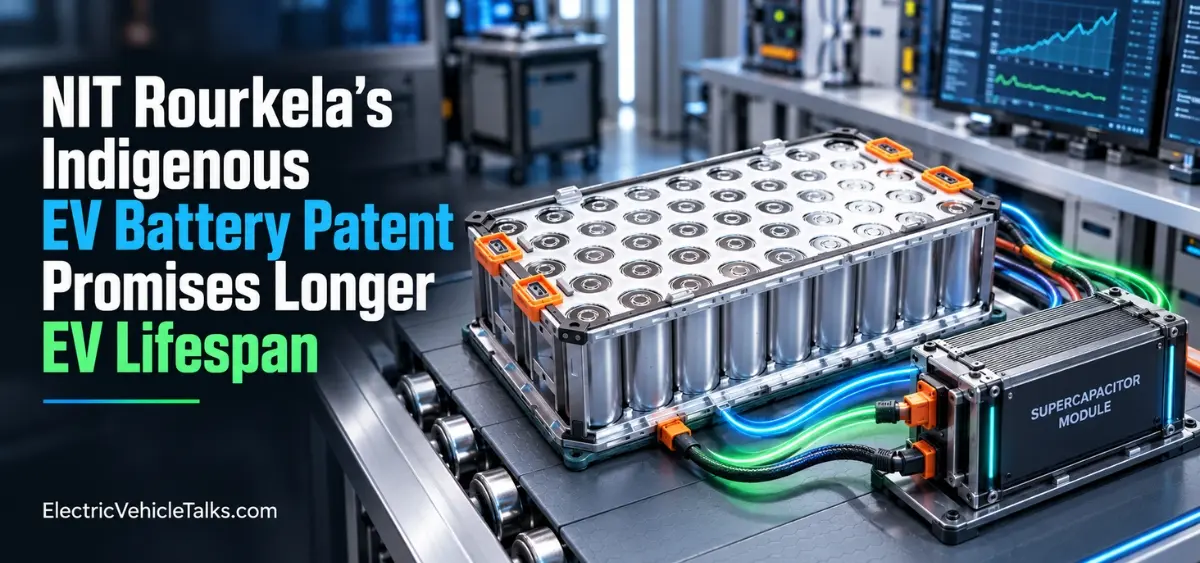

India’s electric-vehicle ambitions are entering a new phase. Beyond manufacturing more EVs, researchers are now focusing on technologies that can extract greater performance, durability, and service life from every battery pack. Researchers at the National Institute of Technology Rourkela have developed and patented an indigenous Hybrid Energy Storage System designed for low-voltage electric vehicles. The NIT Rourkela EV Battery architecture combines a conventional battery with a supercapacitor to manage sudden power demands, reduce current stress, and potentially extend battery life.
The research was led by Prof. Monalisa Pattnaik from the Department of Electrical Engineering, along with Dr. Pradyumna Kumar Behera and Karan Gupta. Developed for platforms operating between 24V and 60V DC, the system could support electric scooters, motorcycles, e-rickshaws, cargo vehicles, and industrial mobility applications.
Why Sudden Power Demand Damages EV Batteries
An electric-vehicle battery pack contains multiple cells working together to store and deliver energy. Although batteries can hold substantial amounts of energy, repeated high-current charging and discharging can accelerate degradation.
Sudden acceleration requires the battery to supply a sharp burst of power. During regenerative braking, electricity flows back into the energy-storage system. Frequent acceleration, braking, and stop-and-go operation can therefore expose battery cells to recurring electrical and thermal stress.
This problem is particularly relevant to urban EVs, which operate in congested traffic and experience constant changes in speed. Over time, these demanding conditions may affect battery capacity, performance, and useful operating life.
Reducing such stress could help manufacturers improve battery reliability without necessarily increasing pack capacity or adopting a completely different battery chemistry.
How the Hybrid Energy Storage System Works
The patented system pairs a conventional battery pack with a supercapacitor. Each device performs a different function.
The battery remains the primary source of stored energy, while the supercapacitor handles short, high-power events. Unlike batteries, which store energy through chemical reactions, supercapacitors store it electrostatically. This allows them to charge and discharge rapidly while tolerating a very high number of operating cycles.
During sudden acceleration, the supercapacitor can supply part of the immediate power requirement. During regenerative braking, it can quickly absorb incoming energy. Consequently, the battery is protected from some of the sharp current fluctuations that contribute to stress and degradation.
The approach does not replace the EV battery. Instead, it creates a supporting energy buffer that allows the battery to operate under comparatively stable conditions.
A Simplified Three-Component Architecture
A notable feature of the NIT Rourkela EV Battery system is its relatively simple power-electronics architecture. It comprises three principal components:
1. One power converter
A single converter connects the battery and supercapacitor to the vehicle’s electrical system. Using one converter for both storage devices can reduce the number of switches and control components required, potentially lowering hardware complexity.
2. One inductor
An inductor positioned in the electrical path helps regulate sudden changes in current. It smooths power flow and assists in protecting the battery from abrupt electrical surges.
3. An integrated control system
The control system continuously manages how energy moves between the battery, supercapacitor, and vehicle.
When the driver accelerates and the motor needs an immediate power boost, the system directs a greater share of the high-rate demand to the supercapacitor. During deceleration or regenerative braking, the supercapacitor can rapidly capture energy returning from the motor.
This coordinated power management allows the battery to deliver energy more steadily, reducing its exposure to demanding transient loads.
Designed for Low-Voltage Electric Mobility
The technology has been developed specifically for EV platforms operating in the 24V–60V DC range. It is therefore aimed primarily at light electric mobility and industrial utility vehicles rather than high-voltage passenger cars.
Potential road-vehicle applications include:
- Electric scooters and motorcycles
- E-rickshaws
- Electric cargo tricycles
- Small campus mobility vehicles
- Light urban delivery vehicles
These vehicle categories often operate in stop-start conditions, making them suitable candidates for a system designed to manage frequent power fluctuations.
The researchers have also identified several applications beyond conventional road transportation, including automated guided vehicles, warehouse utility carts, DC microgrids, and renewable-energy-powered charging stations.
Could It Reduce EV Ownership Costs?
Battery replacement is one of the most significant long-term expenses associated with electric mobility. Technologies that reduce battery stress could potentially improve durability and lower lifecycle costs for individual owners and commercial fleets.
The NIT Rourkela EV Battery technology aims to achieve this by assigning short-duration power spikes to the supercapacitor. If validated through extended real-world use and adopted commercially, this approach could help batteries maintain more consistent performance over a longer period.
The possible benefits are particularly relevant to e-rickshaw drivers, last-mile delivery operators, and electric two-wheeler fleets. These vehicles may cover long distances every day and experience frequent acceleration and braking, increasing the importance of battery longevity and dependable performance.
Actual gains in battery life, operating efficiency, and ownership costs, however, will depend on factors such as vehicle design, battery chemistry, control calibration, operating conditions, and the cost of integrating the additional components.
Battery-Supercapacitor Systems Are Not Entirely New
The broader concept of combining batteries and supercapacitors has been studied internationally for several years. Researchers in Japan, Europe, and the United States have explored hybrid systems that balance the battery’s energy-storage capability with the supercapacitor’s rapid power response.
Supercapacitors have also appeared in performance vehicles. The Lamborghini Sián FKP 37, for example, uses supercapacitor technology to capture braking energy and quickly supply additional power.
The importance of the NIT Rourkela research lies in adapting the concept to lower-voltage mobility through a single-converter design. Its focus on limiting the number of switches and control components could offer a practical balance among efficiency, hardware requirements, and system complexity.
Patent Secured, Commercialization Is the Next Step
The research team has secured a patent for its hybrid energy-storage architecture and is reportedly seeking collaboration with EV manufacturers, powertrain integrators and retrofit startups.
Commercial deployment will be the technology’s critical next test. Laboratory performance must be supported by extensive validation under real-world conditions, including different temperatures, payloads, traffic patterns, charging cycles, and vehicle duty requirements.
Manufacturers will also need to evaluate integration costs, packaging requirements, safety, weight, serviceability, and compatibility with existing battery-management systems.
If these challenges are addressed successfully, the technology could help improve battery utilization and vehicle reliability without requiring an entirely new energy-storage platform.
Why This Indigenous Innovation Matters
India’s EV market is expanding rapidly, but sustainable growth will depend on more than vehicle sales. Battery durability, lifecycle economics, power-management efficiency, and long-term reliability will become increasingly important as electric two-wheelers, three-wheelers, and commercial fleets scale up.
Indigenous research can help develop systems specifically suited to Indian driving conditions, vehicle categories, and price requirements. Solutions designed around low-voltage platforms are especially relevant because electric scooters, motorcycles, and three-wheelers account for a substantial part of the country’s electric-mobility landscape.
The NIT Rourkela EV Battery architecture represents a promising Indian effort to manage battery stress through smarter energy distribution. Its long-term impact will depend on successful testing and industrial adoption, but the patented system highlights how domestic engineering could make electric mobility more durable, efficient, and technologically self-reliant.

Related Articles:









