
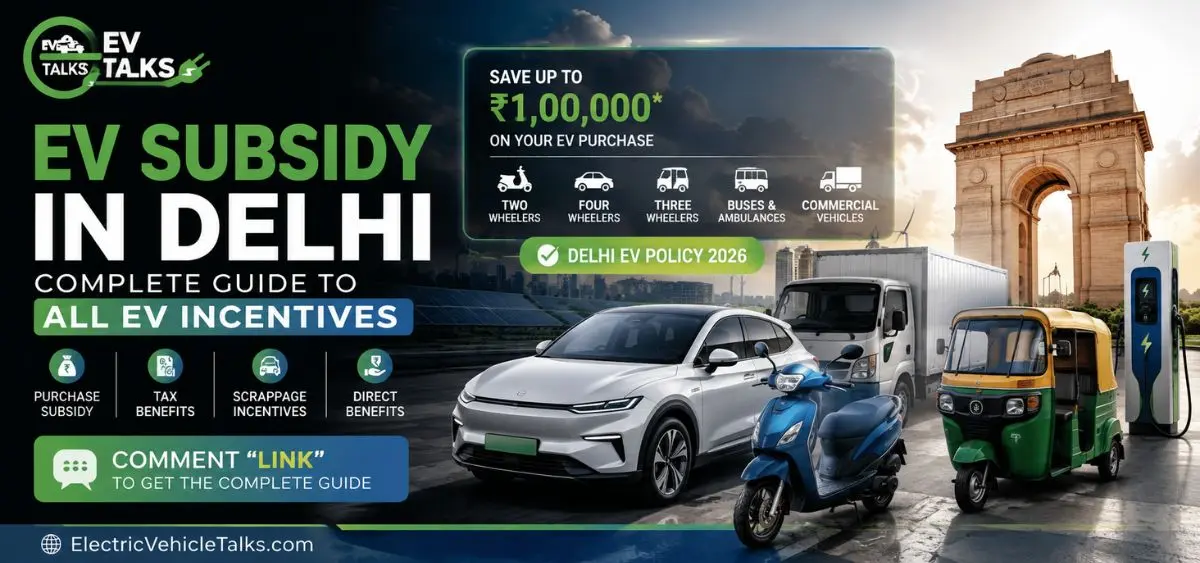

The EV Subsidy in Delhi is among India’s most comprehensive state-level electric mobility incentive programs. Under the Delhi EV Policy 2026, buyers can receive purchase subsidies, road tax and registration fee waivers, scrappage incentives, and benefits for commercial electric vehicles, making the switch to electric transportation significantly more affordable.
Whether you’re planning to buy an electric scooter, an electric car, an e-auto, or an electric commercial vehicle, understanding the available incentives can help you save thousands of rupees while contributing to cleaner air and sustainable mobility.
Why the Delhi EV Policy Matters
Delhi has consistently battled severe air pollution, with road transport being one of the largest contributors to harmful emissions. To accelerate the transition towards cleaner transportation, the Delhi Government introduced an ambitious EV roadmap focused on increasing EV adoption through financial incentives, regulatory reforms, and charging infrastructure expansion.
The latest policy doesn’t simply reduce the purchase price of electric vehicles—it also aims to create an ecosystem where EV ownership becomes easier, more economical, and practical for everyday commuters and businesses.
Delhi EV Policy 2026 at a Glance
| Vehicle Category | Maximum Benefit |
|---|---|
| Electric Two-Wheelers | Up to ₹30,000 purchase subsidy |
| Electric Cars | ₹1 lakh scrappage incentive |
| Electric Auto Rickshaws | Up to ₹50,000 |
| Electric Goods Vehicles (N1) | Up to ₹1 lakh |
| Road Tax | 100% Waiver |
| Registration Charges | 100% Waiver |
| Validity | Up to March 31, 2030 (eligible categories) |
Benefits vary depending on eligibility, vehicle category, and applicable policy conditions.
What Subsidy is Available for Electric Scooters in Delhi?
Electric scooters remain the biggest beneficiaries under the Delhi EV Policy because two-wheelers represent a large share of the city’s vehicle population.
Purchase Subsidy
Eligible buyers receive:
- ₹10,000 per kWh battery capacity
- Maximum subsidy: ₹30,000
- Applicable for eligible models within the prescribed ex-factory price cap
- Higher benefits are available in the first year, with subsidies reducing in subsequent years.
Example
A scooter with a 3.5 kWh battery purchased during the first year of the policy can qualify for the maximum subsidy cap of ₹30,000.
Additional Scrappage Incentive
If you replace a Delhi-registered BS-IV or older petrol scooter or motorcycle with a new electric scooter, you can receive an additional
₹10,000 Scrappage Incentive
Combined Savings for Electric Scooter Buyers
Delhi scooter buyers may benefit from:
| Benefit | Amount |
|---|---|
| Delhi Purchase Subsidy | Up to ₹30,000 |
| Scrappage Incentive | ₹10,000 |
| PM E-DRIVE Incentive | Up to ₹5,000 |
| Road Tax Waiver | Yes |
| Registration Fee Waiver | Yes |
Potential savings can exceed ₹45,000, excluding tax and registration fee waivers.
EV Subsidy for Electric Cars in Delhi
Unlike electric scooters, private electric cars generally do not receive a direct purchase subsidy.
Instead, Delhi encourages owners to replace older, polluting vehicles with electric cars through a generous scrappage incentive.
a) Scrappage Incentive
Eligible buyers can receive:
- Up to ₹100,000
- Applicable on EVs priced below ₹30 lakh
- Old vehicle must be Delhi-registered BS-IV or older
- A new EV must be purchased within six months of receiving the Certificate of Deposit (CoD)
- Limited to the first eligible applicants as specified under the policy.
How to Apply for the Delhi EV Scrappage Incentive
Eligible applicants seeking the scrappage incentive should:
- Select Apply Scrapping Incentive on the subsidy portal.
- Upload the official Scrapping Certificate.
- Enter the Certificate of Deposit (CoD) Number.
- Submit the application for verification.
b) Road Tax & Registration Benefits
Buyers of eligible battery electric cars also receive:
- 100% Road Tax Waiver
- 100% Registration Fee Waiver
- Valid until March 31, 2030, for qualifying vehicles.
Commercial EV Subsidies in Delhi
Commercial transportation plays a vital role in reducing urban emissions.
Delhi therefore provides significant support for commercial electric vehicles.
Electric Auto Rickshaws
Drivers purchasing electric auto-rickshaws can receive the following:
- Purchase incentive up to ₹50,000
- Additional scrappage benefits in eligible cases.
Electric Goods Carriers
N1 category electric goods carriers receive the following:
- Purchase incentive up to ₹1 lakh
- Additional scrappage incentives
- Long-term policy support for fleet electrification.
These incentives are expected to significantly reduce fleet operating costs for logistics companies and small businesses.
Subsidy for Electric Buses and Ambulances
The Delhi Government is also electrifying public transportation and emergency services.
Electric Buses
Key initiatives include:
- All new DTC intra-city buses to be electric
- Progressive electrification of school buses
- Expansion of public electric bus fleets.
Electric Ambulances
The policy also prioritizes the electrification of ambulance fleets through institutional support and healthcare fleet guidelines, encouraging cleaner emergency transportation.
How to Claim EV Subsidy in Delhi
- Visit the Delhi EV Subsidy Portal
- Click Apply for Subsidy.
- Enter the vehicle registration number and the last five digits of the chassis number.
- Verify using the OTP sent to your registered mobile number.
- Complete Aadhaar verification.
- Verify the vehicle details.
- Upload the required documents (PDF format only).
- Confirm the application.
- Note the generated application number for future reference.
Documents Required
Keep these documents ready:
- Aadhaar Card
- Delhi Registration Certificate (RC)
- Purchase Invoice
- Bank Account Details
- Cancelled Check/Passbook
- Certificate of Deposit (for scrappage claims)
- Valid mobile number linked to Aadhaar.
Important Document Upload Guidelines
While uploading documents on the Delhi EV Subsidy Portal:
- Upload documents in PDF format only.
- Include both the front and back sides of each document where applicable.
- Ensure each uploaded file is 300 KB or smaller.
- Verify that all uploaded documents are clearly readable before submission.
APPLICATION FOR OEM REGISTRATION UNDER DELHI ELECTRIC VEHICLE
POLICY, 2026
How to Check Delhi EV Subsidy Status Online
Once you have successfully submitted your EV subsidy application, you can easily track its progress through the official Delhi EV Subsidy Portal. The portal allows applicants to monitor their application in real time without visiting any government office. The online tracking system improves transparency and helps applicants stay informed about the status of their subsidy claim. The Delhi government launched the portal to enable online applications, document uploads, and real-time status tracking for eligible EV buyers.
Source: Delhi EV subsidy portal
Steps to Check Delhi EV Subsidy Status Online
- Visit the official Delhi EV Subsidy Portal.
- Open the Application Status section.
- Enter your Vehicle Registration Number.
- Click on Submit or Search.
- The portal will display the latest status of your subsidy application.
Possible Application Status Messages
While checking your application, you may see one of the following statuses:
| Application Status | Meaning |
|---|---|
| Application Submitted | Your application has been successfully submitted. |
| Under Verification | Your Aadhaar, vehicle, and uploaded documents are being verified. |
| Documents Pending | Additional documents or corrections may be required. |
| Approved | Your subsidy claim has been approved. |
| DBT Initiated | The subsidy has been processed for Direct Benefit Transfer (DBT). |
| Subsidy Credited | The subsidy amount has been credited to your registered bank account. |
| Rejected | Your application was rejected due to ineligibility or incomplete documentation. |
Tips for Faster Processing
- Keep your Application Number safe after submission for future reference.
- Ensure your Aadhaar is correctly verified and linked where required.
- Upload clear PDF documents that meet the prescribed file size and format requirements.
- Double-check your bank account details to avoid delays in Direct Benefit Transfer (DBT).
What If Your Subsidy Status Is Not Updated?
If your application status has not changed for an extended period:
- Verify that all required documents were uploaded correctly.
- Recheck your vehicle registration details.
- Keep your application number handy when contacting the Transport Department.
- Monitor the portal periodically for status updates, as verification and DBT processing may take time depending on application volume. Recent updates indicate the government is processing claims through an upgraded portal with Aadhaar-based DBT to improve transparency and speed.
Delhi EV Subsidy Portal
Replace the existing text with something like:
The official Delhi EV Subsidy Portal. Eligible applicants can use the portal to apply for subsidies, complete Aadhaar verification, upload documents, apply for scrappage incentives, and track the status of their applications.
Ownership Tips Before Buying an EV in Delhi
- Compare the total ownership cost instead of only the purchase price.
- Install a home charger if you have dedicated parking.
- Choose a battery size that matches your daily driving needs.
- Verify warranty coverage for the battery and motor.
- Retain every purchase document to simplify future subsidy claims.
- If replacing an older vehicle, complete the scrappage process within the prescribed timeline to remain eligible for incentives.
What Are the Benefits of the EV Subsidy in Delhi?
Delhi’s EV incentives go far beyond reducing the upfront purchase price. They are designed to make electric mobility more affordable, reduce pollution, lower operating costs, and encourage long-term adoption.
1. Lower Initial Purchase Cost
The biggest advantage is the reduction in the effective purchase price. Buyers of eligible electric scooters can receive substantial purchase incentives, while electric car buyers can benefit from scrappage incentives and tax exemptions.
2. Massive Savings on Running Costs
Compared to petrol or diesel vehicles, EVs offer significantly lower operating expenses.
| Vehicle Type | Average Running Cost |
|---|---|
| Petrol Scooter | ₹2.2–₹3.5/km |
| Electric Scooter | ₹0.20–₹0.50/km |
| Petrol Car | ₹7–₹10/km |
| Electric Car | ₹1–₹2/km |
For commuters covering 1,500–2,000 km every month, these savings can amount to tens of thousands of rupees annually.
3. Zero Road Tax and Registration Charges
Another major financial advantage is the complete waiver of road tax and registration fees for eligible electric vehicles, reducing on-road costs considerably.
4. Better Air Quality
Delhi frequently records some of the highest pollution levels in India. Every electric vehicle replacing an internal combustion engine (ICE) vehicle contributes to:
- Lower tailpipe emissions
- Reduced particulate matter
- Improved urban air quality
- Reduced dependence on fossil fuels
5. Encourages Early EV Adoption
The policy is structured so that incentives reduce over time. This encourages consumers and businesses to adopt EVs sooner rather than later.
Challenges Buyers Should Know
While the policy is generous, prospective buyers should also be aware of practical challenges.
Charging Availability
Although Delhi’s charging network is expanding rapidly, home charging remains the most convenient solution for most private owners.
Documentation
Incomplete paperwork can delay subsidy processing.
Policy Updates
Government schemes evolve. Buyers should always verify the latest eligibility criteria before making a purchase.
Vehicle Eligibility
Not every EV qualifies for every incentive. Purchase price, vehicle category, battery specifications, and registration conditions may affect eligibility.
Common Mistakes That Can Delay Subsidy Approval
Many subsidy applications face delays because of avoidable mistakes.
Avoid these common errors:
- Registering the vehicle outside Delhi
- Missing Aadhaar verification
- Incorrect bank details
- Losing the purchase invoice
- Delaying the scrappage process beyond the permitted period
- Purchasing a vehicle that does not meet policy requirements
Maintaining complete documentation from the day of purchase can save considerable time later.
Buying Guide: Which EV Should You Choose?
Your ideal EV depends on your daily driving needs.
| User Type | Recommended EV |
|---|---|
| College Students | Electric Scooter |
| Daily Office Commuters | Premium Electric Scooter |
| Families | Electric SUV or Sedan |
| Taxi Operators | Electric Sedan |
| Delivery Fleets | Electric Cargo Vehicle |
| Auto Drivers | Electric Auto Rickshaw |
| Businesses | Electric Goods Carrier |
Rather than focusing only on the purchase price, compare the Total Cost of Ownership (TCO), including electricity, maintenance, insurance, battery warranty, and resale value.
Charging Infrastructure in Delhi
Delhi is steadily building one of India’s strongest urban charging ecosystems.
The policy supports:
- Expansion of public charging stations
- Battery swapping infrastructure
- Charging facilities at OEM dealerships
- Single-window approvals for charging operators
- Dedicated digital platforms for charger deployment
This growing network is expected to reduce range anxiety and improve confidence among first-time EV buyers. Government Subsidy for EV Charging Station
Government Incentives Beyond Purchase Subsidies
Apart from direct financial assistance, the Delhi Government is encouraging EV adoption through:
- Fleet electrification
- Public transport electrification
- Commercial vehicle transition
- Battery recycling initiatives
- Producer responsibility programs
- Charging infrastructure investment
Together, these measures strengthen the long-term EV ecosystem.
Industry Trends: Why Delhi Is Leading India’s EV Revolution
Delhi has become one of India’s fastest-growing EV markets because of a combination of the following:
- Strong state incentives
- Rising fuel prices
- Better charging infrastructure
- Improved battery technology
- Increasing availability of affordable EV models
- Growing consumer awareness
Across India, EV adoption continues to accelerate as manufacturers launch vehicles with longer range, faster charging, and enhanced safety features.
Sustainability Impact
Electric mobility is about more than saving money—it is also about building cleaner cities.
Widespread EV adoption can help:
- Reduce greenhouse gas emissions
- Lower urban noise pollution
- Improve public health
- Decrease oil imports
- Support India’s clean energy and net-zero ambitions
As renewable energy becomes a larger part of the electricity mix, the environmental benefits of EVs will continue to grow.
Expert Insight from Electric Vehicle Talks
From our analysis at Electric Vehicle Talks, the Delhi EV Policy 2026 is one of India’s strongest state-level initiatives for accelerating electric mobility. Rather than relying solely on purchase subsidies, it combines tax exemptions, scrappage incentives, charging infrastructure expansion, and fleet electrification into a comprehensive strategy.
For individual buyers, timing is crucial. Since purchase incentives for electric two-wheelers taper over the policy period, early adopters are positioned to maximize savings. Commercial operators, meanwhile, can benefit from lower operating costs, reduced maintenance, and policy-backed incentives that improve fleet economics.
As more manufacturers introduce advanced electric scooters, passenger cars, and commercial EVs, Delhi’s integrated approach could serve as a model for other states aiming to reduce emissions and encourage sustainable transportation.
For more expert buying guides, policy updates, and EV ownership resources, visit Electric Vehicle Talks.
People Also Ask
1. What is the maximum EV subsidy in Delhi for electric scooters?
Eligible buyers can receive up to ₹30,000 as a state purchase subsidy, with additional benefits such as a scrappage incentive and applicable central incentives, subject to eligibility.
2. Is there a subsidy for electric cars in Delhi?
Yes. Instead of a direct purchase subsidy, eligible buyers can receive a scrappage incentive of up to ₹1 lakh when replacing an older Delhi-registered vehicle with a qualifying electric car.
3. How can I apply for the EV subsidy in Delhi?
Eligible buyers can apply through the official Delhi EV subsidy process after purchasing and registering an eligible vehicle once the Transport Department opens the application portal.
4. Are road tax and registration fees waived for EVs?
Yes. Eligible electric vehicles receive a 100% waiver on road tax and registration fees until the applicable policy deadline.
5. Do commercial electric vehicles receive subsidies?
Yes. Electric auto-rickshaws and eligible electric goods carriers qualify for purchase incentives and, in certain cases, additional scrappage benefits.
6. Is Delhi expanding EV charging infrastructure?
Yes. The policy includes support for public charging stations, battery swapping, charging facilities at dealerships, and a dedicated digital platform for charger deployment.
7. Why should I buy an EV now instead of waiting?
Current policy provisions offer higher incentives in the early years, and certain benefits reduce over time, making earlier adoption financially more attractive.
EV Subsidy in Delhi FAQs
1. What is the EV Subsidy in Delhi for 2026?
The Delhi EV Policy 2026 provides incentives for eligible electric two-wheelers, electric auto-rickshaws, commercial EVs, and scrappage benefits for qualifying electric cars, along with road tax and registration fee waivers.
2. Can I combine the Delhi EV subsidy with central government incentives?
Where applicable and permitted under prevailing guidelines, eligible buyers may benefit from both state and central incentives. Buyers should verify the latest scheme conditions before purchase.
3. How do I check my Delhi EV subsidy status online?
Once the official subsidy portal is operational, applicants can track their application status using the designated online platform and reference details.
4. Is there an income limit for claiming the subsidy?
Eligibility is generally determined by vehicle category and policy conditions rather than income. Always review the latest official guidelines.
5. Which electric scooters qualify for the Delhi subsidy?
Eligible models that meet the prescribed ex-factory price and policy requirements can qualify for the purchase subsidy.
6. Does the subsidy apply to second-hand EVs?
The policy primarily targets new eligible electric vehicles. Buyers should verify whether any future amendments include used EVs.
7. How long does it take to receive the subsidy?
State subsidies are generally disbursed through Direct Benefit Transfer (DBT) after successful verification and approval, subject to the notified process.
8. Where can I learn more about EV ownership and policy updates?
For in-depth buying guides, charging resources, ownership tips, and the latest EV news, explore Electric Vehicle Talks.
Conclusion
The EV Subsidy in Delhi represents a major step toward making electric mobility more affordable, practical, and sustainable. By combining purchase incentives, scrappage rewards, tax exemptions, and investments in charging infrastructure, the Delhi Government has created one of India’s most progressive EV ecosystems.
Whether you’re considering an electric scooter for daily commuting, an electric car for your family, or a commercial EV for your business, understanding the available incentives can significantly reduce your total ownership cost while supporting cleaner urban transportation.
As EV technology continues to evolve and charging infrastructure expands, Delhi is well-positioned to remain at the forefront of India’s electric mobility transition. Staying informed about policy updates and choosing the right vehicle at the right time can help you maximize both financial savings and long-term ownership benefits.
If you’re looking for more expert EV news, buying advice, charging guides, and industry insights, keep exploring Electric Vehicle Talks—your trusted resource for everything electric mobility.

Related Articles:
| EV Subsidy in Maharashtra: Benefits, Eligibility & How to Apply | |
| Government Subsidy for EV Charging Station in India: Complete PM E-DRIVE Guide | PM E-DRIVE Scheme: Driving Towards a Greener Future |









