
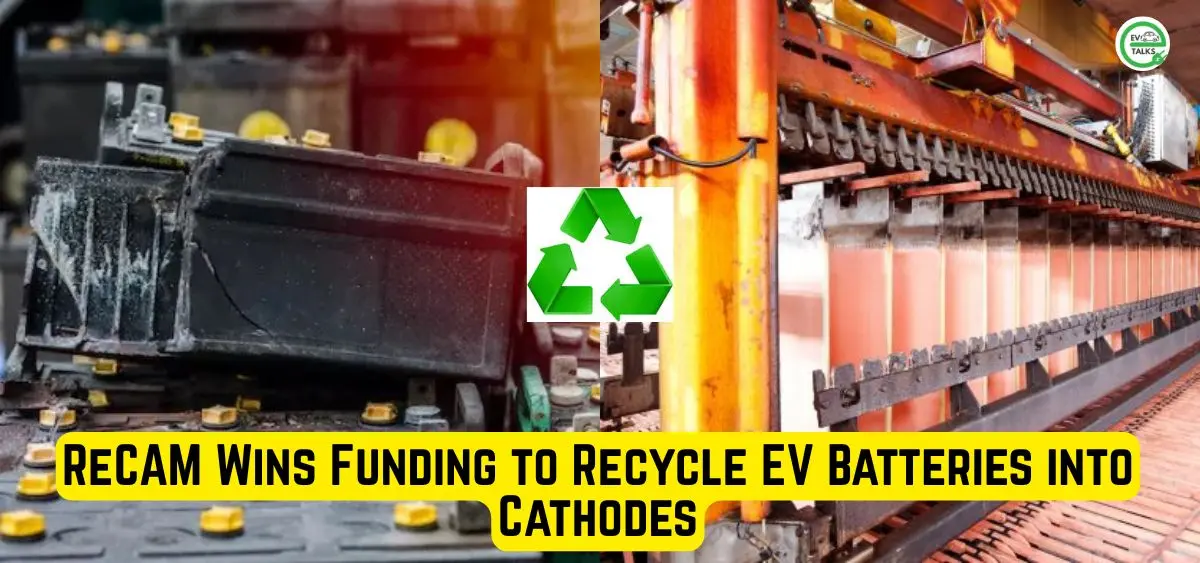

The UK is taking a major step toward building a sustainable electric vehicle ecosystem as ReCAM Wins Funding to Recycle EV Batteries, aiming to transform battery waste into valuable materials. The Recycling of Cathode Active Materials (ReCAM) project has secured support under the government’s £452 million Battery Innovation Programme, a key initiative driving innovation between 2026 and 2030.
Tackling the Growing EV Battery Waste Challenge
With electric vehicle adoption accelerating, the UK faces a looming waste challenge. By 2040, the country is expected to generate up to 94,000 tonnes of lithium-ion battery “black mass” annually. This material, rich in lithium, nickel, cobalt, and manganese, is currently exported due to the lack of domestic processing infrastructure—leading to economic losses and increased emissions.

This is where ReCAM Wins Funding to Recycle EV Batteries becomes a critical milestone. The project aims to create a fully domestic supply chain for recycling and reusing battery materials, strengthening the UK’s industrial independence.
Breakthrough Single-Step Recycling Technology
At the heart of ReCAM is a patented “short-loop” refining process developed by Watercycle Technologies. Unlike traditional multi-stage chemical methods, this innovative system converts black mass directly into high-value Cathode Active Material (CAM) in a single step.
The technology is designed as a modular, zero-waste system capable of processing 250 kg of battery material per hour. It also ensures efficient lithium recovery, making it both environmentally and economically viable. This breakthrough underscores why ReCAM Wins Funding to Recycle EV Batteries is gaining industry attention.
Strong Consortium Driving Innovation
The project is powered by a four-organisation UK consortium:
- Watercycle Technologies—Leads the project and developed the core technology
- UK Battery Industrialisation Centre – Provides large-scale testing and validation
- Recyclus Group – Hosts the pilot system in Wolverhampton
- Polaron – Uses AI to optimise material performance
Polaron’s AI-driven platform will play a key role in linking processing conditions to battery performance, ensuring recycled materials meet industry standards.
Boosting the UK’s Industrial Resilience
Beyond sustainability, the initiative is a strategic move to enhance supply chain resilience. By processing battery waste domestically, the UK can reduce reliance on overseas facilities, cut carbon emissions, and unlock significant economic value.
Industry leaders highlight that ReCAM Wins Funding to Recycle EV Batteries not only addresses waste but also accelerates the transition to a circular battery economy—where materials are continuously reused in new batteries.
A Step Toward a Circular EV Economy
As the demand for EVs continues to rise, projects like ReCAM are essential for ensuring long-term sustainability. By turning waste into opportunity, ReCAM Wins Funding to Recycle EV Batteries positions the UK as a leader in next-generation battery recycling and innovation.

Related Articles:









