
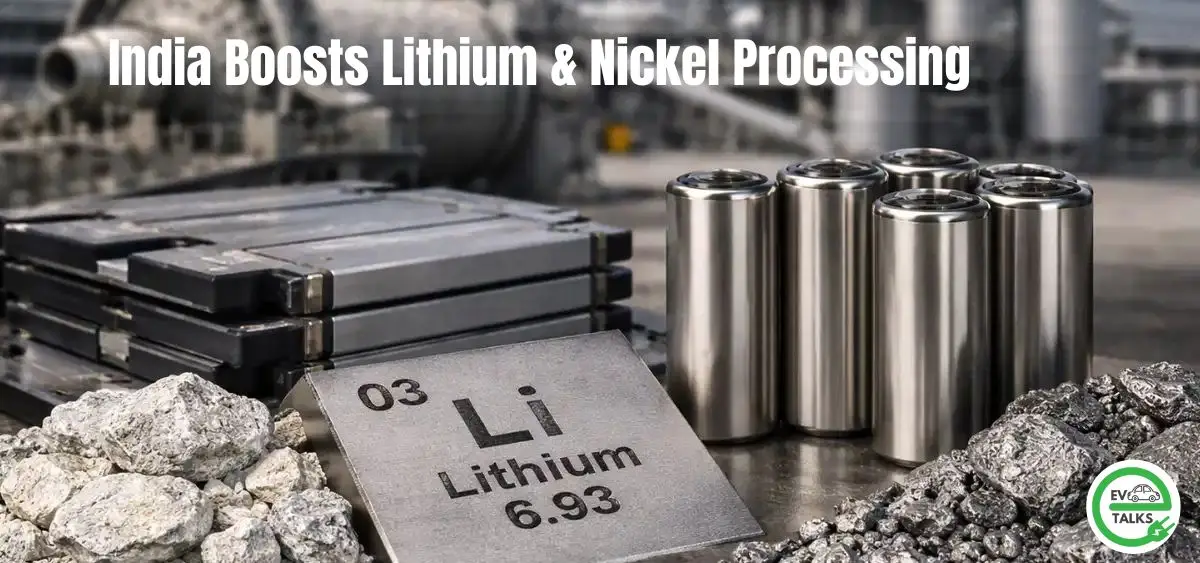

India is taking a decisive step toward securing its clean energy future as it boosts domestic lithium and nickel processing capacity—two minerals critical for electric vehicle (EV) batteries and renewable energy storage. This strategic move aligns strongly with India’s Environmental, Social, and Governance (ESG) goals while reducing dependence on imports.
Why Lithium and Nickel Matter for India?
Lithium and nickel are essential components of Advanced Chemistry Cells (ACC) used in EVs and energy storage systems. Despite rising EV demand, India currently has no large-scale processing capacity for these minerals and relies heavily on imports, particularly from China. By localizing processing, India Boosts Lithium & Nickel Processing to strengthen supply chain security and support its 2030 EV adoption targets.

Incentive Scheme: What’s Being Planned
The government plans to roll out a structured incentive framework starting April 1, 2026, offering strong financial support to companies setting up processing plants.
Key features include:
- 15% capital subsidy for eligible lithium and nickel processing projects
- Incentives available for five years, capped based on annual sales
- Subsidy limits:
- Lithium: up to 40% of annual net sales
- Nickel: up to 25% of annual net sales
- Minimum capacity requirements:
- Lithium plants: 30,000 metric tons
- Nickel plants: 50,000 metric tons
Disbursement will be performance-linked, released in stages based on minimum plant utilisation benchmarks set by the Ministry of Mines. Initially, the government plans to approve two lithium and two nickel projects to meet projected demand by 2030.
Strategic and ESG Significance
This initiative directly supports India’s ESG roadmap. By reducing import dependence and geopolitical risk, India Boosts Lithium & Nickel Processing to ensure long-term mineral security. It also accelerates EV adoption, with India targeting 30% electric car penetration by 2030.
The scheme is expected to integrate with circular economy initiatives, including urban mining and recycling of e-waste and used batteries, enabling the recovery of valuable metals and lowering environmental impact.
Role of the National Critical Mineral Mission
The incentives complement the ₹16,300 crore National Critical Mineral Mission (NCMM), which oversees the entire value chain—from mineral exploration to processing and recycling. Together, these efforts position India as a self-reliant hub for clean energy materials.
What Lies Ahead?
Looking forward, policy experts expect the Union Budget 2026 to further prioritize battery recycling and advanced material recovery as core industrial infrastructure. Alongside plans to begin green ammonia exports by 2028–29, India Boosts Lithium & Nickel Processing as part of its broader ambition to lead global clean energy markets.

Related Articles:-







