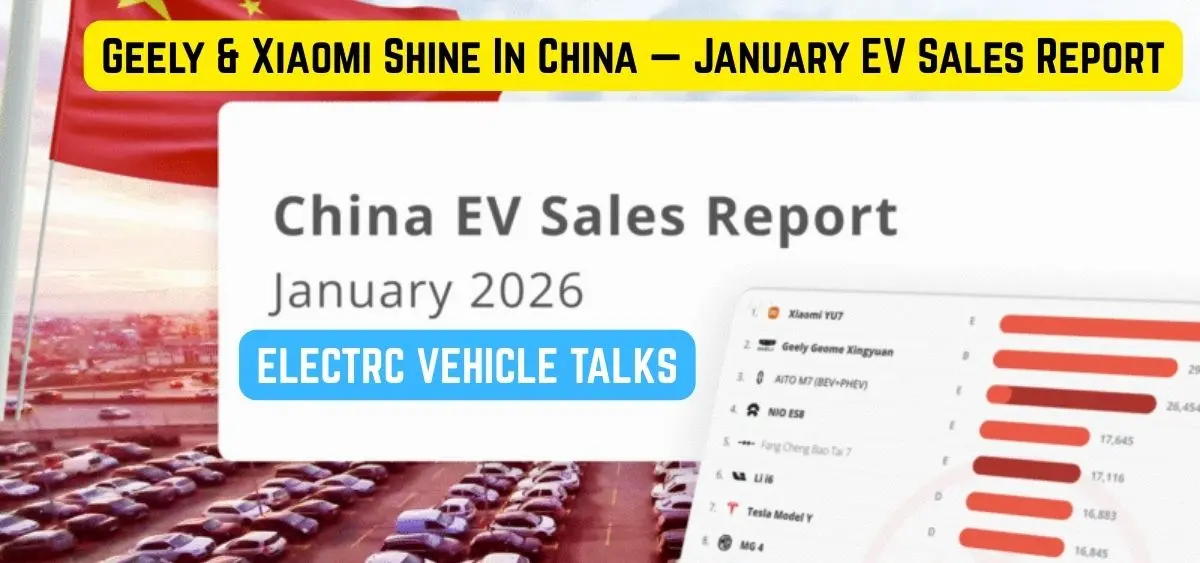

After the typical December surge driven by last-minute incentive buying, China’s EV market entered 2026 with an expected slowdown. With New Energy Vehicles (NEVs) no longer fully exempt from purchase tax, January saw overall vehicle sales drop 14% year-on-year to 1.5 million units. EV demand also cooled, yet despite the slump, Geely & Xiaomi Shine In China as standout winners in an otherwise reshuffled market.
January Market Overview: A Predictable Dip
Following record-breaking December sales, January EV volumes declined by 20%. Battery Electric Vehicles (BEVs) fell 17% YoY to 348,000 units, while Plug-in Hybrid Electric Vehicles (PHEVs) dropped even further by 24% to 248,000 units.
However, one bright spot emerged — Extended Range Electric Vehicles (EREVs). Around 76,000 EREVs were sold, marking a 1% growth YoY. Their popularity in large SUVs helped offset the impact of subsidy withdrawal.

Despite the downturn, plugin EVs still captured a strong 39% market share (23% BEV). While this is below 2025’s final 54% share, projections suggest EV penetration could climb to 60% by year-end.
Geely Takes the Lead
In a major shift, Geely surged ahead to become the top passenger vehicle seller in China.
- Wholesale Sales: 270,167 units (+1.3% YoY)
- Retail Sales: 210,000 units
- NEV Deliveries: 124,252 units
Key growth drivers included:
- Geely Galaxy: 82,990 units (+111% YoY)
- Zeekr: 23,852 units (+99.7% YoY)
- Geome Xingyuan: 29,007 units, dominating the entry-level segment
This performance clearly highlights why Geely & Xiaomi Shine In China even during a market slowdown.
Xiaomi’s Breakthrough Moment
Xiaomi made history in January.
Its YU7 electric SUV became China’s best-selling passenger vehicle model, recording 37,869 sales — more than double the approximately 16,845 units sold by the Tesla Model Y.
- Total Xiaomi Deliveries: 39,000+ units
- YoY Growth: 95%
With production of its SU7 paused for a 2026 update, the YU7 alone contributed over 90% of the brand’s monthly sales — a phenomenon now being dubbed the “YU7 Effect.”
This is another strong reason why Geely & Xiaomi Shine In China in the evolving EV landscape.
Market Shake-Up
The expiration of tax incentives hit competitors hard.
- BYD retail sales plunged 53% to 94,000 units
- Tesla dropped out of the top 10 retail rankings
Yet amid declining retail sales (down 13.9% YoY), innovation and strong product launches helped leaders thrive.
The Road Ahead
While January reflected a transitional phase for China’s EV sector, the resilience shown by top performers signals a strong future. With growing consumer acceptance and evolving technology, Geely & Xiaomi Shine In China not just as January leaders — but as brands shaping the next phase of the global EV revolution.
As adoption rises again through 2026, expect Geely & Xiaomi Shine In China to remain central to the market’s momentum.

Related Articles:-