
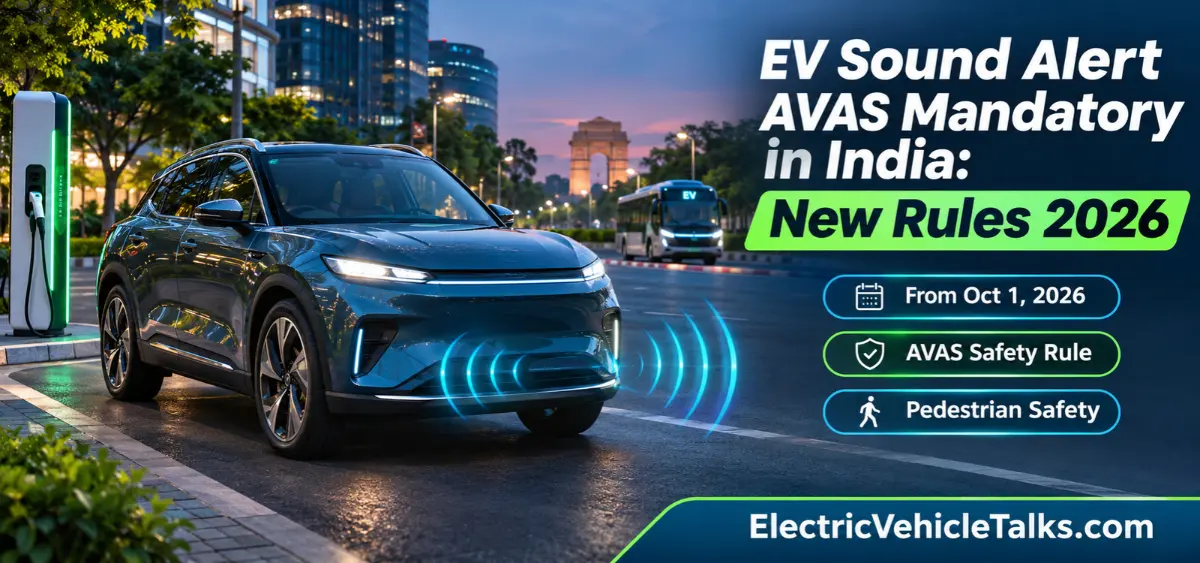

India has officially introduced EV Sound Alert AVAS Mandatory in India regulations, making Acoustic Vehicle Alerting Systems (AVAS) compulsory for newly introduced electric vehicle models in specified categories from October 1, 2026. The new regulation aims to improve pedestrian safety by ensuring that quieter electric vehicles produce an audible warning sound when travelling at low speeds.
The Ministry of Road Transport and Highways (MoRTH) confirmed the requirement through an official Gazette notification issued in January 2026. Under the regulation, eligible electric vehicles must comply with the AIS-173 automotive safety standard.

Government Officially Notifies Mandatory AVAS Rules
The Government of India published Notification G.S.R. 07(E), dated January 2, 2026, in the Gazette of India on January 6, 2026.
The notification introduces the Central Motor Vehicles (First Amendment) Rules, 2026, amending Rule 120(2) of the Central Motor Vehicles Rules, 1989.
According to the official notification, electrified vehicles in categories M and N must be equipped with an Acoustic Vehicle Alerting System that meets the audibility requirements specified in AIS-173.
The government also confirmed this requirement in its response to Lok Sabha Unstarred Question No. 809 on July 23, 2026, explaining that AVAS improves safety for pedestrians, cyclists and visually impaired people.
Official notification: Gazette of India – G.S.R. 07(E)
When Do Mandatory EV Sound Alerts Apply?
The government has introduced two implementation deadlines for vehicle manufacturers.
| Vehicle category | AVAS implementation date |
|---|---|
| New M and N category electrified vehicle models | October 1, 2026 |
| Existing M and N category vehicle models | October 1, 2027 |
The first deadline is already in effect. The second gives manufacturers additional time to make their existing models compliant.
Importantly, these deadlines relate to vehicle models manufactured from the specified dates. The notification does not introduce a general requirement for owners of previously purchased EVs to retrofit AVAS.
What Is an Acoustic Vehicle Alerting System?
An Acoustic Vehicle Alerting System (AVAS) is a safety feature that produces an artificial external sound to warn nearby road users about an approaching electric vehicle.
Unlike petrol and diesel vehicles, electric cars generate very little powertrain noise at low speeds. This can make them difficult to detect, particularly in parking areas, residential streets, and crowded locations.
AVAS addresses this problem by making the vehicle more audible during slow movement and reversing.
Under the AIS-173 standard, the relevant forward-speed sound specifications cover speeds above 0 km/h and up to 20 km/h. The standard also includes reversing sound tests.
Which Electric Vehicles Need AVAS in India?
The regulation applies to eligible electrified vehicles in two categories:
- Category M: Passenger-carrying vehicles, including electric cars and buses.
- Category N: Goods-carrying vehicles, including electric commercial vehicles and trucks.
The AIS-173 standard covers applicable vehicles that can operate without their internal combustion engines running, including certain hybrid vehicles.
Electric two-wheelers are not included in the M and N category AVAS mandate under this notification.
How Will AVAS Improve Road Safety?
Mandatory EV sound alerts are designed to reduce the risks associated with nearly silent vehicle movement.
The system can help pedestrians recognize approaching electric vehicles, especially where visibility is limited or drivers are maneuvering at low speeds.
For visually impaired pedestrians, audible vehicle warnings can provide important information about nearby traffic.
AVAS also helps manufacturers meet consistent acoustic safety requirements while retaining the quieter operation associated with electric mobility.
What Does the New Rule Mean for EV Manufacturers?
Automakers introducing qualifying new electric vehicle models must ensure that their vehicles comply with the applicable AVAS requirements.
Manufacturers of existing models must prepare for the October 2027 deadline.
The rule represents another step towards strengthening India’s electric vehicle safety framework as EV adoption expands.
Conclusion
The introduction of EV Sound Alert AVAS Mandatory in India, marks an important development in electric vehicle safety. With the October 2026 deadline already in effect for new models, AVAS is now part of the compliance requirements for qualifying electric passenger and commercial vehicles.
For existing models, manufacturers have until October 1, 2027, to meet the requirement. The regulation aims to make India’s roads safer without compromising the environmental advantages of electric mobility.

Related Articles:









