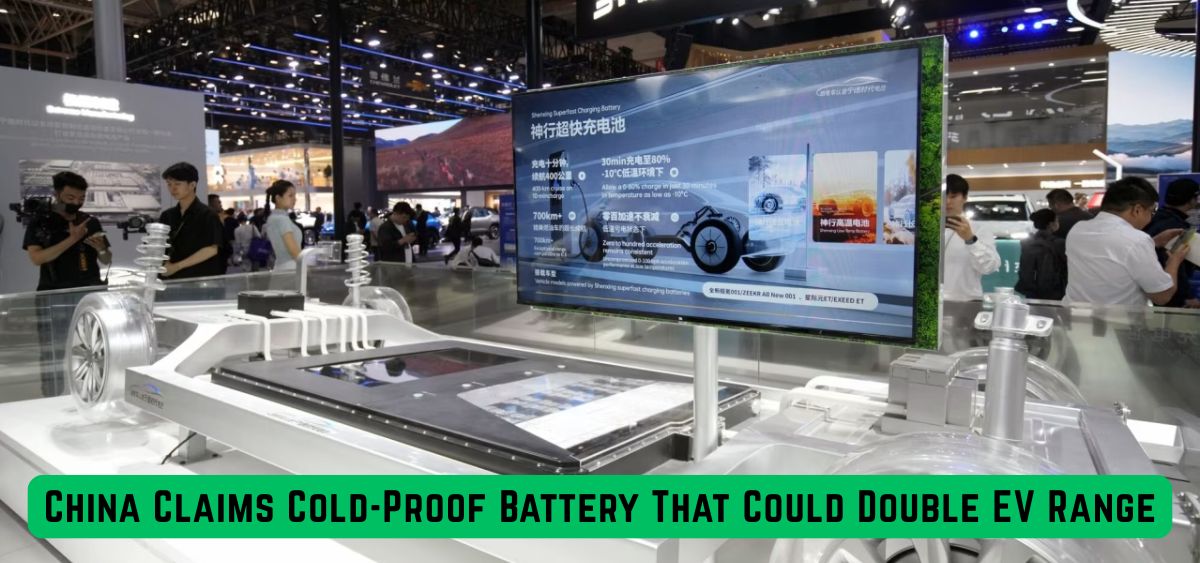

As global EV adoption accelerates, one challenge continues to haunt manufacturers and drivers—extreme cold. During the infamous Texas Arctic freeze, many EV owners found themselves stranded as batteries died faster and charging times tripled. Cold weather can drop EV range by 10–40%, exposing a major weakness in current lithium-ion technology. But this may soon change. China claims cold-proof battery technology that could transform how electric vehicles operate in freezing climates.
A Revolutionary Fluorine-Based Electrolyte
Researchers at Nankai University and the Shanghai Institute of Space Power-Sources (SISP) have unveiled a game-changing electrolyte system engineered for extreme temperatures. Their fluorine-based, semi-solid-state lithium-metal electrolyte maintains extraordinarily high energy density—even at –70°C, a temperature close to the coldest ever recorded in the Northern Hemisphere.

Traditional liquid electrolytes thicken and fail in frigid conditions. But this new fluorine-coordinated system, made using monofluorinated alkane solvents, improves ion transfer and stability. Its design weakens fluorine’s pull on lithium ions, allowing faster ion release and movement. As a result:
- Energy density surpasses 700 Wh/kg, more than double today’s premium lithium-ion batteries (300 Wh/kg).
- Driving range could jump from 500–600 km to over 1,000 km.
- Performance remains stable at –50°C with ~400 Wh/kg, and functional at –70°C.
With these capabilities, China claims cold-proof battery innovation that could eliminate range anxiety in harsh winter regions.
Safer, Stronger & Ready for Mass Production
The semi-solid-state structure reduces flammable liquid components, improving fire resistance even at high temperatures. The technology is already moving beyond the lab—limited mass production is expected later this year in partnership with China Automotive New Energy Battery Technology Co. Beyond cars, this all-weather battery could power spacecraft, drones, and robotics operating in high-altitude or polar environments.
Global Push for Next-Gen EV Batteries
China’s breakthrough arrives as the world races toward advanced battery technologies:
- Solid-State Batteries (SSBs): Toyota aims for a 1,000+ km range and 10-minute charging by 2027–2028.
- QuantumScape: Prototype cells show 95% capacity retention after 1,000 cycles—equivalent to 500,000 km of EV driving.
- Samsung SDI is preparing for 2027 mass production of all-solid-state batteries with a 600-mile range and 20-year lifespan.
Parallel innovations—silicon anodes, LFP/LMFP chemistries, graphene-enhanced cells, sodium-ion, and lithium-sulfur batteries—are pushing the industry toward safer, faster, and more affordable EV solutions.
A Turning Point for Cold-Climate EVs
With this breakthrough, China claims cold-proof battery technology that may redefine EV reliability worldwide. If commercialised at scale, it could usher in a new era of electric mobility—one where range loss in extreme weather becomes a thing of the past.

Related Articles: