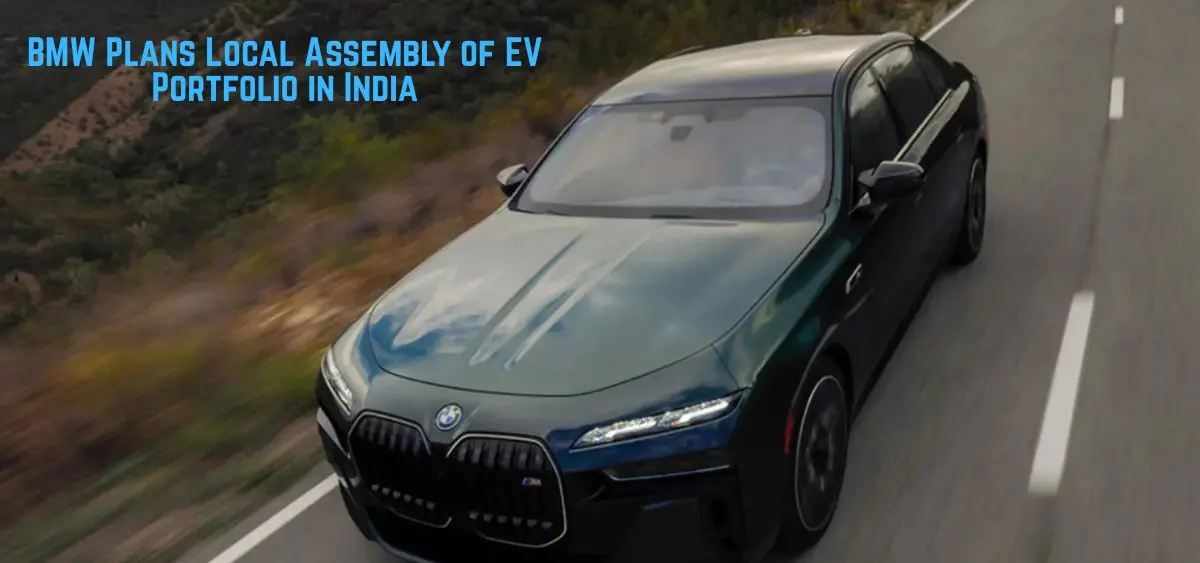

BMW Group is gearing up for a major shift in its India strategy, signaling a deeper commitment to electric mobility. As part of its long-term vision, BMW Plans Local Assembly of EV Portfolio across models sold in India, transitioning from imports to domestic production. The move is aimed at strengthening its manufacturing footprint while accelerating electrification in one of its fastest-growing global markets.
From Imports to Local Manufacturing
Currently, BMW sells a mix of Completely Built-Up (CBU) and Completely Knocked Down (CKD) electric vehicles in India. High-end CBUs attract customs duties of up to 110%, significantly impacting pricing. By localizing production at its Chennai plant, BMW can optimize costs, reduce exposure to foreign exchange volatility, and enhance competitiveness.
BMW’s EV portfolio in India includes the BMW iX1 (₹49.9 lakh), BMW i4 (₹72.5–77.5 lakh), BMW i5 (₹1.20 crore), BMW iX (₹1.40 crore), and BMW i7 (₹2.05–2.58 crore). Under its British marque MINI, the MINI Countryman Electric is also available, while the earlier MINI Cooper SE was introduced as a fully imported model.

Phased Indigenisation Strategy
A key pillar of this transition is a “phased indigenisation” roadmap. The bottom-up approach begins with entry-luxury models like the BMW iX1 Long Wheelbase (LWB) and will gradually extend to premium offerings such as the i7. This marks the first major step as BMW Plans Local Assembly of EV Portfolio to cover its entire electric range.
The iX1 LWB, locally assembled since 2025, has already become the highest-selling luxury EV in India, contributing nearly 80% of BMW’s EV sales. This success has validated BMW’s localization strategy.
Chennai Plant: Scaling for the Future
BMW’s Chennai facility currently has an annual capacity of 14,000 units in a single shift, expandable to 20,000 units with two shifts. The plant has traditionally assembled internal combustion models like the 3 Series and 5 Series. Integrating EV production allows BMW to utilize existing assets efficiently instead of building a greenfield EV-only plant.
Looking ahead, BMW Plans Local Assembly of its EV Portfolio with greater component localization, including high-voltage systems, battery modules, and electric motors. Local manufacturing of the iX3 based on the Neue Klasse platform is expected by early 2027.
Strengthening Market Leadership
BMW currently commands a 60–65% share of India’s luxury EV segment. EV contribution to total sales has jumped from 8% to 21% within a year, and the company aims to reach 25% by 2026.
To support growth, BMW is investing around ₹4 billion in dealership upgrades and charging infrastructure expansion. With 27 product interventions planned in 2026, including three new electric models, BMW Plans Local Assembly of EV Portfolio to solidify its dominance and lead India’s premium electric transformation.
The strategy positions BMW not just as a luxury automaker, but as a key architect of India’s electric future.
Related Articles:-