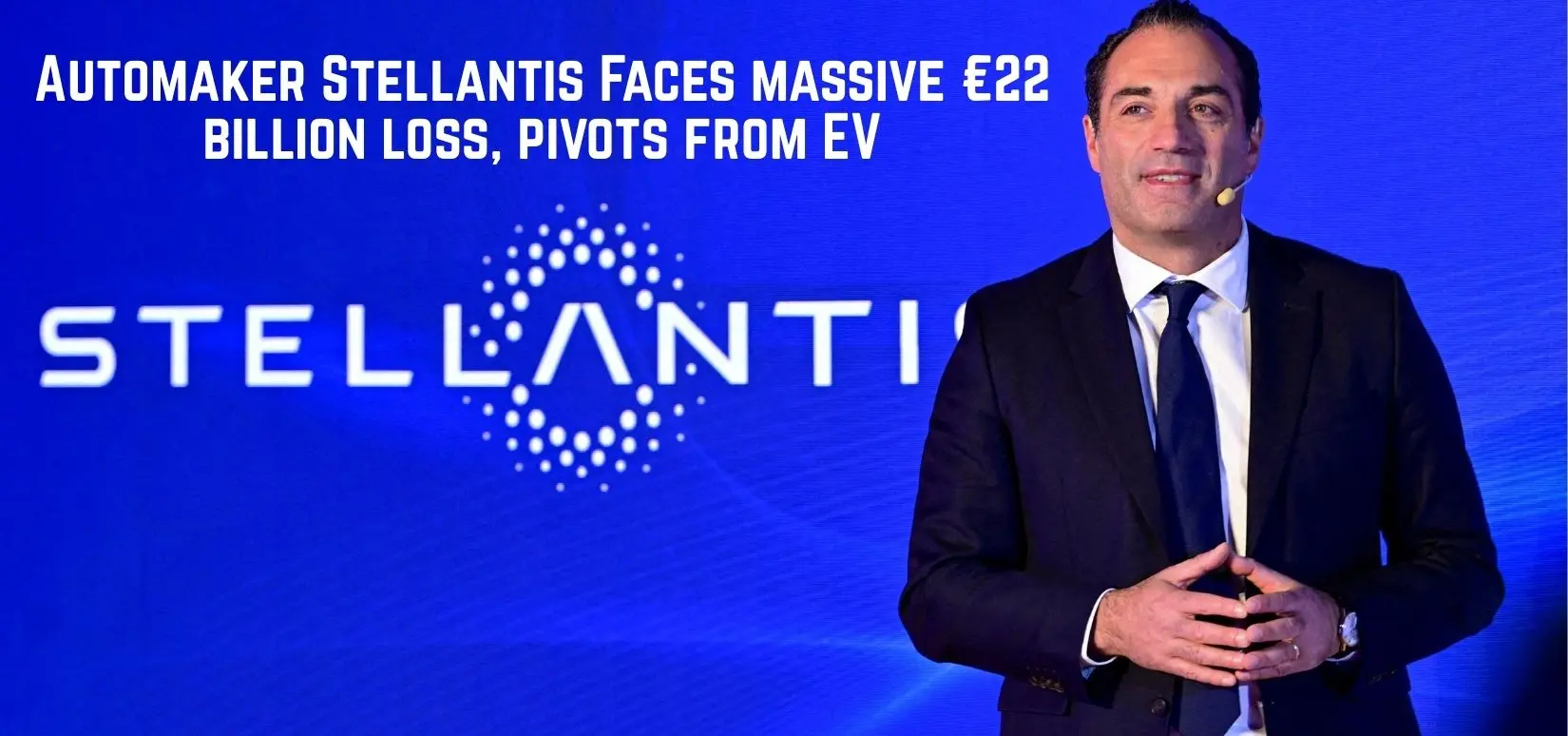

A major financial setback has shaken the global auto industry as Automaker Stellantis reported a staggering net loss of €22.3 billion ($26.3 billion) for the past year. The company — known for iconic brands like Jeep and Fiat — attributed this massive loss largely to weaker-than-expected demand for electric vehicles (EVs).
Interestingly, the loss did not stem solely from falling sales. In fact, Automaker Stellantis saw its total vehicle sales rise from 5.41 million units in 2024 to 5.48 million last year. Revenue dipped only slightly by 2% to €153.5 billion. However, the company incurred huge costs tied to its strategic shift away from EV-heavy investments.
The EV Slowdown Hits Hard
The company acknowledged that it had overestimated the speed of the global transition to electric mobility. This miscalculation forced Automaker Stellantis to take substantial financial hits as it now pivots back toward internal combustion engine (ICE) vehicles.

This shift is not happening in isolation. Industry giants like Ford and General Motors have also announced multi-billion-dollar write-downs linked to scaling back EV plans. The rollback of EV subsidies under Donald Trump further dampened momentum for electrification, while both the U.S. and European Union have softened emissions targets.
Leadership Turmoil and Strategic Reset
The financial crisis was compounded by leadership tensions. Former CEO Carlos Tavares was removed amid disagreements over premium pricing strategies. His successor, Antonio Filosa, stepped in with a clear mandate — restore profitability.
Filosa emphasized that the company must now refocus on giving customers “freedom to choose” between electric, hybrid, and combustion technologies. This new direction signals a more balanced approach rather than an aggressive EV-only roadmap.
Retreat from Gigafactories and EV Investments
As part of its restructuring, Automaker Stellantis has begun scaling back major EV-related investments. The company sold its 49% stake in NextStar Energy — a key player behind Canada’s first battery gigafactory — and plans to exit a joint venture with Samsung to build battery plants in the U.S.
Formed in 2021 through the merger of PSA Group and Fiat-Chrysler, the company is now reintroducing combustion-engine models, including diesel options, in both the U.S. and Europe.
The Road Ahead
Despite the strategic pivot, Automaker Stellantis insists it remains committed to electrification in the long term. With new combustion-engine pickup launches planned in the U.S. and improving sales momentum in late 2025, the company aims to return to profitable growth.
However, challenges remain — including projected tariff-related costs of €1.2 billion in 2025 and €1.6 billion in 2026.
In a rapidly evolving automotive landscape, Automaker Stellantis is now betting on flexibility rather than full electrification — a move that could redefine its future in the global market.

Related Articles:-