
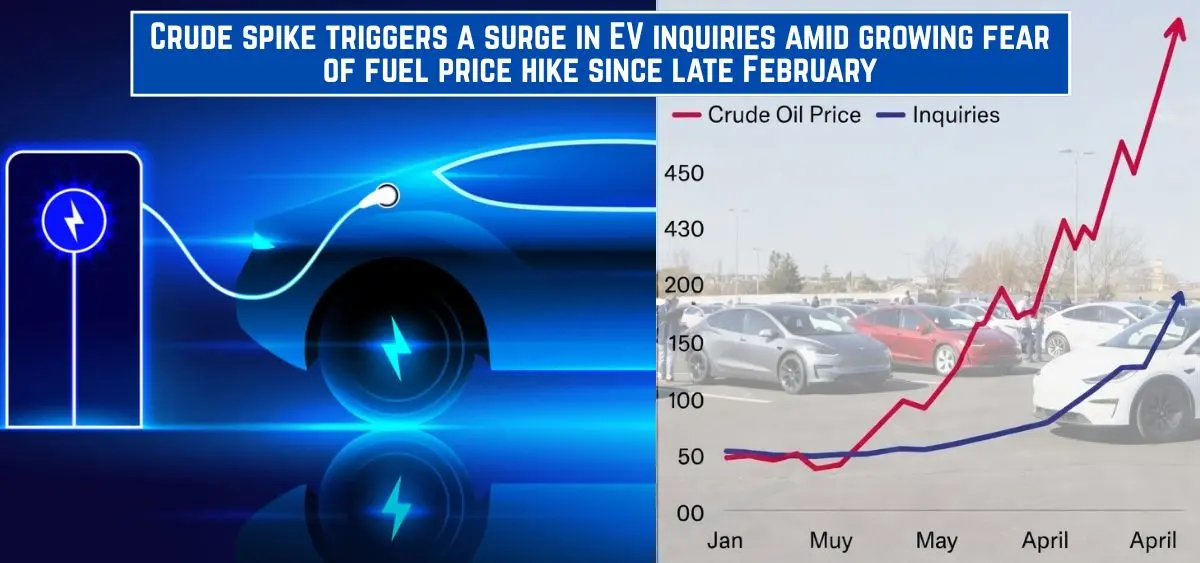

The Indian automobile market is witnessing a noticeable shift as a Crude spike triggers a surge in EV inquiries across the country. Over the past two weeks, automakers and dealers have reported a sharp rise in customer interest in electric vehicles (EVs), driven largely by global fuel price uncertainty.
Global Energy Crisis Fuels Concern
The ongoing geopolitical tensions, particularly the Iran war, have led to a dramatic increase in global energy prices. Brent crude has surged to $112 per barrel, marking nearly a 60% rise since February 28. Additionally, natural gas prices have jumped by 7–10%, intensifying concerns about a broader energy crisis.
The International Energy Agency has warned that the world may be heading toward the worst energy crisis since the 1970s. Its chief, Fatih Birol, described the situation as a combination of multiple oil and gas crises occurring simultaneously.

India Holds Prices, But Pressure Builds
While over 85 countries—including the United States, Japan, Germany, and Australia—have already increased fuel prices, India has so far maintained a price freeze on regular petrol and CNG. However, experts believe this may not be sustainable if crude prices remain elevated.
Despite stable fuel prices, the fear of an impending hike is already influencing buyer behavior. This is a key reason why a Crude spike triggers a surge in EV inquiries even before any official price revision.
EV Demand Gains Strong Momentum
Automakers like Tata Motors have confirmed a significant rise in showroom visits and customer queries. Dealers across major cities are witnessing increased footfall, signaling growing consumer curiosity toward EVs.
Retail data further supports this trend. In just the first three weeks of March 2026, electric passenger vehicle registrations reached 10,370 units—nearly 85% of March 2025’s total of 12,356 units. This rapid growth indicates that the market is on track to surpass last year’s performance.
Why Consumers Are Shifting to EVs?
The rising interest can be attributed to multiple factors. Although EVs come with a 70–75% higher upfront cost compared to petrol cars, their running costs are up to 80% lower. Home charging convenience, sustainability awareness, and energy security concerns are also playing a major role.
Experts say that even speculation around fuel price hikes can influence consumer psychology. As a result, a Crude spike triggers a surge in EV inquiries as buyers actively seek cost-effective alternatives.
Offers and Incentives Accelerate Adoption
Automakers are leveraging this opportunity by introducing attractive deals. VinFast has launched a “Trade Gas for Electric” program, offering benefits of up to ₹2.14 lakh along with buyback assurances and free charging. Similarly, BYD is witnessing increased demand due to financial incentives and year-end benefits.
The Road Ahead
With global uncertainty still looming, the trend is expected to continue. If crude prices remain high, a Crude spike triggers a surge in EV inquiries, which could mark a long-term shift in India’s mobility landscape, accelerating the transition toward electric vehicles.

Related Articles:-









