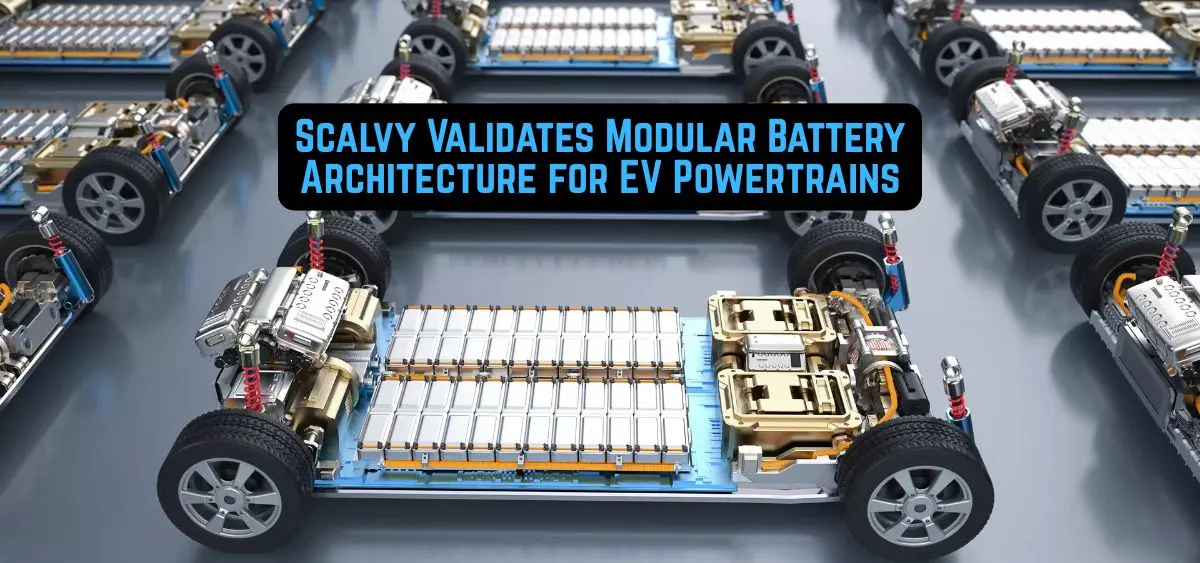

The electric vehicle (EV) industry is rapidly evolving, and innovations in battery and powertrain technology are at the heart of this transformation. One such breakthrough comes as Scalvy Validates Modular Battery Architecture, a concept developed in collaboration with Valeo. This new approach aims to redefine how power is distributed and managed in EVs, potentially improving efficiency, thermal performance, and scalability.
Rethinking Traditional EV Power Systems
In conventional EV designs, powertrain systems rely heavily on centralized high-voltage components such as inverters, DC-DC converters, and onboard chargers. However, Scalvy Validates Modular Battery Architecture by introducing a decentralized system made up of smaller units called “Power Neurons.”

These Power Neurons are positioned closer to individual battery modules, enabling localized power conversion and control. This shift from centralized to distributed architecture reduces energy losses typically associated with long electrical pathways. Additionally, the system is designed to be flexible, allowing it to adapt across different vehicle types and battery chemistries.
Tested Under Real-World Driving Conditions
To ensure reliability, the system was tested using the Worldwide Harmonized Light Vehicle Test Cycle, a globally recognized benchmark that simulates real-world driving scenarios. This evaluation confirmed the system’s capability to perform efficiently under standard automotive conditions.
During testing, inverter efficiency reached an impressive 98.3% at 10,000 rpm and 65 Nm torque. Temperature management also stood out, with motor temperatures staying below 62°C and power devices under 65°C—without any hotspot formation.
Enhanced Efficiency and Battery Longevity
A major advantage highlighted when Scalvy Validates Modular Battery Architecture is its advanced battery management capability. Each battery module can be individually controlled, allowing precise state-of-charge balancing. This minimizes inconsistencies between modules—a common issue in traditional battery packs.
The system also introduces pulse-like current behavior due to distributed switching. This reduces localized thermal and electrical stress, potentially enabling faster charging and improving overall battery lifespan by up to 15%. While these results are promising, broader real-world validation is still required.
Industry Collaboration and Future Outlook
The collaboration between Scalvy and Valeo has played a crucial role in achieving these early milestones. Company leaders have emphasized that these results mark only the beginning, with further development and testing underway.
Looking ahead, Scalvy plans to expand field testing with automotive partners and aims for commercial production by 2027, subject to further validation and certification.
Conclusion
As Scalvy Validates Modular Battery Architecture, it signals a significant shift toward distributed power electronics in EV design. By improving efficiency, thermal stability, and battery health, this innovation could play a key role in shaping the next generation of electric vehicles.

Related Articles:-