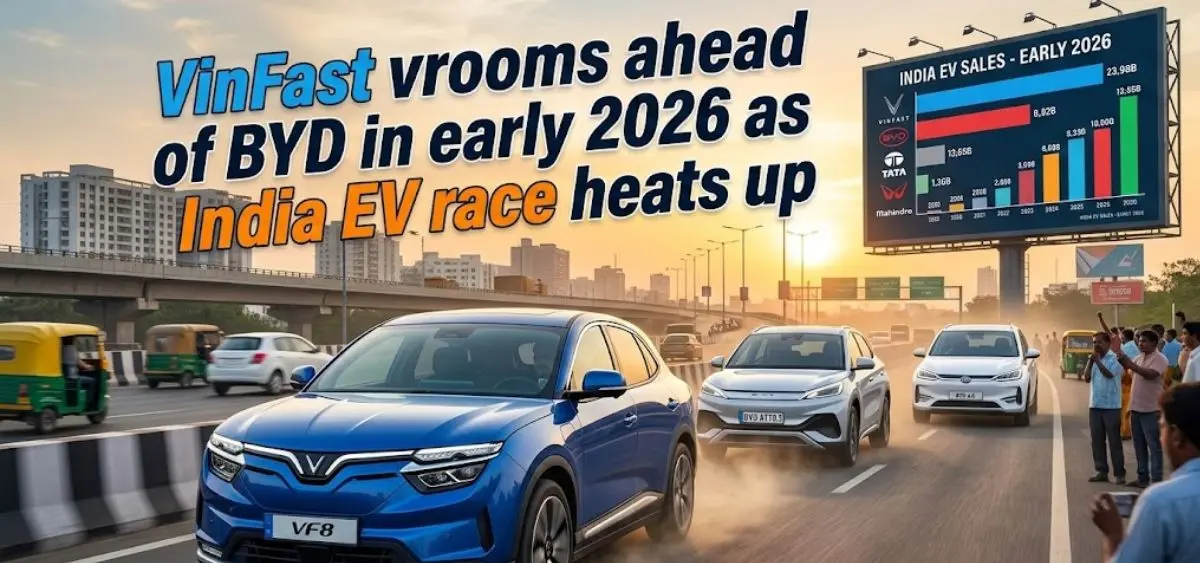

The Indian electric vehicle market is becoming increasingly competitive as global automakers fight for market share. In a surprising shift, VinFast vrooms ahead of BYD in early 2026, marking a significant moment in the evolving EV race in India. According to Vahan data, the Vietnamese EV maker sold more than 850 electric passenger vehicles by March 3, 2026, while Chinese rival BYD recorded over 550 units during the same period.
This early lead highlights how quickly the Vietnamese brand is gaining momentum in India’s fast-growing electric mobility sector.
Rapid Rise in the EV Rankings
The strong start to the year has helped VinFast climb the EV sales rankings in India. In January 2026, the company emerged as the fourth-largest electric passenger vehicle player, behind Tata Motors, JSW MG Motor India, and Mahindra & Mahindra.
Meanwhile, BYD currently stands eighth in the EV passenger vehicle segment. Interestingly, the scenario was very different in 2025, when BYD ranked fifth, and VinFast was tenth, according to FADA data. This dramatic shift demonstrates how VinFast vrooms ahead of BYD in early 2026, fueled by aggressive product positioning and market strategy.

Product Strategy Driving VinFast’s Growth
VinFast entered the Indian market in September 2025 with two electric SUVs — the VinFast VF 6 and VinFast VF 7. These models are priced between ₹16 lakh and ₹25 lakh, placing them strategically between entry-level EVs and premium electric vehicles.
This pricing gap has proven crucial. Many Indian buyers looking to upgrade from affordable EVs often find premium models too expensive. By targeting this middle segment, VinFast created a sweet spot in the market — one reason why VinFast vrooms ahead of BYD in early 2026.
Within just four months of operations, the company crossed 1,000 cumulative sales by January, indicating strong early traction among Indian buyers.
BYD’s Premium Approach in India
BYD, which has been present in India since 2007, initially built its presence through battery and electronics operations and later through electric buses in partnership with Olectra Greentech.
Its passenger EV lineup includes models such as the BYD e6, BYD Atto 3, and BYD Sealion 7. These vehicles typically start at ₹25 lakh and go up to ₹54 lakh, targeting premium buyers and competing with global EVs like the Hyundai Ioniq 5 and Kia EV6.
While this premium positioning has helped BYD build a strong brand image, it limits access to mid-segment buyers.
New Global Rivals Enter the Race
The Indian EV race is also witnessing new global competition. Tesla, led by Elon Musk, entered the Indian market around the same time as VinFast but has sold only 29 units so far in 2026, according to the same dataset.
Meanwhile, VinFast is investing heavily in India, committing up to $2 billion to build a complete EV ecosystem, including a manufacturing and assembly facility in Tamil Nadu.
The Road Ahead for India’s EV Market
India is quickly becoming one of the most important EV markets globally. With aggressive pricing, new product launches, and large-scale investments, competition is intensifying among global automakers.
For now, VinFast vrooms ahead of BYD in early 2026, but the race is far from over. As infrastructure improves and more EV models enter the market, India’s electric vehicle landscape is expected to become even more dynamic in the coming years.

Related Articles:-