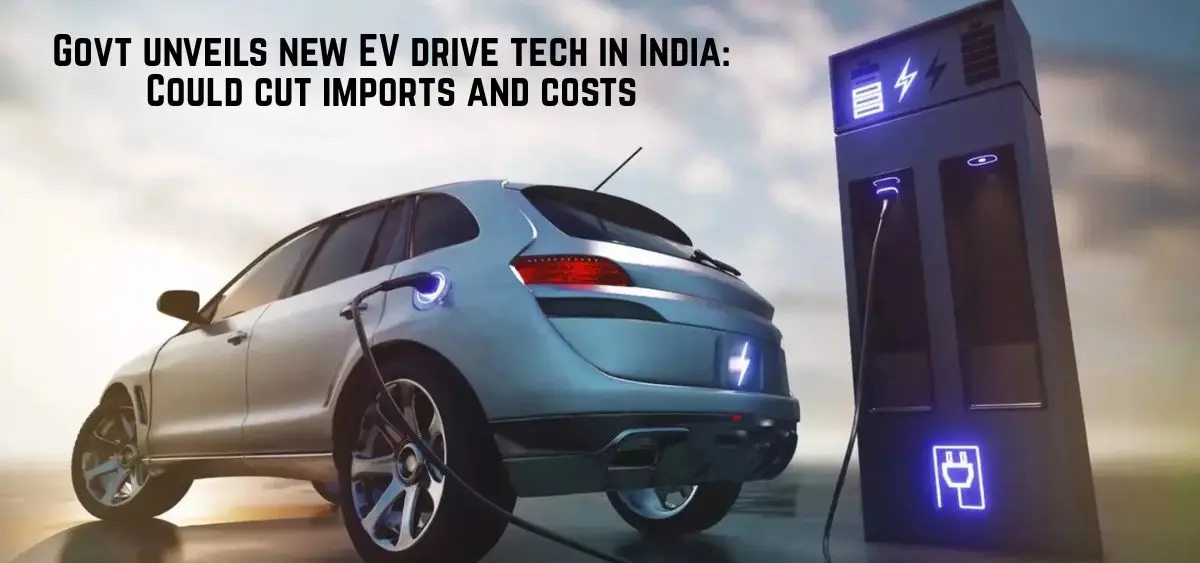

In a major push towards self-reliance in electric mobility, the Govt unveils new EV drive tech in India with the launch of an indigenously developed 30 kW Wide Band Gap (WBG)-based Integrated Drive System (IDS). The system was unveiled on March 2, 2026, at the Indian Institute of Technology Madras, marking a significant milestone in India’s EV technology journey.
What Is the New Integrated Drive System?
The 30 kW IDS has been developed by the Centre for Development of Advanced Computing, Thiruvananthapuram, in collaboration with IIT Madras and Lucas TVS under the National Mission on Power Electronics Technology (NaMPET), supported by the Ministry of Electronics and Information Technology.

Unlike conventional systems, where the motor and inverter function as separate units, this IDS integrates both into a single compact module. The use of Wide Band Gap semiconductor technology enhances power density, efficiency, and thermal performance while reducing space requirements—making it ideal for modern EV platforms.
Designed for India’s Growing EV Market
The 30 kW power category is particularly suited for India’s fast-expanding electric passenger vehicle segment, including compact cars and shared mobility fleets. As the Govt unveils new EV drive tech in India, the focus is clearly on strengthening domestic capabilities in advanced power electronics.
Reducing Imports, Lowering Costs
Currently, a significant portion of high-performance EV powertrains and semiconductor components are imported. The indigenous IDS aims to reduce this dependency by promoting local production. The government expects that as the Govt unveils new EV drive tech in India, localisation will help cut costs and support large-scale manufacturing under initiatives like Production-Linked Incentive (PLI) schemes and the PM E-DRIVE Scheme.
Boost for MSMEs and EV Supply Chain
The Govt unveils new EV drive tech in India, not just as a technological advancement but as an economic strategy. Wider adoption of this system is expected to strengthen the domestic EV supply chain and create opportunities for MSMEs engaged in power electronics and hardware manufacturing, enhancing India’s global competitiveness in semiconductor-based electric mobility technologies.
Related Articles:-