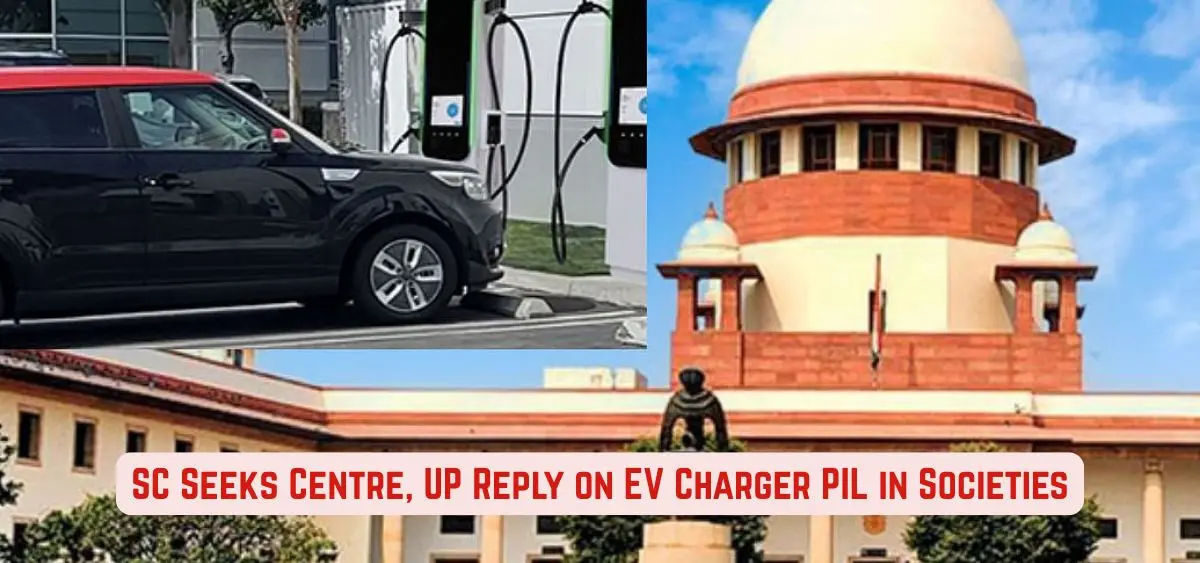

In a significant development for India’s clean mobility transition, the Supreme Court has agreed to examine a plea alleging that housing societies are obstructing the installation of private electric vehicle (EV) chargers. The matter, widely discussed under the headline “SC Seeks Centre, UP Reply on EV Charger PIL in Societies,” highlights the growing tension between individual EV owners and residential management bodies.
Background of the Case
The petition was filed by Greater Noida resident Rachit Katyal in the case Rachit Katyal vs Union of India. A Bench comprising Chief Justice of India Surya Kant and Justice Joymalya Bagchi issued notice to the Union Government, the State of Uttar Pradesh, Nirala Estate Phase-3 in Greater Noida (West), and its facility manager, Cushman & Wakefield Property Management Services India Pvt Ltd.
The core issue raised in SC Seeks Centre, UP Reply on EV Charger PIL in Societies is whether housing societies can withhold No Objection Certificates (NOCs) from residents seeking to install EV charging units in their designated parking spaces at their own expense.

The Petitioner’s Grievance
Katyal, who owns a flat in Nirala Estate Phase-3, purchased an electric vehicle and applied on May 26, 2025, for permission to install a certified private charging unit through authorised technicians. Despite repeated reminders and references to the Ministry of Power’s “Guidelines for Installation and Operation of Electric Vehicle Charging Infrastructure-2024,” the society and its management agency allegedly failed to make a decision.
He argued that such inaction undermines the national push for clean mobility and violates constitutional guarantees under Articles 14 (equality before law) and 21 (right to life). According to the plea, arbitrary delays and denials by resident welfare associations and housing societies create significant barriers to EV adoption in urban residential complexes.
Infrastructure Gaps in Large Housing Projects
The situation at Nirala Estate Phase-3 reflects a broader problem. The project reportedly houses nearly 4,000 flats and dozens of EVs, yet only two low-capacity common charging points are available. The petitioner contended that this inadequate infrastructure forces residents to depend on limited shared facilities, despite being willing to install private chargers at their own cost.
The 2024 Central guidelines explicitly recognise the right of residents in group housing societies to set up private charging stations in their allotted parking spaces, subject to safety norms and appropriate electricity connections. However, inconsistent implementation at the state level has created confusion.
Demand for Uniform Enforcement
Drawing a comparison with Maharashtra, where circulars reportedly mandate time-bound permissions, the petitioner argued that Uttar Pradesh lacks enforceable directions to ensure compliance with Central guidelines. Therefore, in SC Seeks Centre, UP Reply on EV Charger PIL in Societies, he has sought directions for uniform enforcement across housing societies.
Alternatively, he requested that the Court direct the concerned housing society to grant him immediate permission until the State frames suitable legislation.
With the Supreme Court now examining the matter, SC Seeks Centre, UP Reply on EV Charger PIL in Societies could become a landmark step in clarifying the rights of EV owners and accelerating India’s residential charging infrastructure rollout.
Related Articles:-