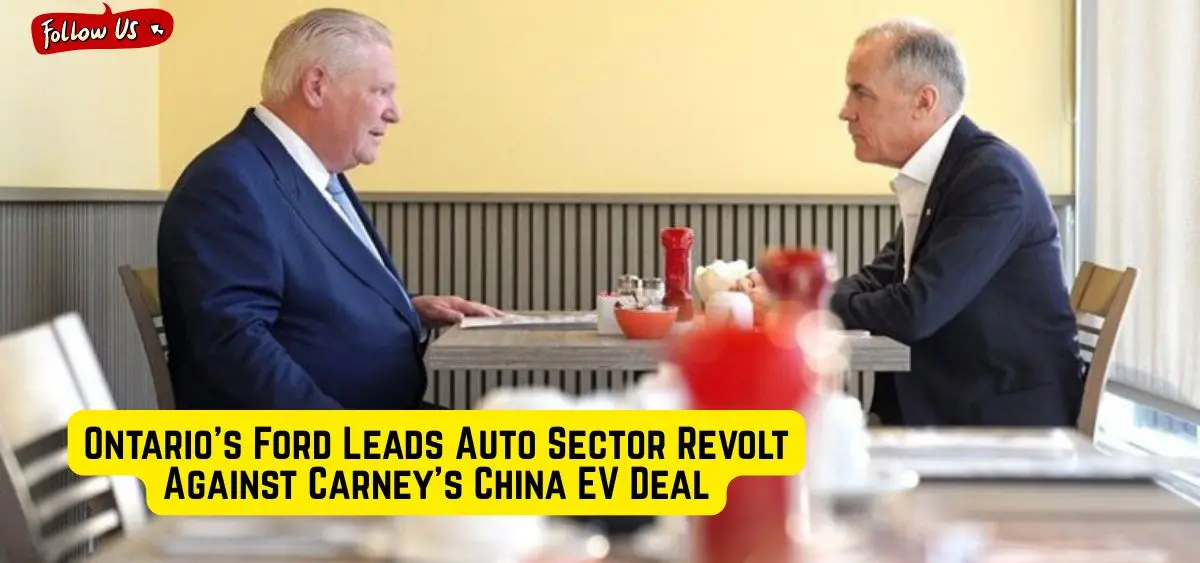

In January 2026, a major political and economic debate erupted in Canada as Ontario’s Ford Rallies Auto Sector against a controversial trade agreement between Canada and China. Ontario Premier Doug Ford publicly urged Canadians to boycott Chinese-made electric vehicles (EVs), warning that the deal threatens Ontario’s automotive industry and thousands of local jobs.
The Carney–China Trade Deal Explained
Prime Minister Mark Carney recently negotiated a “trade truce” with China that significantly reduces tariffs on Chinese EVs entering Canada. Under the agreement, tariffs drop sharply from 100% to just 6.1%, with an annual import quota capped at 49,000 vehicles. In return, China agreed to remove duties on key Canadian agricultural exports such as canola, seafood, and pork.
While the federal government views the deal as economically strategic, Ontario’s leadership sees it as a direct risk to domestic manufacturing.

Ford’s Call for a Consumer Boycott
At a press conference on January 21, 2026, Ontario’s Ford Rally Auto Sector urged consumers to avoid Chinese EVs altogether. His message was blunt: buy vehicles built in Canada and support local workers. Ford argued that cheaper imported EVs could undercut Canadian manufacturers, putting jobs in automotive hubs like Brampton and Oshawa at risk.
Industry and Union Backing
Ford’s stance received strong support from key industry stakeholders, including Unifor, the Canadian Vehicle Manufacturers’ Association, and the Automotive Parts Manufacturers’ Association. These groups warned that the agreement could disrupt the highly integrated North American auto supply chain. They also raised concerns that the United States could impose retaliatory measures during future CUSMA reviews, further harming Canadian auto exports.
Security and Sovereignty Concerns
Beyond economics, Ford has raised national security alarms. He has previously described Chinese EVs as potential “spy cars,” comparing them to “Huawei 2.0,” and suggesting they could be used for data collection or surveillance. These claims have intensified the debate beyond trade into issues of privacy and sovereignty.
Political Tensions Across Provinces
Another flashpoint is the lack of provincial consultation. Ford criticized Carney for finalizing the agreement during a China visit without involving provincial governments. While Ontario’s Ford Rallies Auto Sector in opposition, other provinces have welcomed the deal due to the benefits for the agriculture and fishing industries.
A Divided Economic Vision
Carney has defended the agreement as a necessary move to diversify Canada’s trade partnerships amid shifting U.S. policies. Still, the clash highlights a growing divide between federal trade strategy and provincial manufacturing priorities, with Ontario’s Ford Rally Auto Sector firmly drawing a line in defense of domestic auto jobs.

Related Articles:-