Fast Charging Technologies in 2026: The Future of EV Charging
Fast charging technologies are transforming electric vehicle ownership by allowing compatible EVs to recover substantial driving range in minutes rather than hours. Advances in DC charging, high-voltage battery systems, thermal management, and intelligent charging software are making electric mobility more practical for everyday drivers and commercial fleets.
In 2026, the conversation is no longer simply about installing more chargers. It is about how quickly vehicles can accept electricity, whether charging stations work reliably, how much each session costs, and how safely batteries can handle repeated high-power charging.
For India, these developments matter particularly as electric cars, taxis, delivery fleets, and commercial vehicles increasingly depend on convenient public charging infrastructure.
Key Takeaways
- DC fast charging typically operates across a broad range of power outputs, including 30 kW, 60 kW, 120 kW, 150 kW, and 350 kW systems.
- Ultra-fast charging combines high-power chargers with compatible batteries, advanced cooling, and often 800V-class vehicle architectures.
- Charging from 10% to 80% is a more meaningful comparison than a claimed 0–100% charging time because charging power usually decreases as the battery fills.
- Battery technology matters as much as charger power. A vehicle rated for 50 kW cannot automatically use the full capacity of a 350 kW station.
- Smart charging, Plug & Charge, and real-time station monitoring can reduce delays beyond the time spent transferring electricity.
- India needs a balanced charging network, combining affordable AC charging, reliable highway DC charging, and high-power infrastructure for commercial fleets.
What Are Fast Charging Technologies and How Do They Work?
Fast charging technologies use high-power electrical systems to transfer energy into an EV battery more quickly than conventional home charging.
The fundamental difference is where electricity gets converted.
With AC charging, electricity enters the vehicle, and its onboard charger converts alternating current into direct current for the battery. With DC fast charging, that conversion takes place inside the external charging station.
This allows substantially more power to reach the battery without being restricted by the capacity of the vehicle’s onboard AC charger.
The five stages of DC fast charging
- Grid connection: Electricity reaches the charging station through the distribution network.
- Power conversion: High-power electronic modules convert grid AC into regulated DC electricity.
- Vehicle communication: The charger and battery management system (BMS) negotiate safe voltage and current limits.
- Battery charging: Energy enters the battery while sensors continuously monitor temperature, voltage, and current.
- Automatic power adjustment: Charging power changes as the battery fills or operating conditions change.
A peer-reviewed 2024 study published in Heliyon, titled A Comprehensive Review on Charger Technologies, Types, and Charging Station Models for Electric Vehicles, explains the differences between onboard and offboard chargers, wired and wireless charging, bidirectional systems, and renewable-energy-supported charging stations.
The important point is that fast charging is not simply a matter of supplying more electricity. It requires coordinated control between the charging station, battery, cooling system, and power grid.
What Are the Different Types of EV Charging Technologies?
Electric vehicle charging generally falls into three practical categories: low-power AC charging, higher-power AC charging, and DC fast charging.
| Charging technology | Typical power | Best application |
|---|---|---|
| Low-power AC charging | 2–3.3 kW | Overnight home charging |
| Standard AC charging | 7–7.4 kW | Homes, offices, and apartments |
| Three-phase AC charging | 11–22 kW | Workplaces and commercial parking |
| Moderate DC fast charging | 25–60 kW | City charging and smaller EVs |
| High-power DC charging | 90–180 kW | Highway charging and fleet operations |
| Ultra-fast DC charging | 240–350 kW+ | Compatible high-performance EVs |
| Megawatt charging | 1 MW and above | Heavy electric trucks and large commercial vehicles |
These are illustrative charging categories, not universal regulatory definitions. Actual delivered power depends on vehicle compatibility, station configuration, and battery conditions.
AC charging versus DC fast charging
AC charging remains attractive because it is comparatively inexpensive to install and well suited to vehicles parked for several hours.
DC charging requires more sophisticated equipment, stronger electrical connections, and greater investment. Its advantage is dramatically shorter charging sessions for compatible vehicles.
For Indian buyers, a 7.2 kW home charger may be more useful for everyday commuting than access to a 350 kW public charger that their vehicle cannot fully utilize.
How Fast Can a 50 kW, 150 kW, or 350 kW Charger Charge an EV?
Charging speed depends on both the charger’s output and the vehicle’s ability to accept that power.
Consider a hypothetical electric car with a 60 kWh usable battery. Charging from 10% to 80% requires approximately 42 kWh of energy stored in the battery.
| Charger power | Theoretical minimum time for 42 kWh | Practical interpretation |
|---|---|---|
| 30 kW | 84 minutes | Useful for smaller vehicles or extended stops |
| 50 kW | 50 minutes | Suitable for many urban and highway locations |
| 100 kW | 25 minutes | Faster if the EV supports sustained high power |
| 150 kW | 17 minutes | Requires strong charging capability |
| 350 kW | 7 minutes | Only a mathematical limit, not a realistic promise for every EV |
The figures assume the listed power is maintained continuously and ignore charging losses. Real charging sessions are usually longer because power varies throughout the session.
Why does charging slow down after 80%?
Most lithium-ion batteries cannot sustain their maximum charging power across the entire state-of-charge range.
At lower and moderate charge levels, the battery may accept high current. As the battery approaches full charge, the BMS generally reduces charging power to manage cell voltage, heat, and degradation risks.
This behavior produces a charging curve rather than a constant charging speed.
Illustrative EV fast-charging curve
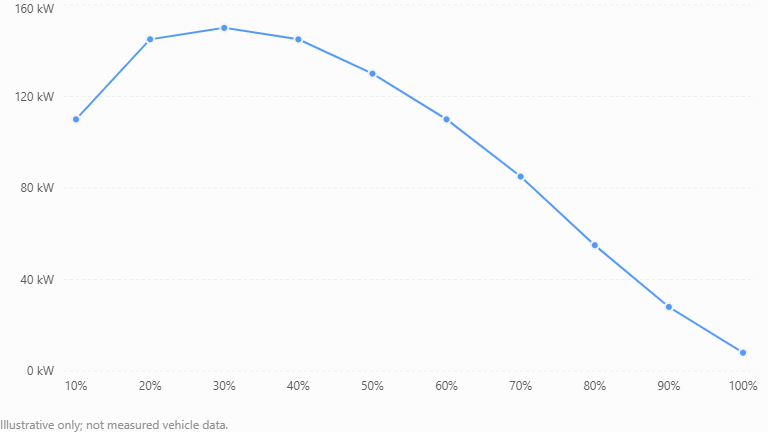
| Battery State of Charge (SoC) | Charging Power (kW) |
|---|---|
| 10% | 110 kW |
| 20% | 145 kW |
| 30% | 150 kW |
| 40% | 145 kW |
| 50% | 130 kW |
| 60% | 110 kW |
| 70% | 85 kW |
| 80% | 55 kW |
| 90% | 28 kW |
| 100% | 8 kW |
Conceptual charging profile showing how power may rise, peak, and taper as battery charge increases. Actual curves vary significantly between EVs.
This explains why an EV might charge from 10% to 80% relatively quickly but require considerably more time for the final 20%.
For highway journeys, charging to approximately 70–80% and continuing to another suitable station can sometimes be faster than waiting for a complete charge.
Why Are 800V EV Charging Systems Important in 2026?
One of the most significant advances in modern electric vehicles is the transition from conventional 400V-class battery architectures toward 800V-class systems.
The underlying electrical relationship is straightforward:
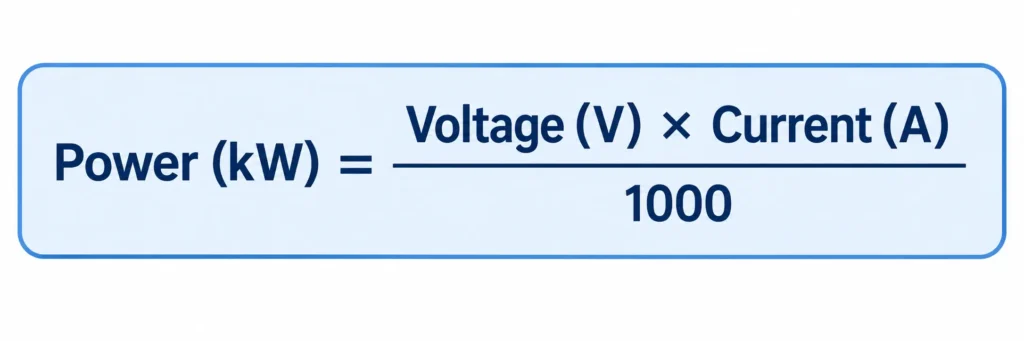
At 200 kW, a 400V system would require approximately 500 amperes, while an 800V system would require approximately 250 amperes, assuming those exact operating voltages.
Reducing current helps limit resistive heating and can improve the efficiency of cables and electrical components.
Advantages of higher-voltage architectures
Higher-voltage platforms can support greater charging power, reduce current-related losses, and enable more manageable cable designs.
However, an 800V battery does not automatically guarantee faster charging. Cell chemistry, cooling, charger voltage compatibility, and BMS programming remain critical.
A well-engineered 400V EV can also deliver competitive charging performance.
Which Battery Technologies Support Ultra-Fast Charging?
The ability to charge quickly begins inside the battery cells.
High charging currents increase the demands placed on electrodes, electrolytes, and thermal-management systems. Battery manufacturers are therefore improving several technologies simultaneously.
Lithium iron phosphate (LFP)
LFP batteries are widely used because of their durability, thermal stability, and relatively favorable material costs.
Modern high-rate LFP cell designs can support faster charging, although charging performance varies considerably between products. LFP chemistry alone does not guarantee ultra-fast capability.
Nickel-rich lithium-ion batteries
Nickel-rich chemistries can offer high energy density, making them attractive for long-range vehicles. Their charging performance depends on electrode design, cooling, and battery-management strategies.
Silicon-enhanced anodes
Silicon can store more lithium than conventional graphite, but it expands significantly during charging.
Silicon-carbon composite materials and improved binders aim to manage that expansion while supporting better energy density and charging performance.
Solid-state batteries
Solid-state batteries are a promising longer-term development, potentially offering improved energy density and different safety characteristics.
However, solid-state technology should not be treated as a guaranteed solution to charging delays. Manufacturing scale, interface resistance, cycle life and cost remain substantial engineering challenges.
Why thermal management matters
High-power charging generates heat in cells, busbars, cables, and connectors.
Advanced battery packs use liquid cooling, temperature sensors, and intelligent BMS controls to maintain safe operating conditions.
The uploaded research paper also examines charger architectures, wireless charging, and energy-storage integration, reinforcing the importance of treating fast charging as a complete electrical system rather than a single charger specification.
What Are the Latest Fast Charging Innovations in 2026?
1. Ultra-high-power DC charging
Charging systems are progressing beyond conventional 150–350 kW hardware toward substantially higher peak outputs.
These systems are especially relevant to vehicles engineered for high charge acceptance and short turnaround times.
However, laboratory demonstrations, manufacturer announcements and commercially accessible charging networks represent different stages of technological maturity.
A headline promising charging in five minutes should always be assessed against the stated battery percentage window, vehicle specification and actual station availability.
2. Megawatt Charging Systems for trucks and buses
The Megawatt Charging System (MCS) is being developed for heavy-duty vehicles with large batteries.
CharIN describes an MCS technical framework supporting up to 1,250V and 3,000A, corresponding to a theoretical maximum of 3.75 MW. These are system design capabilities, not a promise that every installation or vehicle will operate at that level.
3. Silicon carbide power electronics
Silicon carbide (SiC) semiconductors can reduce switching losses and support more efficient high-voltage power conversion. Their use in chargers and vehicle electronics can help manufacturers design more compact, efficient electrical systems, although component cost remains a consideration.
4. Intelligent charging management
Modern charging software can distribute available electricity between charging points, monitor equipment performance and manage station demand.
Dynamic load balancing is particularly useful when several vehicles connect to one site simultaneously.
For example, a station with a 240 kW shared power cabinet might distribute available power across two connected vehicles rather than supply the full 240 kW to both.
5. Plug & Charge technology
Plug & Charge enables compatible vehicles and charging networks to authenticate a charging session automatically.
The technology uses standards such as ISO 15118 and can reduce dependence on separate charging apps, manual authentication and RFID cards.
The benefit is convenience and smoother station operation, rather than an increase in the battery’s physical charging speed.
6. Wireless and inductive EV charging
Wireless charging transfers electricity through electromagnetic coupling between a ground-based pad and a compatible receiver mounted on the vehicle.
Static wireless charging may become useful for taxis, accessible parking, autonomous vehicles and selected commercial fleets.
Dynamic wireless charging, where vehicles receive energy while moving over specially equipped roads, remains a more experimental and infrastructure-intensive approach.
Wireless charging should therefore be viewed as a convenience technology, not necessarily an ultra-fast alternative to high-power DC charging.
7. Battery swapping
Battery swapping replaces a depleted battery with a charged unit instead of waiting for electricity to transfer into the vehicle.
It is particularly relevant to electric two-wheelers, three-wheelers and high-utilisation delivery fleets.
The major challenges are battery standardisation, network coverage, equipment costs, battery ownership arrangements and compatibility between vehicle manufacturers.
Unlike conventional charging, battery swapping can shorten vehicle downtime without requiring the battery itself to accept extremely high charging power.
Which EV Charging Connectors and Standards Are Used in India?
Charging connector compatibility is just as important as charger power.
A high-power station is useful only when its connector, voltage range, and communication system are compatible with the vehicle.
| Charging standard | Main application | Relevance to India |
|---|---|---|
| CCS2 | AC and high-power DC charging | Widely used for modern electric passenger cars |
| Type 2 | AC charging | Common for electric cars and commercial AC stations |
| Bharat DC-001 | Legacy low-power DC charging | Found in parts of India’s earlier charging infrastructure |
| Bharat AC-001 | Legacy low-power AC charging | Relevant to older installations |
| CHAdeMO | DC charging | Limited presence compared with CCS2 |
| GB/T | Chinese-market charging systems | Relevant to certain vehicles and specialised applications |
| NACS / SAE J3400 | AC and DC charging | Primarily associated with North America |
| MCS | High-power commercial charging | Emerging technology for heavy-duty vehicles |
CCS combines AC and DC charging interfaces, while standards such as ISO 15118 help coordinate communication between vehicles and charging equipment.
India’s EV charging ecosystem is expanding, but availability and reliability remain uneven across different locations.
A government response published in December 2025 reported 39,485 installed EV chargers, including 8,414 fast chargers for cars. These figures provide a dated official benchmark, not a live October 2026 total.
India’s biggest infrastructure challenge is not simply installing the maximum number of chargers. It is ensuring that drivers can find compatible, functioning stations where they need them.
Urban charging networks must serve apartment residents, commercial fleets and drivers without dedicated parking. Highway charging networks need dependable equipment, accessible locations and sufficient electrical capacity.
How does PM E-DRIVE support charging infrastructure?
The government’s PM E-DRIVE programme includes a ₹2,000 crore allocation for public charging infrastructure, including public charging stations, battery swapping stations and battery charging stations.
Official guidance identifies government ministries, eligible public-sector entities and state or Union Territory bodies as channels for submitting funding proposals. This is not a universal cash subsidy directly available to every private EV owner.
What regulations govern charging stations?
The framework also encourages charging during solar generation hours and preparing electricity distribution systems for increasing EV demand.
These measures matter because fast-charging growth requires more than installing charging cabinets. Distribution capacity, land access, approvals and long-term operational economics are equally important.
How Much Does Fast EV Charging Cost in India?
Public fast charging generally costs more per unit of electricity than residential charging because operators must recover equipment, infrastructure, maintenance and network operating expenses.
However, there is no single nationwide public charging tariff applicable to every station.
For illustration, consider a vehicle that needs 30 kWh of energy delivered by the charging station.
| Illustrative tariff | Cost for 30 kWh |
|---|---|
| ₹8/kWh | ₹240 |
| ₹12/kWh | ₹360 |
| ₹16/kWh | ₹480 |
| ₹20/kWh | ₹600 |
| ₹25/kWh | ₹750 |
These are calculation examples, not verified current tariffs from specific operators. Actual bills may include taxes, session fees, idle charges or other applicable components.
What affects charging cost?
The main factors include the electricity tariff, station operator, charging speed, location and any additional service charges.
A higher-power charger is not necessarily more expensive per kWh, although premium highway locations may charge more.
Owners should compare the final effective cost rather than only the displayed electricity rate.
For example, an EV consuming 15 kWh per 100 km would have an electricity cost of approximately ₹2.70 per km at ₹18/kWh, excluding additional fees and charging losses.
That makes charging efficiency and tariff transparency important parts of EV ownership economics.
Does Fast Charging Damage EV Batteries?
Fast charging does not automatically damage a modern EV battery. However, repeated exposure to high charging currents, elevated temperatures and unsuitable charging conditions can accelerate battery ageing.
Lithium plating is one important risk. Under certain conditions, lithium may deposit on an electrode surface instead of being stored through the intended electrochemical process.
Battery management systems reduce these risks by adjusting charging power according to temperature, voltage and battery condition.
Practical tips to protect battery health
- Prefer manufacturer-approved chargers and charging practices.
- Use AC charging when the vehicle will remain parked for several hours.
- Precondition the battery before DC charging if the vehicle supports it.
- Avoid unnecessarily leaving the battery at 100% for extended periods, subject to the manufacturer’s recommendations.
- Do not assume that every charging session must reach 100%.
- Follow battery-specific guidance because LFP and nickel-rich batteries may have different recommended charging routines.
In India’s hot weather, effective battery cooling can be particularly important during repeated fast-charging sessions.
Drivers should also understand that an EV may automatically reduce charging power during extreme temperatures. This is a protective feature rather than necessarily a charging station fault.
What Are the Biggest Challenges Facing Fast Charging Technologies?
Despite rapid progress, several obstacles remain.
- Grid capacity: A site with multiple high-power chargers can require substantial electricity infrastructure. Transformer upgrades, distribution connections and peak demand management may increase costs.
- Charging reliability: Broken connectors, payment failures, unavailable stations and inaccurate app information can create longer delays than the charging process itself.
- Vehicle limitations: Many affordable EVs cannot accept the maximum power advertised by premium charging stations.
- Battery heat: Sustained high charging power requires effective thermal management, especially in demanding climates.
- Installation economics: High-power charging stations need sufficient utilisation to justify their investment. This can be challenging in locations with relatively few EVs.
- Interoperability: Different payment systems, charging applications and vehicle compatibility requirements can complicate the ownership experience.
These challenges explain why infrastructure software, maintenance and thoughtful station placement are becoming just as important as charging hardware.
Expert Insight from Electric Vehicle Talks
The next competitive advantage in electric mobility will not necessarily belong to the vehicle with the highest peak charging power.
It will belong to vehicles and charging networks that deliver the best combination of consistent charging speed, reliability, battery durability, accessibility, and cost.
For Indian consumers, three considerations stand out.
First, buyers should compare actual 10–80% charging times rather than relying only on peak kilowatt ratings. A vehicle with a lower peak but a more consistent charging curve may deliver a comparable charging experience.
Second, India’s charging infrastructure must match real usage patterns. Affordable urban charging, dependable highway stations, and strategically located fleet chargers will likely create more practical value than installing ultra-high-power equipment everywhere.
Third, battery technology and charging infrastructure must advance together. Installing a 350 kW charger does little to reduce waiting times for vehicles designed to accept only 50 kW.
Looking toward 2030, advances in high-voltage electronics, fast-charge-capable batteries, charging software, and grid-connected energy storage could make EV charging more predictable and convenient.
The most meaningful progress will be measured not only in minutes saved but also in the proportion of charging sessions completed successfully. Electric Vehicle Talks
People Also Ask
1. What is the fastest EV charging technology available?
High-power DC charging is among the fastest commercially relevant methods. Advanced systems can deliver several hundred kilowatts, while megawatt-class charging is being developed for heavy commercial vehicles. Actual charging time depends on the EV’s battery and charging capability.
2. Can an electric car charge in five minutes?
Some advanced battery systems and manufacturer demonstrations report extremely short charging windows. However, these claims often cover a partial battery recharge under specific conditions. Five-minute charging is not a universal capability across production EVs.
3. Is a 350 kW charger better than a 150 kW charger?
Only when the vehicle can benefit from the additional power. An EV limited to 100 kW may receive little or no charging-time advantage from a 350 kW station compared with a compatible 150 kW charger.
4. Why do EVs charge faster between 10% and 80%?
Many batteries accept higher power at lower and moderate charge levels. Charging generally slows as the battery approaches full capacity to protect cell health and manage voltage and temperature.
5. What is the difference between fast charging and ultra-fast charging?
Fast charging generally refers to DC systems that recharge batteries substantially faster than AC charging. Ultra-fast charging usually describes higher-power systems, often around 150–350 kW or above. Terminology varies by region and operator.
6. Can fast charging work with solar energy?
Yes. Solar power can contribute electricity to a charging station, either directly through suitable power electronics or through the electrical grid. Battery energy storage can help manage fluctuations between solar generation and charging demand.
7. Is DC fast charging available for electric scooters?
Some electric two-wheelers support faster charging systems, but charging standards and battery capabilities differ significantly between manufacturers. Battery swapping is another option for compatible electric scooters and commercial two-wheelers.
Fast Charging Technologies FAQs
1. How long does it take to charge an electric car in India?
Charging time varies with battery capacity, charging power, and the vehicle’s charging curve. Home AC charging may require several hours, while a compatible DC fast charger can complete a substantial partial recharge in approximately 20–60 minutes. Some advanced EVs can charge faster.
2. Can I install a DC fast charger at home?
Technically, specialised DC installations are possible, but conventional residential properties usually lack the electrical infrastructure needed for high-power DC charging. A manufacturer-approved AC wallbox is generally the more practical home solution.
3. What is the best charging technology for daily EV use?
For most private EV owners with dedicated parking, AC charging offers a convenient and potentially economical solution. DC fast charging is especially useful during longer journeys or when charging time is limited.
4. What is the role of artificial intelligence in EV charging?
AI-based systems can support demand forecasting, predictive maintenance, energy management and charger utilisation planning. Their effectiveness depends on reliable operational data and integration with charging hardware and software.
5. Will future EV chargers completely eliminate waiting times?
Charging times are likely to improve, but physical battery limitations, grid capacity and station congestion will remain relevant. Better reliability, reservations and intelligent charging management may reduce total waiting time even when battery charging speed does not increase.
6. Are bidirectional chargers the same as fast chargers?
No. Bidirectional charging describes the ability to move energy both into and out of a compatible vehicle. Fast charging describes the rate of energy transfer into the battery. A system can support one capability without necessarily supporting the other.
7. Is battery swapping better than DC fast charging?
Battery swapping can offer very short turnaround times for compatible vehicles, particularly commercial two-wheelers and three-wheelers. DC charging offers greater flexibility for many passenger cars without requiring removable, standardised battery packs.
Conclusion
Fast charging technologies are progressing from basic high-power electricity delivery toward sophisticated systems that combine advanced batteries, intelligent software, efficient electronics and connected infrastructure.
For EV owners, the most valuable outcome is greater freedom to travel without excessive planning or long charging stops.
For businesses, reliable high-power charging can improve vehicle utilisation and make electric fleets more commercially practical.
And for India, the next phase of EV infrastructure development must focus on charging accessibility, interoperability, grid readiness and dependable everyday operation.
The future of EV charging will not be defined by one impressive charging-speed record. It will be defined by how consistently those technological advances improve the experience of ordinary drivers.
For more electric vehicle news, EV buying guides, battery technology developments, and practical charging insights, explore Electric Vehicle Talks.

Related Articles: