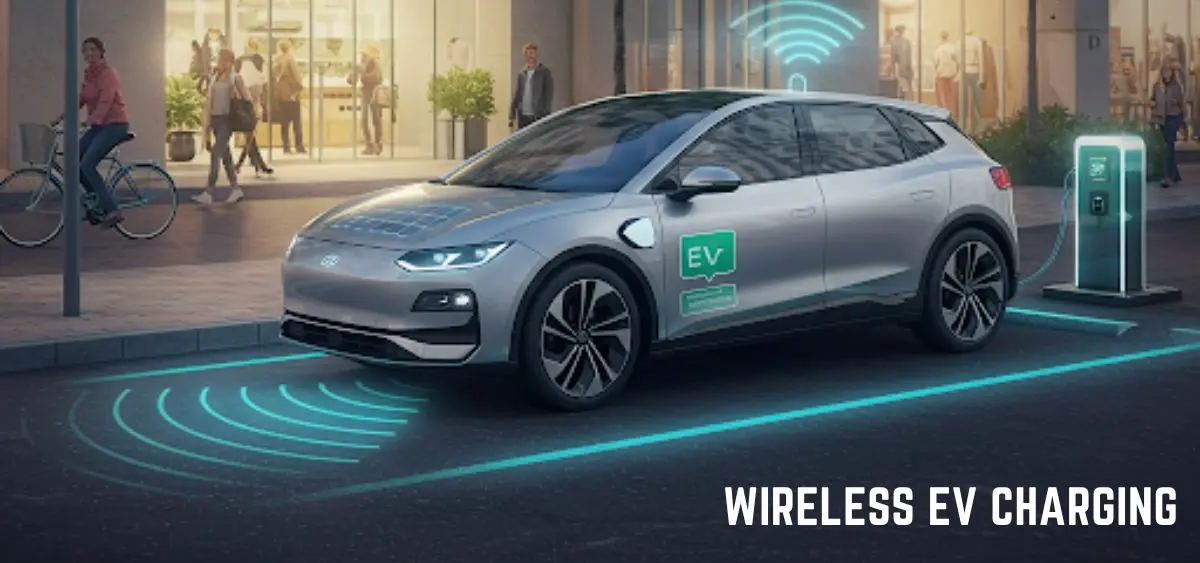

Wireless EV charging allows an electric vehicle to receive electricity without a conventional charging cable or plug. Using wireless power transfer (WPT), the technology transfers energy from a ground-mounted charging pad to a receiver installed underneath the vehicle. In 2026, stationary wireless charging is progressing towards broader commercial use, while charging vehicles as they drive remains an emerging infrastructure technology.
For Indian EV owners, the biggest questions are whether wireless charging is available, how much it costs, which vehicles support it, and whether it can replace conventional charging. The answers depend on vehicle compatibility, charging power, installation costs, and the maturity of local infrastructure.
Wireless EV Charging: Key Takeaways
- Wireless EV charging uses electromagnetic fields to transfer electricity from a transmitter pad to a receiver coil inside or underneath an electric vehicle.
- Static wireless charging is the more practical near-term application, particularly for homes, commercial parking facilities and vehicle fleets.
- Dynamic wireless charging could allow vehicles to receive electricity while moving, but it requires expensive road infrastructure and further real-world validation.
- India has already developed an indigenous 1.5 kW wireless EV charger through VNIT Nagpur and C-DAC Thiruvananthapuram, demonstrating the country’s technical capabilities.
- Wireless charging is not automatically faster or cheaper than plug-in charging. Its principal advantage is convenience and automation.
- Most Indian electric cars still rely on conventional conductive charging, so buyers must verify wireless receiver compatibility before investing in a wireless charging system.
What Is Wireless EV Charging?
Wireless EV charging, also called inductive charging or wireless power transfer, is a technology that transfers electrical energy to an electric vehicle without a physical connection between the charging equipment and the vehicle.
Unlike conventional EV chargers, which use a cable and connector, a wireless system relies on electromagnetic induction. A transmitter coil generates an alternating magnetic field, and a receiver coil on the vehicle captures that energy and converts it into electricity for the battery.
The concept is similar to wireless smartphone charging, but automotive applications require substantially more power, larger components, reliable vehicle communication, and additional safety measures.
Wireless charging can operate in three main ways:
- Static charging: The vehicle receives power while parked over a charging pad.
- Quasi-dynamic charging: The vehicle receives power during short stops, such as at designated parking areas or traffic signals equipped with charging infrastructure.
- Dynamic charging: The vehicle receives electricity while travelling over specially equipped road surfaces.
The distinction matters because stationary charging can use a fixed parking space, whereas dynamic charging requires specialized infrastructure across a road or lane.
How Does Wireless EV Charging Work?
Wireless EV charging uses electromagnetic induction to move energy between two coils without direct electrical contact. The charging process involves several stages.
1. Electricity enters the transmitter system.
Electricity from the grid enters a power electronics unit connected to the ground charging pad. The system converts the incoming electricity into high-frequency alternating current suitable for wireless power transfer.
2. The ground pad generates a magnetic field.
The transmitter coil produces an alternating magnetic field when energized. The charging pad may sit on the floor of a garage or be installed within a designated parking space.
3. The vehicle’s receiver coil captures energy.
A compatible electric vehicle contains a receiver coil underneath its chassis. When the vehicle is positioned over the transmitter, the changing magnetic field induces an electrical current in the receiver coil.
4. Power electronics prepare the electricity.
The receiver-side electronics convert the captured energy into the electrical form required by the vehicle’s battery system. The battery management system monitors charging conditions and helps ensure safe operation.
5. Communication and safety controls manage charging.
The transmitter and vehicle communicate to coordinate charging, monitor performance, and detect potentially unsafe conditions. Depending on the system, charging begins automatically once the vehicle is correctly positioned and authenticated.
An important technical point: Electricity does not simply travel freely across large distances through the air. Automotive inductive charging relies on controlled magnetic coupling between closely positioned transmitter and receiver components.
What Are the Main Types of Wireless EV Charging?
Wireless EV charging systems differ according to where and when power transfer occurs.
| Feature | Static wireless charging | Dynamic wireless charging |
|---|---|---|
| Charging condition | The vehicle is parked | The vehicle is moving. |
| Infrastructure | Fixed charging pad | Coils installed beneath road surfaces |
| Main applications | Homes, offices, depots and parking facilities | Selected roads, bus routes and logistics corridors |
| Installation complexity | Relatively manageable | High |
| Potential benefit | Convenient everyday charging | Reduced charging stops on equipped routes |
| Deployment outlook | More practical for near-term adoption | Dependent on pilots, costs and infrastructure development |
Static wireless charging
Static wireless charging is the most straightforward application. A driver parks over a charging pad and the system transfers power without requiring the driver to connect a cable.
It may be particularly useful for people who park in the same location every night. Commercial parking operators and fleet managers could also use it to automate charging across predictable vehicle schedules.
Dynamic wireless charging
Dynamic charging uses transmitter coils installed underneath a road surface. As a compatible vehicle travels over the equipped section, the system transfers electricity to its receiver.
This approach could eventually support buses, taxis, delivery vehicles and heavy trucks. However, charging only occurs on equipped sections, and the energy received depends on factors such as road coverage, vehicle speed, power-transfer capability and alignment.
A vehicle using a dynamic charging road would still need a suitable battery and conventional charging arrangements unless the wider infrastructure network could reliably meet its energy requirements.
Quasi-dynamic charging
Quasi-dynamic charging sits between the two approaches. It supplies power during brief stops, such as while a bus waits at a terminal or a vehicle remains at a designated stopping point.
Its usefulness depends on whether the power delivered during those short intervals justifies the installation and operating costs.
Wireless EV Charging in India: What Is the Current Status in 2026?
India’s wireless EV charging ecosystem remains at an early stage compared with its established plug-in charging market. Research, technology development and commercialization efforts are progressing, but wireless charging is not yet a mainstream feature across Indian electric cars.
One of the most significant domestic developments is the indigenous wireless charger developed by Visvesvaraya National Institute of Technology (VNIT), Nagpur, in collaboration with the Centre for Development of Advanced Computing (C-DAC), Thiruvananthapuram.
According to the Government of India’s Press Information Bureau, the technology was developed under the National Mission on Power Electronics Technology (NaMPET), with technology transfer undertaken to Global Business Solution Pvt. Ltd. in 2025.
India’s indigenous wireless EV charger: Key specifications
| Parameter | Reported specification |
|---|---|
| Rated power | 1.5 kW |
| Electrical supply | 230 V, 50 Hz, single-phase AC |
| Demonstrated battery | 4.8 kWh, 48 V |
| Reported charging time | Approximately 3 hours |
| Maximum reported efficiency | 89.4% |
| Coil separation | 7.5–12.5 cm |
| Development partners | VNIT Nagpur and C-DAC Thiruvananthapuram |
| Programme | NaMPET, supported by MeitY |
This development is important because it demonstrates domestic engineering capability in contactless charging and power electronics.
However, the demonstrated 1.5 kW system should not be confused with a high-power wireless charger for a modern electric passenger car. Its reported battery size and power rating describe a particular development, not a universal specification for India’s wireless charging market.
Technology transfer also does not, by itself, establish nationwide commercial availability, compatibility with popular electric cars or a confirmed retail price.
What about Indian electric cars and scooters?
Most mainstream electric cars and scooters sold in India are designed around conductive charging systems. A vehicle needs a compatible receiver, power electronics and appropriate control systems to support inductive charging.
For example, prospective buyers of electric cars from Tata Motors, Mahindra, MG Motor and other manufacturers should not assume that a vehicle supports wireless charging simply because it supports AC home charging.
Before buying a wireless charger, confirm compatibility with the exact vehicle variant and obtain written confirmation from the vehicle manufacturer and charging-system supplier.
Is wireless EV charging available in India?
Research and indigenous technology development are established, but widespread public availability of interoperable wireless chargers for ordinary Indian passenger EVs has not been demonstrated by the evidence reviewed for this article.
For most buyers, conventional AC home charging and compatible public charging stations remain the practical options.
What Is the Cost of Wireless EV Charging in India?
There is no reliable, universal retail price for a complete wireless EV charging system in India that can be applied to every vehicle and installation.
The total cost depends on the charging power, transmitter and receiver hardware, vehicle integration, civil work, electrical upgrades, communication systems and installation requirements.
Imported equipment and customised fleet installations may have very different economics from a small research prototype.
Factors that determine installation cost
| Cost component | What influences the expense? |
|---|---|
| Ground charging pad | Power rating, coil design, shielding and construction |
| Vehicle receiver | Compatibility, mounting and integration with vehicle electronics |
| Power electronics | Conversion equipment, cooling and control hardware |
| Electrical installation | Wiring, protection equipment, earthing and supply capacity |
| Civil work | Excavation, floor preparation and installation of embedded pads |
| Software and communication | Authentication, charging control, monitoring and billing |
| Maintenance | Inspection, electronics servicing and repairs |
How can buyers estimate the cost?
A practical estimate should be based on a supplier quotation rather than an unverified online price.
For an individual EV owner, request a quotation covering:
- The transmitter and vehicle receiver as a complete compatible system.
- Installation, taxes and any required electrical upgrades.
- The usable charging power and expected energy-transfer efficiency.
- Warranty coverage for both the ground pad and receiver.
- Annual maintenance and replacement-part costs.
- Compliance documentation and installation safety requirements.
For a fleet operator, the assessment should also include the number of charging bays, vehicle utilisation, time saved per charging session, maintenance costs and electricity tariffs.
Do not use the price of a 1.5 kW research or development system as the purchase price of a commercial passenger-car charger. The equipment specifications and intended applications may be substantially different.
Will wireless EV charging be cheaper than plug-in charging?
Not necessarily. Wireless charging can reduce manual handling and connector wear, but the ground pad, vehicle receiver and power electronics introduce additional costs.
The total cost of ownership depends on how frequently the system is used and the value of its convenience. A fleet that charges dozens of vehicles every day may justify automation more easily than an individual owner who plugs in once overnight.
Market forecasts indicate potential growth, but they should not be interpreted as proof that wireless charging is already inexpensive or widely available in India.
What Is the Efficiency of Wireless EV Charging?
Wireless charging efficiency measures how much of the electricity supplied to the system reaches the intended charging output. Efficiency varies with the system design, alignment, coil separation, power level and operating conditions.
Some modern systems report efficiencies in the low-to-mid 90% range under specified conditions. The Indian 1.5 kW prototype discussed earlier reported a maximum efficiency of 89.4%.
These figures should not be compared without checking where efficiency was measured. A system-level figure that includes all conversion losses is not necessarily equivalent to a measurement taken only across the transmitter and receiver.
Wireless versus wired EV charging
| Comparison | Wireless charging | Conventional wired charging |
|---|---|---|
| Physical connection | No exposed charging connector during energy transfer | Cable and connector required |
| Energy losses | Depends on coils, alignment, and conversion electronics | Depends on charger and vehicle power electronics |
| Convenience | Potentially automatic | Manual connection is normally required |
| Connector wear | Reduced at the vehicle charging interface | Connector and cable experience physical wear |
| Installation | Requires a compatible ground pad and vehicle receiver | Usually simpler for AC home charging |
| Charging speed | Depends on rated wireless power | Broad range from AC charging to high-power DC fast charging |
| Vehicle compatibility | Requires a compatible receiver system | More widely supported by current EVs |
Wireless charging is not inherently more efficient than wired charging. Nor is it necessarily slower in every application. The result depends on the rated power, system design and conditions of use.
For everyday Indian EV ownership, the more important question is whether the wireless system can deliver the required energy reliably at a reasonable total cost.
What Are the Pros and Cons of Wireless EV Charging?
Wireless EV charging offers practical advantages, but the technology also has limitations that matter when evaluating a purchase or infrastructure project.
Benefits of wireless EV charging
1. Greater convenience
Drivers can park over a compatible charging pad without handling a cable. This can simplify everyday charging, especially when the vehicle returns to the same parking space.
2. Reduced physical connector wear
Eliminating repeated plugging and unplugging reduces wear on the vehicle’s conductive charging interface. The system still contains electronic components that require maintenance.
3. Better automation
Wireless charging can work well with autonomous parking, robotaxis and vehicles that return to a depot on a predictable schedule. Automated positioning and charging controls can reduce manual intervention.
4. Fewer exposed electrical contacts
The absence of an exposed conductive connector during energy transfer can reduce some risks associated with physical connections. It does not remove the need for electrical protection, insulation, weatherproofing or safety monitoring.
5. Potential benefits for fleet operations
Taxis, delivery vehicles and other commercial fleets could receive short, automated charging sessions during scheduled parking periods. The value depends on the vehicle’s duty cycle and the charging system’s power.
Challenges of wireless EV charging
1. Higher upfront costs
A compatible receiver and transmitter pad can cost more than a conventional charging setup. Installation may also require ground preparation and electrical upgrades.
2. Limited vehicle compatibility
Many current EVs do not have factory-installed wireless receivers. Retrofitting must be technically approved and compatible with the vehicle’s design.
3. Energy-transfer losses
Wireless charging involves power conversion and magnetic coupling. Misalignment and other operating conditions can reduce efficiency.
4. Installation constraints
The ground pad needs a suitable location, power supply and mounting arrangement. Existing parking spaces may require civil work.
5. Standardisation and interoperability
Vehicles and charging equipment need compatible power-transfer, communication and safety systems. SAE J2954 provides an important framework for light-duty vehicles, but global standardisation does not mean every vehicle can charge on every wireless pad.
6. Dynamic charging infrastructure costs
Electrifying roads involves installation, maintenance, traffic management and grid-integration challenges. These costs make dynamic charging more complex than installing a charger in a private parking space.
What Is the SAE J2954 Wireless Charging Standard?
SAE J2954 is an industry standard for wireless power transfer to light-duty plug-in electric vehicles. Its scope includes interoperability, electromagnetic compatibility, electromagnetic-field considerations, performance and safety testing.
The revised SAE J2954_202408 specification, published on 13 August 2024, defines three charging levels up to 11 kVA and identifies future expansion towards 22 kVA.
It is intended to support both private and public wireless charging. SAE also publishes J2954/2, which addresses wireless power transfer for heavy-duty electric vehicles.
Official reference: SAE J2954 technical standard.
Why does standardisation matter?
- It helps manufacturers develop compatible vehicle receivers and ground charging equipment.
- It establishes a framework for safety and electromagnetic compatibility.
- It supports consistent testing and alignment procedures.
- It can reduce uncertainty for infrastructure operators and consumers.
For Indian buyers, the practical lesson is to check both vehicle compatibility and the relevant compliance documentation. The existence of an international standard does not automatically establish local product certification or guarantee compatibility with a particular vehicle.
How Is Wireless Charging Technology Evolving in 2026?
The industry is moving beyond the question of whether wireless charging can transfer electricity. Researchers and manufacturers are increasingly investigating how it can operate efficiently, safely and economically in real-world transportation systems.
1. Higher-power wireless charging
Research and standardisation efforts are addressing higher charging-power requirements, particularly for commercial vehicles. Higher power can reduce charging time, but it also increases the importance of thermal management, power electronics and electrical infrastructure.
2. Dynamic charging for highways
A major development reported in October 2026 concerns Honda’s in-motion wireless charging technology.
According to Reuters on 5 October 2026, Honda developed a system intended to wirelessly charge electric vehicles, including large trucks, while they are moving. The company plans to test the technology with Taisei and Taisei Rotec on a Japanese highway in the financial year beginning in April 2027 or later.
The planned trial is a significant development, but it is not evidence that dynamic charging roads are already commercially widespread. Honda’s reported plans also leave the technology’s comparative economics to be assessed.
3. Internet of Things and smart charging
Wireless charging systems can integrate with connected sensors, energy-management platforms and communication networks.
A 2026 research review published in IEEE Access examines how wireless power transfer and the Internet of Things can work together for real-time monitoring, charging control, grid-aware scheduling and energy management. It also identifies cybersecurity, interoperability and system cost as continuing challenges.
Source: Karim et al., Wireless Power Transfer and IoT in EV Charging: Opportunities, Challenges, and Future Directions, IEEE Access, 2026.
This integration could help fleet operators coordinate charging according to vehicle availability, electricity prices and operational requirements. However, connected systems also require robust authentication, data protection and cybersecurity.
4. Automated charging for autonomous vehicles
Wireless charging is well suited to vehicles that can park without human assistance. A robotaxi or autonomous delivery vehicle could return to a designated charging bay and begin charging without requiring someone to connect a cable.
The commercial value will depend on reliable parking accuracy, compatible vehicles, charging availability and the cost of equipping the depot.
5. Integration with renewable energy
Wireless charging pads could be integrated with solar generation, battery storage and smart energy-management systems.
Such integration could help operators coordinate vehicle charging with local electricity supply. It would not eliminate energy losses, and the overall environmental benefit would still depend on the electricity mix, equipment production and system lifetime.
Can Wireless EV Charging Work on Indian Roads?
The technology can potentially be adapted to Indian conditions, but practical deployment would require careful planning.
Road and parking conditions
Uneven surfaces, drainage, dust, monsoon waterlogging and road repairs can affect the design and maintenance of ground-mounted or embedded equipment. Installations must be engineered for the specific site rather than assumed to work equally well in every parking environment.
Electricity supply and grid capacity
A wireless charging installation still draws electricity from the grid or another power source. High-power systems and charging depots may require electrical upgrades, load management and appropriate protection equipment.
Vehicle ground clearance and alignment
The distance between the transmitter and receiver influences power transfer. A vehicle’s ground clearance, suspension arrangement and parking position must be compatible with the system’s design.
Urban and commercial applications
Private parking facilities, office campuses, controlled fleet depots and selected public-transport facilities may offer more predictable conditions for initial deployments than unrestricted roads.
For India, a targeted approach is more practical than immediately equipping large highway networks. Pilot projects can help establish real-world performance, maintenance requirements, safety compliance and costs before broader deployment.
Buying Advice: Should You Choose Wireless EV Charging?
For most individual buyers in India, wireless charging should currently be considered a specialised option rather than a standard requirement when choosing an electric car. Before purchasing a system, ask the supplier and vehicle manufacturer the following questions:
- Does the exact vehicle variant support wireless charging?
- Is the receiver factory-installed or an approved retrofit?
- What is the rated power, and what charging performance is achieved under realistic conditions?
- What is the complete installed cost, including the receiver and electrical work?
- Which safety and interoperability standards does the equipment meet?
- What are the warranty, maintenance and replacement-part arrangements?
- Can the vehicle still use its conventional charging port?
For fleets, conduct a pilot with actual vehicles and daily operating schedules before committing to a large installation. Measure energy delivered, availability, downtime, efficiency and total cost of ownership.
A conventional AC wallbox will generally remain the simpler option where charging is performed overnight, and manual connection is not a major inconvenience. Wireless charging becomes more attractive when automation or reduced handling offers a measurable operational advantage.
Expert Insight from Electric Vehicle Talks
The most important development in wireless EV charging is not the disappearance of the charging cable by itself. It is the possibility of integrating energy transfer directly into how vehicles park, operate, and return to service.
For private owners, the value proposition is convenience. For fleet operators, the more important opportunity is reducing the labour and downtime associated with repeated charging connections. For road authorities and transport planners, dynamic charging raises a much larger question: whether continuous energy transfer can justify the cost of electrifying and maintaining road infrastructure.
India’s indigenous 1.5 kW wireless charger is an encouraging example of domestic technology development. However, moving from a demonstrated system to widespread passenger-car adoption requires additional evidence on vehicle compatibility, scalable production, pricing, efficiency and long-term reliability.
The emerging research agenda also highlights a point that is easy to overlook: charging hardware alone is not enough. Communication, cybersecurity, power management, interoperability and safety must work together as part of a complete system.
Our assessment is that stationary wireless charging has the clearer near-term use case, especially for controlled parking and fleet operations, while dynamic charging remains a longer-term infrastructure proposition. The next phase of progress should be judged by independently verified performance, real-world pilots and transparent economic comparisons—not projections alone.
People Also Ask About Wireless EV Charging
1. What is wireless EV charging?
Wireless EV charging transfers electricity to an electric vehicle through electromagnetic induction. A transmitter pad sends energy to a compatible receiver coil on the vehicle without a conventional cable connection.
2. Is wireless EV charging available in India in 2026?
India has developed indigenous wireless charging technology and is progressing in research and technology transfer. However, wireless charging is not yet a mainstream, universally compatible option for Indian passenger EVs.
3. How much does wireless EV charging cost in India?
There is no single verified retail price for a complete wireless charging system in India. Costs depend on the power rating, vehicle receiver, installation work, electrical upgrades and maintenance requirements. Buyers should obtain a site-specific quotation.
4. Is wireless EV charging more efficient than wired charging?
Not inherently. Wireless charging can achieve high efficiency, but performance depends on alignment, coil separation, power electronics and system design. A like-for-like comparison should use the same measurement boundaries and operating conditions.
5. Can an electric car charge while driving?
Yes, in principle, using dynamic wireless power transfer from equipment embedded in a specially equipped road. However, the vehicle must have a compatible receiver, and only equipped road sections can supply energy. Large-scale adoption remains dependent on infrastructure costs and further testing.
6. Does wireless charging damage an EV battery?
Wireless charging does not inherently damage an EV battery. As with other charging methods, battery health depends on factors such as temperature, charging control, battery chemistry and operating conditions. The system must be compatible with the vehicle’s battery management system.
7. Is wireless charging suitable for Indian weather?
It can be designed for Indian weather, but suitability depends on the equipment’s environmental protection, drainage, installation quality and thermal management. A wireless pad is not automatically immune to water ingress, flooding, or heat-related problems.
FAQs About Wireless EV Charging
What is the difference between inductive charging and wireless power transfer?
Inductive charging is a form of wireless power transfer that uses electromagnetic induction between coils. Wireless power transfer is the broader term covering multiple methods of transferring energy without a conventional conductive connection.
Does a wireless EV charger require a special battery?
Usually, the existing battery can be charged if the vehicle’s receiver and power electronics are designed to work with its battery system. A compatible receiver and appropriate control hardware are required; a standard battery alone does not make a vehicle wireless-charging capable.
Can wireless EV charging be installed at home?
Potentially, yes, if a compatible system is available for the vehicle and the property meets the electrical and installation requirements. Buyers should confirm product availability, compatibility, installation costs and applicable compliance requirements before proceeding.
Is wireless EV charging faster than DC fast charging?
Wireless charging is not automatically faster. Stationary systems are commonly intended for convenient charging while parked, whereas high-power DC chargers are designed for rapid energy delivery. The actual charging time depends on the system’s power rating and the vehicle’s charging limits.
What is the SAE J2954 standard used for?
SAE J2954 establishes a technical framework for light-duty vehicle wireless charging, including interoperability, performance, electromagnetic compatibility and safety considerations. It helps guide the development of compatible vehicle and infrastructure systems.
Will wireless charging reduce the size of EV batteries?
Dynamic charging could potentially reduce the battery capacity needed for certain operating patterns if vehicles receive sufficient energy along their routes. However, the outcome depends on route coverage, power availability, vehicle duty cycles, and the need for energy storage when the vehicle leaves equipped roads.
What is the future of wireless EV charging in India?
Likely areas for further development include indigenous power electronics, controlled fleet deployments, automated parking, higher-power systems and research into dynamic charging. Widespread adoption will depend on affordability, vehicle compatibility, safety compliance and demonstrated real-world benefits.
Conclusion: Is Wireless EV Charging the Future?
Wireless EV charging is evolving from a research-led concept into a technology with practical applications in selected parking facilities, commercial fleets and specialised transport systems. Advances in standards, power electronics, automation and dynamic charging research are helping the industry explore what comes next.
For Indian EV owners, however, the immediate priority remains straightforward: confirm that the vehicle supports the technology, establish the complete installation cost and compare its convenience with a conventional charging setup.
India’s indigenous wireless-charger development demonstrates the potential for domestic innovation, while Honda’s planned highway testing illustrates the continuing ambition to extend charging beyond stationary parking. Neither development removes the need to prove affordability, interoperability and real-world reliability.
Wireless charging is unlikely to make conventional charging obsolete overnight. Its long-term importance will depend on where cable-free charging creates enough practical value to justify the additional equipment and infrastructure.
For more electric vehicle news, charging guides, ownership advice and EV technology updates, explore Electric Vehicle Talks.

Related Articles: