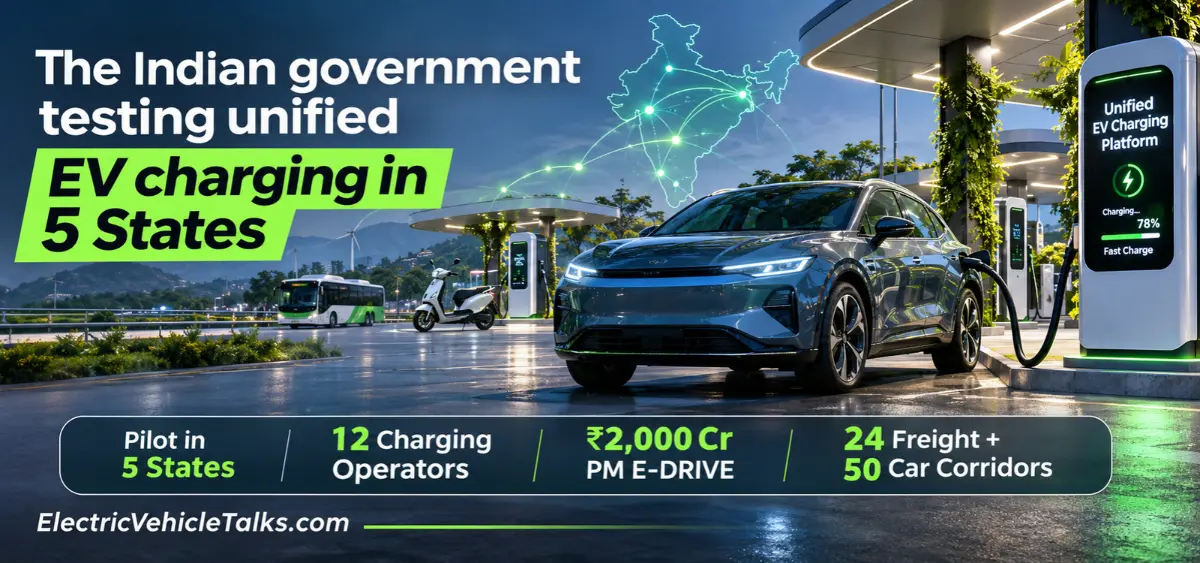

The Indian government has started testing a new digital platform designed to make electric vehicle charging easier, faster, and more convenient. Currently operating as a pilot project across five states, the Unified Bharat e-Charge platform aims to connect multiple charging networks through one interface. This initiative could mark a major step towards Unified EV Charging in India, allowing electric car, scooter, and three-wheeler owners to access charging services without switching between different applications.
With support from leading charging operators and vehicle manufacturers, the government plans to expand the system nationwide once network reliability improves, and the infrastructure becomes more dependable for users.
What Is Unified Bharat e-Charge?
Unified Bharat e-Charge is a government-backed EV charging platform being tested in five Indian states. Developed by NPCI BHIM Services Ltd and BHEL, it enables users to locate, access, and pay for charging services across participating networks through a single interface.
12 Charging Operators Join India’s Unified EV Network
The platform has already attracted around 12 charging network operators. Most manufacturers of electric two-wheelers, three-wheelers, and four-wheelers have also been integrated into the system.
Key highlights include:
- Five states: Pilot testing is currently underway.
- 12 operators: Charging networks have joined the platform.
- One interface: Users can find chargers and make payments.
- Multiple EV categories: Electric two-wheelers, three-wheelers, and cars are covered.
- Nationwide expansion: No official launch deadline has been announced.
Government Plans Nationwide Expansion
Speaking during the inaugural Growth and Readiness for EV Infrastructure Dialogue (GRID), organised by the Society of Indian Automobile Manufacturers (SIAM), Hanif Qureshi, Additional Secretary at the Ministry of Heavy Industries, confirmed the government’s expansion plans.
He explained that additional states would join as the charging network becomes stronger and more reliable.
However, officials have not announced a fixed nationwide rollout date.
₹2,000 Crore Investment to Strengthen EV Charging
The government is supporting Unified EV Charging in India alongside a major infrastructure expansion under the PM E-DRIVE scheme.
The Ministry of Heavy Industries has allocated ₹2,000 crore to support public EV charging infrastructure nationwide.
The initiative focuses on improving charger accessibility, supporting infrastructure development, and encouraging greater electric vehicle adoption.
74 Highway Corridors Identified for Electrification
National highways remain a major priority for India’s charging infrastructure strategy.
The government has identified:
- 24 freight corridors for commercial vehicle electrification.
- Approximately 50 passenger car corridors for charging infrastructure development.
These routes are expected to improve charging accessibility for long-distance electric vehicles.
Private Companies Can Establish Charging Stations
The government has clarified that establishing public EV charging stations is an unlicensed business in India.
Private operators can develop charging facilities without obtaining a specific charging-business licence, subject to applicable technical and regulatory requirements.
Government subsidies will primarily support locations where private investment remains commercially unattractive.
What This Means for EV Owners
Unified EV Charging in India could simplify charging payments, reduce app dependency, and improve access to participating networks.
However, successful nationwide implementation will depend on charging reliability, network expansion, and effective coordination between operators.

Related Articles: