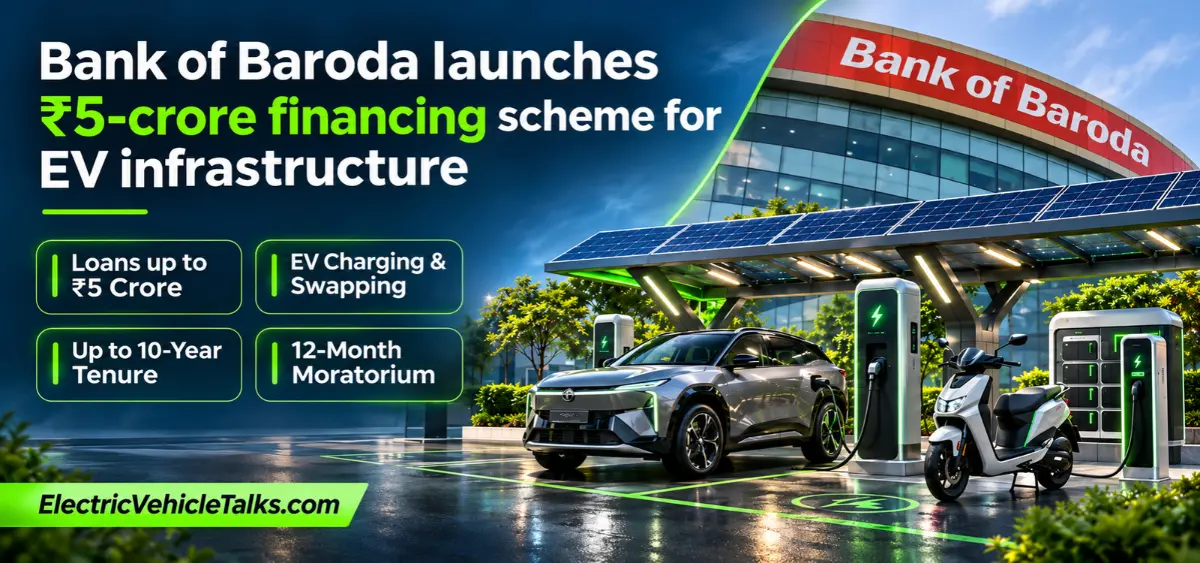

India’s electric vehicle charging network could receive a major financing boost as Bank of Baroda introduces BOB Green PLUG, a dedicated loan scheme for EV infrastructure businesses. Announced on November 19, 2026, the initiative offers funding of ₹10 lakh and above, up to ₹5 crore, for charging stations, battery-swapping facilities, and related projects. Through the Bank of Baroda EV Charging Loan, eligible businesses can access financing with repayment periods extending to 10 years.
The scheme also supports solar-integrated charging facilities, making it relevant to startups, fleet operators, petrol pumps and commercial establishments planning to invest in India’s expanding electric mobility ecosystem.
What Is the bob Green PLUG Scheme?
Bank of Baroda’s bob Green PLUG scheme is an MSME financing initiative offering loans above ₹10 lakh and up to ₹5 crore to establish or expand EV charging stations, battery-swapping facilities and supporting infrastructure across India. Reported interest rates range from 8.15% to 9.60% annually, with repayment terms of up to 10 years, including a moratorium of up to 12 months.
Bank of Baroda Launches ₹5 Crore EV Charging Infrastructure Scheme
Bank of Baroda has announced a specialized financing initiative to support India’s growing electric vehicle infrastructure market.
Named bob Green PLUG, the scheme aims to provide structured financial assistance to businesses investing in EV charging stations, battery-swapping networks and related facilities.
The initiative targets registered micro, small and medium enterprises (MSMEs), charging station operators, startups, fleet owners and commercial establishments planning to develop EV infrastructure.
As electric vehicle adoption increases, reliable charging infrastructure is becoming increasingly important for both private and commercial users.
However, establishing a charging station often requires significant investment in electrical equipment, charging hardware, grid connectivity, site development and supporting facilities.
The new financing scheme seeks to address these investment requirements by offering loans for eligible infrastructure projects.
Importantly, the scheme is not designed to finance the purchase of personal electric vehicles. It focuses on businesses developing and operating charging and battery-swapping infrastructure.

BOB Green PLUG Scheme: Key Features and Loan Details
The Bank of Baroda EV Charging Loan offers several financing features designed for businesses entering or expanding in the electric mobility sector.
| Particulars | Details |
|---|---|
| Scheme Name | bob Green PLUG |
| Bank | Bank of Baroda |
| Loan Amount | Above ₹10 lakh to ₹5 crore |
| Interest Rate | 8.15%–9.60% per annum, as announced |
| Loan Type | Term Loan / Demand Loan |
| Minimum Age | 18 years |
| Maximum Age | 70 years |
| Repayment Period | Up to 120 months (10 years) |
| Moratorium Period | Up to 12 months |
| Target Borrowers | Eligible MSMEs and EV infrastructure businesses |
| Main Purpose | Charging stations, battery swapping and allied infrastructure |
| Renewable Energy Integration | Supported, including rooftop solar |
| Credit Guarantee | CGTMSE coverage for eligible facilities, subject to guidelines |
The applicable loan amount, interest rate, repayment structure and credit guarantee eligibility will depend on the bank’s assessment and applicable lending conditions.
Loan Amount: How Much Funding Can Businesses Get?
Under bob Green PLUG, eligible borrowers can apply for financing ranging from above ₹10 lakh to a maximum of ₹5 crore.
The financing is intended for different types of infrastructure projects, from smaller commercial charging facilities to larger charging networks and battery-swapping operations.
For example, eligible businesses may seek funding to establish charging points at commercial properties, develop charging infrastructure for electric fleets or expand existing facilities.
However, the ₹5 crore figure represents the maximum loan available under the scheme, not a guaranteed amount for every applicant.
Actual sanctions will depend on the proposed project, its financial viability, eligibility and the bank’s credit assessment.
Interest Rates: What Will Borrowers Pay?
One of the important features of bob Green PLUG is its announced interest-rate range of 8.15% to 9.60% per annum.
The applicable interest rate is linked to factors including
- Bank of Baroda’s Repo Linked Lending Rate (BRLLR).
- The amount of financing requested.
- The borrower’s credit rating and risk profile.
- Applicable lending terms at the time of sanction.
Since the financing is linked to the bank’s lending benchmark, borrowers should confirm the applicable rate before signing their loan agreements.
The advertised range should not be interpreted as a fixed interest rate guaranteed throughout the loan tenure.
Applicants should also clarify processing charges, collateral requirements, margin contribution, applicable fees and the final repayment schedule directly with the bank.
Repayment Period: Up to 10 Years With 12-Month Moratorium
The scheme offers a maximum repayment period of 120 months, or 10 years, including a moratorium period of up to 12 months.
This structure may help businesses manage financing during the initial development and operational stages of their charging projects.
For example, an EV charging station may require time for installation, regulatory approvals, electricity connections and customer acquisition before generating consistent revenue.
A moratorium can provide some initial repayment flexibility, depending on the sanctioned terms.
However, a 12-month moratorium does not mean an additional year beyond the 10-year repayment period.
Borrowers should also confirm whether interest must be serviced during the moratorium or whether any amount is capitalised into the outstanding loan balance.
Who Can Apply for the bob Green PLUG EV Infrastructure Loan?
The scheme covers a broad range of eligible businesses and establishments involved in developing charging infrastructure.
1. Registered MSMEs
Registered micro, small and medium enterprises involved in establishing, managing or expanding EV charging facilities fall within the scheme’s target segment.
2. EV Charging Station Operators
Existing charging station operators planning to expand their networks and prospective operators intending to establish new charging facilities can seek financing.
3. Petrol Pumps and Fuel Stations
Petrol pump operators planning to introduce EV charging services alongside conventional fuel facilities are among the target borrowers.
4. Startups and Franchise Operators
Startups and franchise businesses involved in EV charging services or battery-swapping operations are included in the target segment, subject to the bank’s eligibility requirements.
5. Commercial Establishments
The scheme targets establishments interested in developing EV charging facilities, including:
- Hotels and shopping malls.
- Office complexes and business centres.
- Hospitals and educational institutions.
- Logistics parks and commercial properties.
6. Fleet Owners and Transport Operators
Businesses operating electric taxis, delivery vehicles, electric buses or other commercial EV fleets may seek financing for captive charging infrastructure.
Captive charging refers to facilities primarily developed for an organisation’s own vehicles.
7. Residential Societies and Industrial Parks
Residential societies, industrial parks and business centres establishing shared charging facilities are also included in the target segment.
Eligibility and borrower structure will need to satisfy the bank’s MSME lending conditions.
8. Renewable Energy-Integrated Projects
Businesses combining EV charging infrastructure with renewable energy systems, including rooftop solar installations, are also covered.
Being listed as a target segment does not automatically guarantee loan approval. The applicant and project must satisfy the bank’s requirements.
Which EV Infrastructure Projects Are Eligible for Financing?
The financing scope extends beyond traditional electric car charging stations.
Public EV Charging Stations
Businesses can seek financing for charging stations intended to serve members of the public, including eligible facilities at commercial locations and along major transport routes.
Private and Captive Charging Stations
Organizations operating electric vehicle fleets can develop dedicated charging facilities for their own operational requirements.
These projects may be particularly relevant to logistics businesses, delivery operators and commercial fleet owners.
Battery Charging and Swapping Infrastructure
The scheme also supports battery-swapping infrastructure, where compatible depleted batteries are exchanged for charged battery packs.
Battery swapping can be relevant to electric two-wheelers, three-wheelers and certain commercial fleet applications.
Solar-Powered EV Charging Facilities
Projects integrating renewable electricity generation, such as rooftop solar, with EV charging infrastructure are included within the financing scope.
Such integration may help businesses manage electricity consumption and improve their sustainability profile, depending on system design and operating conditions.
Supporting Infrastructure and Utilities
The scheme also permits financing for certain supporting facilities connected to the charging project.
These may include cafeterias, utilities and other eligible ancillary amenities.
Important financing limit: Funding for such ancillary facilities is restricted to the lower of ₹1 crore or 25% of the total sanctioned loan amount.
For example, if a project receives a sanctioned loan of ₹2 crore, the ancillary financing limit would be ₹50 lakh, subject to eligibility.
The overall loan must also remain within the scheme’s maximum limit of ₹5 crore.
CGTMSE Credit Guarantee: Is Collateral-Free Financing Available?
The bob Green PLUG scheme provides for potential coverage under the Credit Guarantee Fund Trust for Micro and Small Enterprises (CGTMSE) framework.
CGTMSE helps facilitate credit to eligible micro and small enterprises through participating lending institutions.
However, credit guarantee coverage is subject to the trust’s applicable rules and the bank’s assessment.
Borrowers should not assume that every loan under the scheme is automatically collateral-free.
The availability of guarantee coverage, required security and related charges should be confirmed during the application process.
Documents Required for the Bank of Baroda EV Charging Loan
Bank of Baroda states that documentation requirements are generally aligned with those applicable to its MSME loans.
The exact document checklist may vary depending on the borrower’s legal structure, business history and proposed project.
Applicants should be prepared to discuss or submit documents such as:
- Identity and KYC documents: PAN and other applicable identity and address proofs.
- Business registration: MSME/Udyam registration and applicable business incorporation or registration records.
- Financial information: Available financial statements, bank statements, income-tax returns and other documents requested for credit appraisal.
- Project report: Proposed charging location, equipment requirements, estimated investment, operating expenses and revenue projections.
- Premises documents: Ownership, lease or other site-use records, where applicable.
- Project permissions: Relevant regulatory approvals and statutory licences.
- Equipment information: Supplier quotations and installation estimates, if required.
These are preparatory examples rather than a separately published, mandatory bob Green PLUG document checklist. The bank advises applicants to contact a branch for the exact requirements.
How to Apply for the BOB Green PLUG Scheme?
Businesses interested in the scheme should approach their nearest Bank of Baroda branch for application guidance.
A practical application process may involve the following steps.
Step 1: Check Eligibility
Confirm that the proposed borrower and EV charging business activity fall within the scheme’s eligible categories.
Step 2: Prepare a Project Plan
Develop a business proposal outlining the charging infrastructure, proposed location, equipment costs, power requirements and estimated revenue.
Step 3: Arrange Required Documents
Collect KYC records, business registration documents, financial records and applicable approvals requested by the bank.
Step 4: Approach the Bank
Visit a Bank of Baroda branch and enquire about financing under the bob Green PLUG scheme.
Step 5: Complete the Loan Application
Submit the application form and supporting documents according to the bank’s instructions.
Step 6: Loan Assessment and Sanction
The bank will assess the proposal and communicate its decision, along with the applicable interest rate, security requirements and repayment conditions.
This is a general branch-based application guide. A separate, fully online application process has not been confirmed in the published scheme details.
Important Terms and Conditions Applicants Must Know
Before applying, prospective borrowers should understand the following requirements.
Regulatory Approvals and Licences
Applicants must make available relevant mandatory approvals, registrations and statutory licences for verification, wherever applicable under central, state or local laws.
The exact requirements can vary according to the project location, charging equipment and business structure.
Government Subsidies and Incentives
Borrowers are responsible for applying directly for any eligible government subsidies or incentives.
Such benefits will depend on the rules and eligibility conditions of the relevant government schemes.
The Bob Green PLUG loan does not automatically provide a subsidy.
KYC and Financial Documentation
Applicants must comply with the bank’s KYC requirements and submit any additional documents requested during loan processing.
Bank Lending Conditions
Loan approval remains subject to applicable Bank of Baroda lending policies, credit appraisal and other terms and conditions.
The bank may seek additional information or impose project-specific conditions before sanctioning a loan.
Why Could Bob Green PLUG Matter for India’s EV Industry?
India’s electric mobility transition depends not only on increasing electric vehicle sales but also on building dependable charging infrastructure.
One challenge for charging infrastructure businesses is the capital required to establish facilities before they generate stable revenue.
The bob Green PLUG scheme could help eligible enterprises access financing for infrastructure expansion.
Its potential significance extends across several areas.
- Charging Network Expansion: Financing may help operators establish additional charging locations and expand existing facilities.
- Business Opportunities: Startups, MSMEs and franchise operators may gain another financing option for commercially viable EV projects.
- Commercial Fleet Electrification: Dedicated charging infrastructure can support businesses transitioning their fleets to electric vehicles.
- Battery-Swapping Growth: Financing for swapping facilities could help operators develop infrastructure for compatible electric vehicle segments.
- Renewable Energy Integration: Support for solar-integrated charging facilities may encourage investment in cleaner electricity solutions.
Nevertheless, the long-term success of charging infrastructure depends on several commercial factors, including electricity costs, charger utilisation, equipment reliability, location and customer demand.
Financing availability alone does not guarantee that every charging station will become profitable.
What Should Businesses Check Before Taking an EV Charging Loan?
Prospective borrowers should evaluate their projects carefully before committing to long-term financing.
Important considerations include:
- Location and demand: Are enough electric vehicles likely to use the charging facility?
- Electricity availability: Can the site support the required power connection and charging capacity?
- Installation costs: Does the project budget account for chargers, electrical upgrades, civil work and approvals?
- Operating expenses: What are the expected electricity, maintenance, networking and staffing costs?
- Revenue projections: Can realistic charger utilisation support loan repayments?
- Loan conditions: What interest rate, collateral, margin contribution and repayment schedule will apply?
A financially viable charging project requires more than installing chargers. Businesses should assess the expected utilisation and operating costs before deciding how much to borrow.
FAQs about Bank of Baroda EV Charging Loan
1. What is the Bank of Baroda bob Green PLUG scheme?
bob Green PLUG is a specialised MSME financing scheme supporting the establishment and expansion of EV charging stations, battery-swapping facilities and related infrastructure in India.
2. What is the maximum loan amount under BOB Green PLUG?
Eligible borrowers can apply for loans above ₹10 lakh and up to a maximum of ₹5 crore, subject to the bank’s approval.
3. What is the interest rate on the BOB Green PLUG loan?
The announced interest-rate range is 8.15% to 9.60% per annum. The applicable rate depends on factors such as the bank’s lending benchmark, loan amount and borrower credit rating.
4. Can startups apply for an EV charging infrastructure loan?
Yes. Startups and franchise operators engaged in eligible EV charging or battery-swapping activities are included in the scheme’s target segment, subject to the bank’s eligibility requirements.
5. Can petrol pump owners apply for this scheme?
Yes. Petrol pump and fuel station operators establishing EV charging facilities are among the target borrowers.
6. Does BOB Green PLUG finance solar-powered EV charging stations?
Yes. Eligible projects integrating charging infrastructure with renewable energy solutions, including rooftop solar installations, are supported.
7. What is the maximum repayment period?
The maximum repayment period is 120 months, or 10 years, including a moratorium of up to 12 months.
8. Is collateral required for a bob Green PLUG loan?
Collateral and security requirements depend on the bank’s lending assessment. Eligible facilities may receive CGTMSE credit guarantee coverage, but this does not automatically make every loan collateral-free.
9. Can residential societies get financing for EV charging stations?
Residential societies establishing common EV charging facilities are included in the scheme’s target segment, subject to applicable borrower eligibility and lending conditions.
10. How can businesses apply for the scheme?
Interested businesses should contact their nearest Bank of Baroda branch to confirm eligibility, obtain the required application documents, and understand the loan approval process.
Conclusion: Bank of Baroda EV Charging Loan
Bank of Baroda’s BOB Green PLUG scheme introduces a dedicated financing option for businesses investing in India’s electric vehicle charging ecosystem.
With loans above ₹10 lakh and up to ₹5 crore, announced interest rates ranging from 8.15% to 9.60%, and a maximum repayment period of 10 years, the initiative could support eligible MSMEs, charging station operators, startups and fleet businesses.
Its coverage of battery-swapping facilities, captive charging infrastructure, and solar-integrated projects also reflects the growing needs of India’s electric mobility sector.
However, applicants should carefully evaluate project feasibility, financing costs and regulatory requirements before applying.
For eligible businesses planning to establish or expand charging networks, the scheme offers another potential source of infrastructure funding.

Related Articles: