If you are searching for EV Subsidy in Mizoram in 2026, the first thing to understand is that Mizoram’s EV support is not structured around one simple, statewide cash-subsidy table.
The Mizoram Electric Vehicle Policy 2024, which remains the governing state framework in 2026, focuses heavily on creating an EV ecosystem: priority registration, charging infrastructure, favorable electricity tariffs, parking support, traffic-related concessions, and phased electrification of government and public transport.
For buyers, this distinction matters.
A person purchasing an electric scooter, motorcycle, car, bus, or commercial EV in Mizoram should calculate three separate benefits: state-level concessions, central PM E-DRIVE support where applicable, and the lifetime running-cost advantage of electric propulsion.
The policy was notified on 10 September 2024 and has a five-year validity period covering 2024–2029. It targets at least 5% EV adoption by 2029. The policy also envisages approximately 56,250 EVs during its policy period.
Mizoram’s starting point was small. The policy recorded only 477 EVs against 316,385 internal-combustion-engine vehicles as of 1 July 2024. That makes the state’s EV transition less about replacing an already mature EV fleet and more about building the infrastructure needed for the next stage of adoption.
How much EV subsidy is available in Mizoram in 2026?
| EV category | Mizoram state cash subsidy | Road-tax / registration position | PM E-DRIVE / central support in 2026 |
|---|---|---|---|
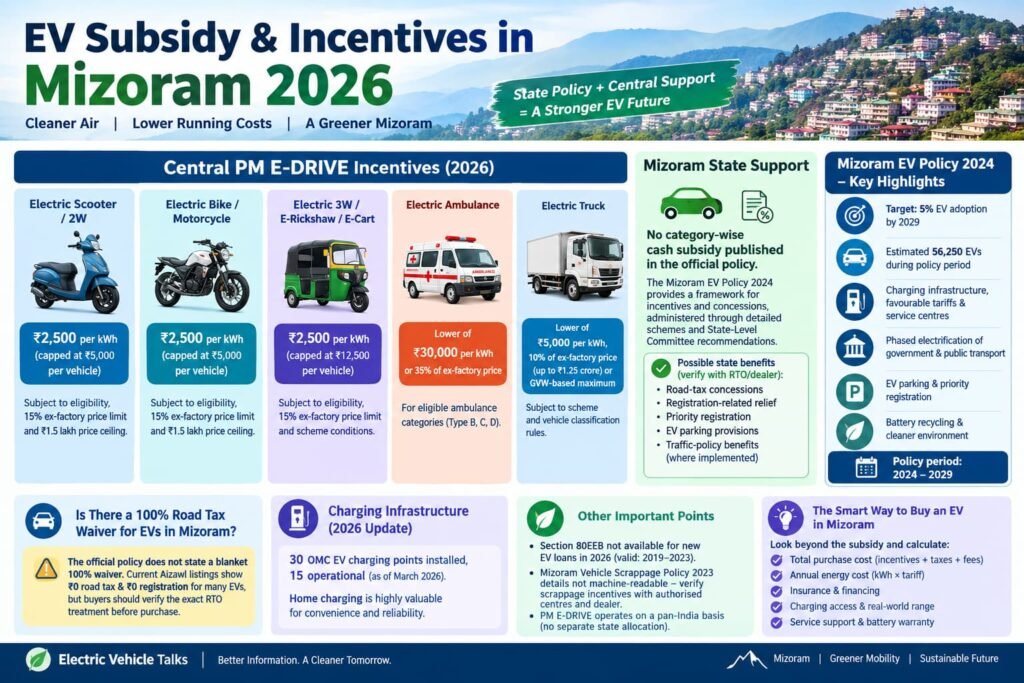
| Electric scooter / 2W | No verified category-wise state amount | Current market/on-road data show road-tax and registration relief; verify at RTO/dealer. | ₹2,500/kWh, capped at ₹5,000 for eligible e-2Ws, with a ₹1.5 lakh ex-factory price ceiling; the Aug. 2026 amendment extends this through Mar. 2028. |
| Electric bike/motorcycle | No verified Mizoram cash amount | Same policy position as other EVs; confirm invoice/RTO treatment | Same e-2W PM E-DRIVE incentive, if eligible. |
| Electric 3W / e-rickshaw / e-cart | No verified state amount | Policy-wide EV concessions; confirm current registration/RTO treatment | The PM E-DRIVE framework provides ₹2,500/kWh, capped at ₹12,500 for the specified e-rickshaw/e-cart segment under the applicable period. (PM E-DRIVE) |
| Electric car / private 4W | No verified Mizoram purchase subsidy | Current Aizawl on-road listings generally show ₹0 road tax and ₹0 registration fee, but the official 2024 policy itself does not state a 100% waiver; verify before purchase. | No direct PM E-DRIVE purchase incentive for private passenger e-cars |
| Electric bus | No verified state per-bus cash subsidy | Policy supports charging and phased bus electrification. | PM E-DRIVE supports e-buses through its national program/procurement framework rather than a general retail buyer subsidy. |
| Electric ambulance | No verified Mizoram state cash amount | Check applicable state registration/tax treatment. | Demand incentive: lower of ₹30,000/kWh or 35% of ex-factory price for eligible e-ambulances. |
| Electric truck | No verified Mizoram state cash amount | Check applicable commercial-vehicle treatment. | Lower of ₹5,000/kWh, 10% of ex-factory price up to ₹1.25 crore, or applicable GVW-based maximum. |
The Income Tax Department says it applies to EV loans sanctioned between 1 April 2019 and 31 March 2023, with a ₹1.5 lakh interest-deduction limit.
What is the EV Subsidy in Mizoram in 2026?
There is an important misconception surrounding the phrase “EV subsidy in Mizoram.”
The state’s official policy does not publish a straightforward table saying, for example, “₹50,000 for every electric car” or “₹20,000 for every electric scooter.”
Instead, the policy creates a framework under which incentives and subsidies, if introduced, can be administered by the Directorate of Transport based on State-Level Committee recommendations.
That makes the term “EV subsidy” broader than a direct purchase discount.
For a Mizoram EV buyer, the practical benefits can include:
- Road-tax treatment
- Registration-related concessions
- Priority registration
- Traffic-management exemptions where implemented
- EV parking provisions
- Lower energy cost
- Central PM E-DRIVE incentives for eligible categories
- Expanding public-charging infrastructure. Know about government subsidies for EV charging stations
- Better long-term protection from petrol and diesel price volatility
This is why buyers should not compare EV policies solely by the size of a headline cash subsidy.
Mizoram EV Policy 2026: What Has Changed?
The biggest 2026 development is institutional rather than a new headline cash incentive.
On 23 March 2026, Mizoram’s Transport Department notified a State-Level Committee for implementation of the Mizoram Electric Vehicle Policy 2024.
That matters because the original policy already provided the framework, but implementation requires coordination between transport, finance, planning, commerce and industries, power, tourism, employment and skill development, science and technology, and pollution-control authorities.
The policy’s broader objectives include:
- At least 5% EV adoption by 2029
- Around 56,250 EVs during the policy period
- More charging stations
- Better electricity supply for EV charging
- Favorable charging tariffs
- EV service centers
- EV adoption in government fleets
- Phased replacement of passenger buses with battery-electric vehicles
- EV-focused tourism areas
- EV-related skill development and entrepreneurship
For the industry, this is important because an EV market cannot scale on purchase incentives alone.
A scooter buyer can purchase an EV tomorrow. But if there is no technician, charger, spare-parts ecosystem, or reliable electricity supply six months later, adoption slows down.
Mizoram’s policy recognizes that problem.
Is There a 100% Road-Tax Waiver for EVs in Mizoram?
This is one area where buyers should be particularly careful.
Several EV price portals currently show electric cars in Aizawl with ₹0 road tax and ₹0 registration charges. That suggests substantial practical relief for EV owners.
However, the official Mizoram Electric Vehicle Policy 2024 supplied for this article does not itself specify a blanket 100% road-tax and registration-fee waiver.
Instead, it says the nodal agency may notify separate registration and road-tax arrangements and that implementation of incentives and concessions is subject to detailed schemes, guidelines, and statutory notifications.
So the safest 2026 buying advice is
Do not treat a website’s “100% road-tax waiver” figure as sufficient proof. Ask the dealer to show the exact RTO calculation and verify the amount before making payment.
This is especially important for expensive electric cars, where even a small change in registration or taxation can materially alter the on-road price.
EV Subsidy in Mizoram for Electric Cars
For private electric cars, the central policy picture is relatively clear.
PM E-DRIVE does not provide a general direct purchase subsidy for private passenger electric cars.
Therefore, a person buying an electric car in Aizawl should not assume that a ₹10 lakh or ₹20 lakh EV will automatically receive a central PM E-DRIVE discount.
The more relevant financial factors are
- Current Mizoram road-tax treatment
- Registration charges
- Insurance
- Dealer discounts
- Manufacturer offers
- Financing rate
- Home-charging installation
- Electricity cost
- Battery warranty
- Actual annual kilometers
For example, if an electric car is primarily used for commuting around Aizawl and can be charged at home, the ownership equation can be significantly different from that of a petrol car even without a large upfront purchase subsidy.
What should an electric-car buyer verify?
Before booking, ask the dealer for a written breakup showing:
| Cost component | What to check |
|---|---|
| Ex-showroom price | Manufacturer’s current price |
| Road tax | Exact Mizoram RTO amount |
| Registration fee | Exact applicable charge |
| Insurance | Compare at least 2–3 quotes. |
| FASTag | Actual amount |
| Accessories | Avoid unnecessary bundled products. |
| Home charger | Included or extra |
| Installation | Wiring and civil work included? |
| Central incentive | Confirm whether applicable. |
| State incentive | Ask for the notification/order number. |
This simple checklist can prevent a surprising number of on-road-price disputes.
EV Subsidy in Mizoram for Electric Scooters
Electric scooters are particularly relevant to Mizoram.
Aizawl has steep roads, dense urban travel patterns, and relatively short daily commuting distances for many users. That makes an electric two-wheeler an interesting alternative to a petrol scooter.
The central PM E-DRIVE programme provides support to eligible electric two-wheelers with advanced batteries.
Under the August 2026 amendment, the incentive for eligible registered e-2Ws is
₹2,500 per kWh, capped at ₹5,000 per vehicle, subject to the scheme’s eligibility requirements and the 15% ex-factory-price limitation.
The eligible vehicle must also meet the scheme’s requirements, including the applicable ex-factory price ceiling.
This is a central incentive rather than a Mizoram-specific purchase subsidy.
Why this matters
Suppose an eligible electric scooter has a 3 kWh battery.
A simple ₹2,500 × 3 calculation would produce ₹7,500, but the scheme cap is ₹5,000.
So the buyer cannot assume that battery capacity automatically translates into an equivalent cash discount.
The dealership’s PM E-DRIVE eligibility and e-voucher process should be checked at the time of purchase.
EV Subsidy in Mizoram for Electric Bike & Motorcycle
Electric motorcycles fall under the two-wheeler category when they meet the applicable PM E-DRIVE classification and eligibility requirements.
For buyers, the same principle applies as with electric scooters:
Check eligibility, not just battery size.
A motorcycle with a larger battery does not necessarily receive a proportionally larger subsidy because the PM E-DRIVE incentive is capped.
The bigger question for Mizoram riders is often range rather than subsidy.
On mountainous roads, energy consumption can increase because of:
- Frequent elevation changes
- Stop-start traffic
- Heavy loads
- Aggressive acceleration
- Rain
- Low temperatures in some conditions
- Passenger carrying
An electric motorcycle advertised with a headline laboratory range should therefore be evaluated against the rider’s real route.
EV Subsidy in Mizoram for Electric Three-Wheelers
Electric three-wheelers are particularly relevant to shared mobility and commercial transport.
Under PM E-DRIVE, registered electric rickshaws and e-carts have had an incentive structure based on battery capacity, subject to per-vehicle and ex-factory-price limits.
For the applicable period in the PM E-DRIVE notification, the incentive was
₹2,500/kWh, capped at ₹12,500 per eligible e-rickshaw/e-cart, with the applicable ex-factory price and 15% limits.
However, PM E-DRIVE eligibility depends on vehicle classification, registration, and other scheme conditions.
For commercial buyers, subsidy is only one part of the business calculation.
The more useful calculation is
Daily revenue – electricity cost – finance EMI – maintenance – downtime = operating surplus
An electric three-wheeler with a slightly higher purchase price can still make commercial sense if its energy and maintenance costs are sufficiently lower.
EV Subsidy in Mizoram for Electric Bus
Electric buses require a different policy approach from electric scooters.
A private consumer cannot simply walk into a showroom and claim a universal PM E-DRIVE bus subsidy.
The central programme includes support for e-buses through national procurement and deployment mechanisms. The scheme envisages support for thousands of e-buses, while Mizoram’s own EV policy calls for phased replacement of passenger buses with battery-electric vehicles.
For Mizoram, the important issue is route planning.
Mountain roads can make an electric bus considerably more energy-intensive than a flat-city route.
Before deploying an e-bus, operators should study:
- Route elevation
- Average passenger load
- Daily kilometers
- Charging turnaround
- Depot electricity capacity
- Battery usable capacity
- Seasonal operating conditions
- Regenerative braking opportunities
- Emergency charging availability
For a state like Mizoram, route-specific energy modelling is more valuable than relying on a generic range figure.
EV Subsidy in Mizoram for Electric Ambulances
Electric ambulances received a dedicated category under PM E-DRIVE.
The official PM E-DRIVE portal identifies eligible ambulance categories, including:
- Patient Transport Vehicle / Type B
- Basic Life Support / Type C
- Advanced Life Support / Type D
The demand incentive is the lower of:
- ₹30,000 × battery capacity in kWh, or
- 35% of the vehicle’s ex-factory price
The category therefore has a significantly different incentive formula from electric two-wheelers.
For healthcare institutions, however, the purchasing decision should not be based on subsidy alone.
An electric ambulance requires reliable charging, high uptime, adequate cabin HVAC performance, and route planning. Hospitals should consider installing dedicated charging capacity rather than depending entirely on public chargers.
EV Subsidy in Mizoram for Electric Trucks
The PM E-DRIVE framework also supports eligible electric trucks.
The current central structure uses a combination of battery capacity, ex-factory price, and gross vehicle weight criteria.
The demand incentive is the lowest applicable amount among:
- ₹5,000 × battery capacity in kWh
- 10% of ex-factory price, subject to the scheme’s stated ceiling
- The applicable maximum incentive based on GVW
Electric-truck operators should also pay close attention to the scrapage requirements and vehicle classification applicable under the scheme.
For Mizoram, this segment could become strategically important because road connectivity and fuel logistics can affect operating costs.
What Benefits Does the Mizoram EV Policy Provide?
The policy’s most interesting feature is that it treats EV adoption as an ecosystem problem.
1. Priority registration
The policy provides for priority registration of EVs over ICE vehicles by the District Transport Officers.
2. Traffic-policy preference
If an odd-even system is implemented to control pollution, the policy provides for EV exemption.
This provision became controversial after the policy was notified, and actual local enforcement should be checked rather than assumed.
3. EV parking
The government plans to reserve parking spaces for EVs at important locations.
4. Charging infrastructure
The policy encourages slow and fast charging stations at:
- Transport depots
- Interstate Bus Terminus
- Deputy Commissioner’s offices
- Secretariat
- State Central Library
- Urban Affairs parking areas
- Government facilities
- Hotels
- Shopping malls
- Cinemas
- Apartments
5. Electricity connections
The policy says EV charging stations should receive priority electricity connections, with an intended completion period of approximately 15 days after application.
6. Government land
Where available, government land may be facilitated for EV charging stations under public-private partnership arrangements.
These measures may not appear as dramatic as a ₹50,000 purchase subsidy, but they can be important for long-term EV adoption.
Charging Infrastructure in Mizoram: The Real 2026 Challenge
If there is one factor that deserves more attention than subsidy headlines, it is charging.
The 2024 policy explicitly recognizes the need for adequate electricity supply, charging points, favorable tariffs, and service centers.
The 2026 market picture remains relatively early-stage.
The All India EV review, using Oil Marketing Company data, reported 30 OMC EV charging points installed and 15 operational as of March 2026. That does not represent every private, home, or captive charger in the state.
For a private EV owner, the practical lesson is simple:
Home charging remains extremely valuable.
If you own a car in Aizawl and can charge overnight, public charging becomes a backup rather than the foundation of your ownership model.
That changes the ownership experience dramatically.
How Much Does EV Charging Cost?
Electricity tariffs vary by connection type and usage, so there is no single universal Mizoram charging cost.
A simple calculation is:
Charging cost = battery energy consumed × electricity tariff
For example, if an EV consumes 15 kWh to travel 100 km and the effective electricity cost is ₹8 per kWh:
15 × ₹8 = ₹120 per 100 km
That is ₹1.20 per km.
Actual consumption will vary substantially according to vehicle size, speed, road gradient, weather, and driving style.
For Mizoram, hill driving makes real-world testing especially important.
EV Ownership in Mizoram: What Buyers Should Look For
For electric scooters
Prioritise:
- Removable or convenient charging options
- Hill-climbing performance
- Battery warranty
- Service availability
- Water resistance
- Real-world range
- Brake performance
- Tyre quality
For electric cars
Prioritise:
- Home charging
- DC fast-charging capability
- Ground clearance
- Hill efficiency
- Battery warranty
- Local service support
- Parts availability
- Real-world range
For commercial EVs
Prioritise:
- Daily route distance
- Payload
- Charging downtime
- Financing cost
- Battery warranty
- Service response time
- Residual value
- Fleet utilization
Common Mistakes for EV Buyers in Mizoram Should Avoid
Mistake 1: Assuming every EV receives the same subsidy
It doesn’t.
PM E-DRIVE has category-specific eligibility rules, while Mizoram’s state policy does not publish a universal cash-subsidy amount for every EV.
Mistake 2: Treating an online subsidy calculator as an official notification
Calculators are useful for estimates but should not replace the RTO or government notification.
Mistake 3: Ignoring charging
A discounted EV is not necessarily a convenient EV.
Mistake 4: Using claimed range as the only metric
Hill roads can change energy consumption considerably.
Mistake 5: Forgetting insurance
Insurance can materially affect the on-road cost, especially for premium EVs.
Mistake 6: Assuming Section 80EEB is available for a new 2026 loan
It isn’t for newly sanctioned loans. The Income Tax Department specifies the eligible loan-sanction period as 1 April 2019 to 31 March 2023.
What About the Mizoram Vehicle Scrappage Policy?
The second uploaded document, the Mizoram Gazette Vehicle Scrapping Policy 2023, could not be machine-read from the supplied PDF because its contents were image-based/unextractable.
Therefore, this article does not assign a specific scrappage incentive amount from that document.
That distinction is important.
If you are planning to scrap an old petrol or diesel vehicle before purchasing an EV, ask the dealer and authorized scrapping facility for the current applicable scrappage certificate and incentive rules rather than assuming that a generic national or state figure applies.
Mizoram Electric Vehicle Policy Timeline
March 2024
The state approved registration of certain electric two-wheelers for two-wheeler taxi operations.
10 September 2024
The Mizoram Electric Vehicle Policy 2024 was notified.
The policy became effective from the date of notification and was designed for five years.
September 2024
The EV traffic-access provisions generated public debate, particularly around preferential treatment under an odd-even system.
2025
EV adoption continued to develop against a backdrop of charging and fuel-supply challenges.
23 March 2026
The Transport Department notified the State-Level Committee responsible for implementation and oversight.
2026
Mizoram remains within the original 2024–2029 policy period rather than operating under a completely new 2026 EV policy.
2029
The current policy’s target year is 2029 to achieve at least 5% EV adoption.
Can You Apply for EV Subsidy in Mizoram 2026 Online?
There is no single universal “Mizoram EV subsidy application” form covering every vehicle category.
For an eligible PM E-DRIVE vehicle, the process is generally dealer-led and linked to the central scheme’s authentication and e-voucher mechanism.
For state-level benefits, the relevant process can depend on the notification and implementation mechanism issued by the Transport Department.
Practical application checklist
Before paying the booking amount:
- Ask the dealer whether the vehicle is eligible for PM E-DRIVE.
- Ask for the applicable central incentive amount in writing.
- Ask whether a PM E-DRIVE e-voucher is generated.
- Ask for the Mizoram road-tax calculation.
- Ask for the registration-fee calculation.
- Ask for the relevant state notification/order supporting any claimed concession.
- Check the final RTO invoice.
- Keep the registration certificate and purchase invoice safely.
This is much safer than relying on a generic “EV subsidy available” banner.
EVs, FAME II, and PM E-DRIVE: What Is the Difference?
FAME II was the earlier major national EV-demand incentive programme.
PM E-DRIVE is its more recent successor framework.
The Mizoram policy itself references FAME II because it was drafted in 2024, but buyers in 2026 should use the current PM E-DRIVE rules for central incentives rather than assuming that older FAME II rates still apply.
This is particularly important because PM E-DRIVE rules have already been amended several times.
As of August 2026, the central scheme’s overall outlay is ₹11,900 crore, and the scheme runs through 31 March 2028, subject to fund availability and category-specific provisions.
The government also states that PM E-DRIVE operates on a pan-India basis rather than assigning a separate state-level demand-incentive budget to Mizoram.
Expert Insight from Electric Vehicle Talks
The most useful way to understand the EV Subsidy in Mizoram is to stop looking at subsidy as a single number.
Mizoram is building its EV market from a very small base. The official 2024 policy recorded just 477 EVs compared with more than 316,000 ICE vehicles. Its ambition of approximately 56,250 EVs during the policy period therefore represents a substantial shift from the starting point.
The policy’s strength is its ecosystem approach.
Priority registration, charging infrastructure, electricity connections, parking, skills, and government-fleet electrification can collectively reduce the friction involved in EV adoption.
But infrastructure will determine how quickly the market can scale.
For an individual buyer, my practical recommendation is to calculate the total cost of ownership rather than chasing the largest advertised subsidy.
For a scooter, home charging and battery warranty can matter more than a few thousand rupees of incentive.
For an electric car, road-tax treatment and charging access can matter more than a central subsidy that the vehicle does not qualify for.
For a commercial EV, utilization and charging downtime can make a much larger difference to profitability than the initial purchase incentive.
And for buses and ambulances, charging reliability should be treated as mission-critical infrastructure.
This is where Electric Vehicle Talks sees the larger story: Mizoram’s EV transition is not simply about selling more electric vehicles. It is about building a mobility system that works with the state’s terrain, energy needs, and road network.
A Practical EV Buying Formula for Mizoram
Before signing the purchase agreement, calculate:
Effective purchase cost = Ex-showroom price – eligible central incentive – verified state incentive + taxes/fees + insurance + charger cost
Then calculate:
Annual energy cost = Annual kilometres × real-world kWh/km × electricity tariff
Finally:
Five-year ownership cost = Purchase cost + financing + energy + insurance + maintenance – resale value
This calculation gives a much more realistic picture than comparing petrol and EV sticker prices.
Sustainability Impact
The environmental case for EVs becomes stronger when the vehicle replaces kilometers that would otherwise be powered by petrol or diesel.
Mizoram’s own EV policy connects electric mobility with cleaner air, lower fossil-fuel dependence and energy security.
The policy also proposes battery recycling support and encourages the development of recycling businesses focused on recovering valuable materials.
That matters because the EV transition does not end when a vehicle’s battery reaches the end of its first useful life.
Second-life applications, battery recycling, and responsible end-of-life management will become increasingly important as the EV fleet grows.
People Also Ask
Does Mizoram give an EV subsidy in 2026?
Mizoram’s 2024 EV policy does not publish a verified category-wise cash-subsidy table. It provides a framework for incentives and concessions, while the central PM E-DRIVE scheme provides demand incentives for eligible categories.
Is road tax free for electric cars in Mizoram?
Current Aizawl EV price listings show ₹0 road tax for electric cars, but the official 2024 Mizoram EV Policy text supplied for this article does not itself state a blanket 100% road-tax waiver. Buyers should verify the current RTO treatment before purchase.
Is registration free for EVs in Mizoram?
Current Aizawl EV price calculations commonly show ₹0 registration fees. However, buyers should verify the applicable charge on the actual RTO/dealer invoice rather than relying solely on online calculators.
Does PM E-DRIVE subsidize electric cars?
PM E-DRIVE does not provide a general direct purchase incentive for private passenger electric cars. Its supported categories include electric two-wheelers, three-wheelers, ambulances, trucks, buses, and charging infrastructure.
How much of the PM E-DRIVE subsidy is available for an electric scooter?
For eligible registered electric two-wheelers under the amended 2026 scheme, the incentive is ₹2,500 per kWh, capped at ₹5,000 per vehicle, subject to eligibility and the applicable price/capping rules.
Is Section 80EEB available for a new EV loan in 2026?
No. Section 80EEB covers qualifying EV loans sanctioned between 1 April 2019 and 31 March 2023. The Income Tax Department lists a maximum deduction of ₹1.5 lakh on eligible interest.
How many EV chargers are available in Mizoram?
The 2026 All India EV review reports 30 OMC EV charging points installed and 15 operational as of March 2026. The figure does not represent every home, private, or captive charger in the state.
EV Subsidy in Mizoram FAQs
1. What is the Mizoram Electric Vehicle Policy?
The Mizoram Electric Vehicle Policy 2024 is the state’s five-year EV framework, valid from 2024 to 2029. It focuses on EV adoption, charging infrastructure, service support, priority registration, parking, and phased electrification of public and government transport.
2. What is the main benefit of buying an EV in Mizoram?
The practical benefits can include lower operating costs, EV-related registration and road-tax concessions where currently applicable, priority registration, traffic-policy benefits where implemented, and access to central incentives for eligible PM E-DRIVE categories.
3. Can I claim PM E-DRIVE and Mizoram benefits together?
Potentially, where both schemes permit it. The Mizoram policy says its incentives can be fungible, subject to State-Level Committee approval. Buyers should confirm the specific vehicle and benefit combination with the dealer and Transport Department.
4. Is there a cash subsidy for electric cars in Mizoram?
No verified category-specific Mizoram cash subsidy for private electric cars has been identified in the official policy material reviewed for this article. Current road-tax and registration treatment should be checked separately.
5. Are electric scooters eligible for PM E-DRIVE?
Eligible registered electric two-wheelers can qualify under PM E-DRIVE if they satisfy the scheme’s technical, pricing, battery, and registration requirements.
6. Are electric buses supported in Mizoram?
Mizoram’s EV policy explicitly calls for phased replacement of passenger buses with battery-electric vehicles. National PM E-DRIVE support for e-buses operates through the central programme and its deployment/procurement framework rather than a universal retail cash subsidy.
7. Should I buy an EV in Mizoram mainly because of the subsidy?
The better approach is to evaluate the complete ownership equation: verified incentives, road-tax treatment, home charging, electricity cost, financing, insurance, service availability, battery warranty, and expected annual kilometers.
Conclusion
The EV Subsidy in the Mizoram 2026 story is more nuanced than a simple “₹X subsidy per vehicle” headline.
Mizoram’s governing EV framework is the Mizoram Electric Vehicle Policy 2024, which runs through 2029 and aims to accelerate EV adoption while building charging infrastructure, service capacity, and supporting infrastructure.
For buyers, the biggest mistake is assuming that every EV receives the same financial incentive.
Electric scooters and motorcycles may qualify for PM E-DRIVE support. Electric cars generally do not receive a direct PM E-DRIVE purchase incentive. Electric ambulances and trucks have separate central incentive structures. Electric buses are supported through a different deployment model.
At the state level, road-tax and registration treatment can materially reduce the on-road cost, but buyers should verify the current RTO treatment because the official policy framework does not itself publish the blanket 100% waiver often quoted online.
The next phase of Mizoram’s EV journey will depend less on headlines and more on execution: reliable charging, electricity availability, trained technicians, battery recycling, financing, and vehicles suited to mountainous terrain.
For consumers, that means the smartest EV purchase is not necessarily the one with the biggest advertised subsidy. It is the one whose purchase price, charging access, range, running cost, and after-sales support make sense for the way you actually travel.
Electric mobility in Mizoram is still at an early stage, but the foundations are being built. For buyers and industry stakeholders, following policy changes closely will be just as important as comparing the latest EV models.
Explore more EV buying guides, charging insights, ownership resources, and electric-mobility policy updates from Electric Vehicle Talks as India’s EV ecosystem continues to evolve.
Related Articles: