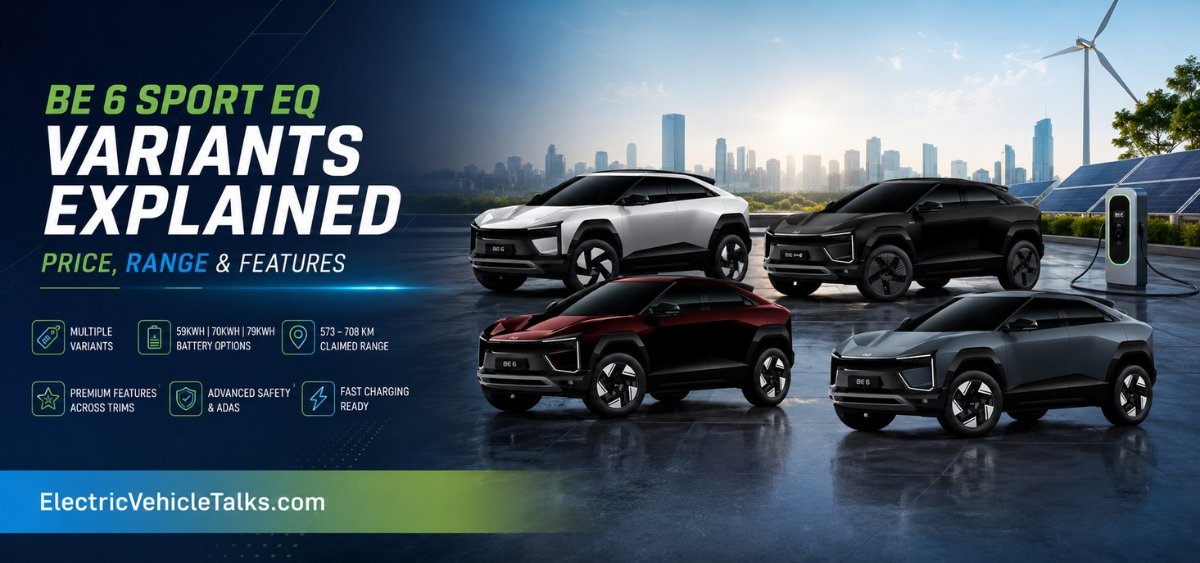

The Mahindra BE 6 SportEQ is offered across eight core variants—ONE, TWO, THREE, THREE+, FOUR, FE, FE FOUR, and Launch Edition—with 59 kWh, 70 kWh, and 79 kWh battery choices depending on the trim. Prices without a wall charger start at ₹19.45 lakh and rise to ₹26.95 lakh, while the 59 kWh ONE and TWO can also be bought under Mahindra’s Battery-as-a-Service model.
For most buyers, however, the decision is more complicated than simply moving up the price ladder.
The SPORTEQ THREE 70 kWh looks like one of the strongest range-and-value combinations, while the THREE+ 79 kWh makes a compelling case for buyers wanting maximum battery capacity without paying for every flagship technology. Buyers interested in L2+ ADAS, adaptive suspension, Google Gemini, AR HUD, and the most advanced technology package will want to look at the FOUR.
Enthusiasts have another choice: the Formula E Freedom Edition, which keeps the distinctive dual-screen, halo-style driver-focused cockpit and adds a more motorsport-inspired character.
Mahindra introduced SPORTEQ on 15 August 2026 and says customer deliveries begin on 26 August 2026. The company describes it as a distinct evolution of the BE 6 built around design, software, AI, personalization, and performance.
This detailed BE 6 SportEQ variants comparison breaks down exactly what changes as you move through the range.
BE 6 SportEQ Variants Price List
Mahindra officially lists prices without the wall charger and installation cost.
Based on the pricing supplied for this comparison, adding the 11.2 kW charger package increases each listed vehicle price by ₹75,000.
| Variant | Battery | Without Charger | With 11.2 kW Charger |
|---|---|---|---|
| SPORTEQ ONE | 59 kWh | ₹19.45 lakh | ₹20.20 lakh |
| SPORTEQ TWO | 59 kWh | ₹20.95 lakh | ₹21.70 lakh |
| SPORTEQ THREE | 59 kWh | ₹21.95 lakh | ₹22.70 lakh |
| SPORTEQ THREE | 70 kWh | ₹22.95 lakh | ₹23.70 lakh |
| SPORTEQ THREE+ | 70 kWh | ₹23.95 lakh | ₹24.70 lakh |
| SPORTEQ THREE+ | 79 kWh | ₹24.95 lakh | ₹25.70 lakh |
| SPORTEQ FE | 79 kWh | ₹24.45 lakh | ₹25.20 lakh |
| SPORTEQ FOUR | 79 kWh | ₹26.95 lakh | ₹27.70 lakh |
| SPORTEQ FE FOUR | 79 kWh | ₹26.95 lakh | ₹27.70 lakh |
| SPORTEQ Launch Edition | 79 kWh | ₹26.95 lakh | ₹27.70 lakh |

BE 6 SportEQ Battery, Range and Performance Comparison
All three battery configurations use a rear-wheel-drive layout, with power increasing as battery capacity rises.
| Specification | 59 kWh | 70 kWh | 79 kWh |
| Motor power | 170 kW | 180 kW | 210 kW |
| Approx. power | 231 PS | 245 PS | 286 PS |
| Torque | 360 Nm | 360 Nm | 360 Nm |
| Drive | RWD | RWD | RWD |
| MIDC P1+P2 Range | 573 km | 651 km | 708 km |
| 11.2 kW AC 0–100% | ~6 hours | ~7 hours | ~8 hours |
| 7.2 kW AC 0–100% | ~8.7 hours | ~10.2 hours | ~11.7 hours |
| DC 20–80% | ~20 min | ~20 min | ~20 min |
| Required DC input for quoted time | 140 kW/400A | 160 kW/400A | 180 kW/400A |
These are the figures published in Mahindra’s SPORTEQ brochure.
1. 59 kWh
The 59 kWh battery is available on ONE, TWO, and THREE.
With 170 kW of power and a claimed 573 km MIDC range, it is already substantial enough for buyers whose driving consists mainly of commuting, weekend trips, and occasional highway journeys.
2. 70 kWh
The 70 kWh battery is offered with THREE and THREE+.
Its claimed 651 km MIDC range provides a significant buffer over the entry battery without forcing the buyer all the way into the 79 kWh price band.
For mixed city-highway ownership, this may be the most rational battery size.
3. 79 kWh
The largest battery powers THREE+, FE, FOUR, FE FOUR, and Launch Edition.
It develops 210 kW (roughly 286 PS) while retaining 360 Nm and has a claimed 708 km MIDC range.
For frequent highway travelers and buyers who want the strongest BE 6 performance, this is the obvious battery.
Full BE 6 SportEQ Variants Features Comparison
Mahindra has built the SPORTEQ range progressively. Rather than repeating every feature at every level, higher trims generally add equipment over the variant below them.
The official brochure also warns that not every advertised feature is available on every variant and that accessories may require a separate purchase.
| Major Feature | ONE | TWO | THREE | THREE+ | FOUR |
| Dual 12.3-inch screens | ✓ | — | — | — | — |
| Triple 12.3-inch screens | — | ✓ | ✓ | ✓ | ✓ |
| Halo instrument panel | ✓ | — | — | — | — |
| Straight instrument panel | — | ✓ | ✓ | ✓ | ✓ |
| 6 airbags | ✓ | ✓ | ✓ | ✓ | ✓ |
| Drift Mode | ✓ | ✓ | ✓ | ✓ | ✓ |
| Revive / Revive SOS | ✓ | ✓ | ✓ | ✓ | ✓ |
| Single-pedal drive | ✓ | ✓ | ✓ | ✓ | ✓ |
| Wireless Android Auto/Apple CarPlay | ✓ | ✓ | ✓ | ✓ | ✓ |
| 16-speaker Harman Kardon | — | ✓ | ✓ | ✓ | ✓ |
| Dolby Atmos | — | ✓ | ✓ | ✓ | ✓ |
| NFC/Digital Key | — | ✓ | ✓ | ✓ | ✓ |
| 540° camera | — | ✓ | ✓ | ✓ | ✓ |
| Dual-zone climate control | — | ✓ | ✓ | ✓ | ✓ |
| Panoramic glass roof | — | — | ✓ | ✓ | ✓ |
| Powered driver memory seat | — | — | ✓ | ✓ | ✓ |
| Front-ventilated seats | — | — | ✓ | ✓ | ✓ |
| Personalised tailgate messaging | — | — | — | ✓ | ✓ |
| L2 ADAS | — | — | — | ✓ | ✓ |
| Power tailgate | — | — | — | ✓ | ✓ |
| Adaptive suspension | — | — | — | — | ✓ |
| Google Gemini | — | — | — | — | ✓ |
| L2+ ADAS | — | — | — | — | ✓ |
| Secure360 Pro | — | — | — | — | ✓ |
| AR HUD | — | — | — | — | ✓ |
| HandsFree Park | — | — | — | — | ✓ |
| In-car gaming | — | — | — | — | ✓ |
| Karaoke | — | — | — | — | ✓ |
| Knee airbag | — | — | — | — | ✓ |
The progression above is based on Mahindra’s detailed variant ladder in the brochure. THREE+ adds features including L2 ADAS, personalized tailgate messaging, additional lighting, and convenience upgrades; FOUR then adds adaptive suspension, L2+ ADAS, Gemini-based TEQ_Talk, AR HUD, Secure360 Pro, and additional entertainment technologies.
1. BE 6 SPORTEQ ONE 59 kWh: Is the Base Variant Enough?
Price: ₹19.45 lakh without charger
Battery: 59 kWh
MIDC range: 573 km
Power: 170 kW
Drive: RWD
SPORTEQ ONE is surprisingly sophisticated for an entry variant.
It gets dual Super HD screens, a Halo instrument panel, six airbags, multiple drive modes, Drift Mode, Revive and Revive SOS, multi-level regeneration, single-pedal driving, wireless Android Auto and Apple CarPlay, 5G connectivity, and OTA software updates.
The ONE also gets R18 wheels with aero covers.
The interior uses a distinctive Sage Green & Grey theme. Mahindra’s brochure confirms that interior alongside Racing Tan & Black for TWO through FOUR, Black & Firestorm Orange for FE models, and Racing Tan for the Launch Edition.
Best for: Buyers who want the BE 6 driving experience and technology without paying for premium comfort equipment.
Main compromise: You miss the triple-screen dashboard, Harman Kardon audio, 540-degree camera, panoramic roof, and ADAS.
2. SPORTEQ TWO: The Technology Upgrade
Price: ₹20.95 lakh without charger
Battery: 59 kWh
The ₹1.50 lakh jump from ONE to TWO changes the cabin considerably.
TWO introduces the coast-to-coast triple HD screen setup, 16-speaker Harman Kardon audio with Dolby Atmos, NFC compatibility for the Digital Key/Card, a 540-degree camera, manual drive video recording, individual TPMS, front parking sensors, and TEQ_Me user-profile auto detection.
You also gain dual-zone automatic climate control, power-folding ORVMs, an auto-dimming IRVM, a windshield auto-defogger, and a wireless phone charger.
For buyers who care about everyday technology more than maximum range, TWO could actually be more satisfying than the entry ONE.
3. SPORTEQ THREE: Best Value Variant?
THREE is available with two batteries:
- 59 kWh – ₹21.95 lakh
- 70 kWh – ₹22.95 lakh
The 70 kWh upgrade therefore costs just ₹1 lakh based on Mahindra’s introductory pricing.
That makes the THREE 70 kWh batteries particularly interesting.
Its claimed MIDC range rises from 573 km to 651 km, while output increases from 170 kW to 180 kW.
THREE also brings a fixed panoramic glass roof, sequential indicators, acoustic laminated door glass, a six-way powered driver memory seat, ventilated front seats, and reverse auto-dip ORVM functionality.
Why THREE 70 kWh makes so much sense
It balances the four things most Indian family EV buyers are likely to care about:
range + comfort + technology + price.
You do sacrifice ADAS, which arrives at THREE+, but for buyers who don’t consider ADAS essential, THREE 70 kWh arguably delivers one of the cleanest value propositions in the range.
4. SPORTEQ THREE+ 70 kWh vs 79 kWh
Prices without charger:
| Variant | Price | MIDC Range | Power |
| THREE+ 70 kWh | ₹23.95 lakh | 651 km | 180 kW |
| THREE+ 79 kWh | ₹24.95 lakh | 708 km | 210 kW |
Another ₹1 lakh buys the 79 kWh battery.
That gives you 57 km more claimed MIDC range and a substantial power increase from 180 kW to 210 kW.
THREE+ also represents an important equipment threshold.
It introduces L2 ADAS, personalized LED tailgate messaging, signature C-shaped animated DRLs, ambient lighting, a power-operated tailgate with gesture control, electrically deployed flush handles, an additional front wireless charger and more.
Mahindra calls its personalized tail-lamp functionality TEQ_xting, allowing the rear lighting system to display personalized messages.
EVT pick: THREE+ 79 kWh
If your budget stretches to roughly ₹25 lakh ex-showroom, the 79 kWh THREE+ may be the best all-around BE 6 SportEQ variant.
You get the biggest battery and 210 kW motor while avoiding the roughly ₹2 lakh jump to FOUR.
5. SPORTEQ FE 79 kWh: The Enthusiast’s Alternative
Price: ₹24.45 lakh without charger
Battery: 79 kWh
Power: 210 kW
Range: 708 km MIDC
FE stands for the Formula E Freedom Edition.
Unlike regular SPORTEQ variants from TWO upwards, FE deliberately returns to the driver-focused dual-screen cockpit and Halo instrument-panel design.
Mahindra pairs it with Black & Firestorm Orange interiors and Formula E-inspired visual treatment.
It also gets Intelligent Adaptive Suspension and unique SonicSuite virtual engine sounds.
Mahindra further says the Freedom Edition offers an Acceleration Boost function capable of taking it from 0 to 100 km/h in a claimed 6.44 seconds.
This isn’t necessarily the sensible family choice.
That’s exactly the point.
The FE is for someone who wants their EV to feel like more than a silent transportation appliance.
6. SPORTEQ FOUR: The Technology Flagship
Price: ₹26.95 lakh without charger
Battery: 79 kWh
FOUR is where SPORTEQ becomes a showcase for Mahindra’s software-defined vehicle strategy.
Key additions over THREE+ include:
- Intelligent Adaptive Suspension
- L2+ ADAS with five radars and one vision camera
- Google Gemini-powered TEQ_Talk
- Secure360 Pro
- Continuous DVR
- Knee airbag
- StraightAhead VisionX AR HUD
- HandsFree Park
- Qualcomm 8295 Snapdragon chipset
- Dolby Vision
- Private Audio
- In-car gaming
- Karaoke
- VR-LED smart air filtration
- Infinity Roof with integrated LED pattern
The uploaded brochure says L2+ ADAS uses five radars plus one vision camera, compared with the one-radar/one-camera L2 system introduced on THREE+.
This distinction is more meaningful than a longer equipment list suggests.
FOUR is effectively the variant where the BE 6 transforms from a feature-rich EV into a technology flagship.
How Does Google Gemini Work in the BE 6 SportEQ?
Mahindra calls the feature TEQ_Talk, built with Google Gemini.
According to Mahindra, it uses 17 specialized AI agents and supports more than 100 core functions and 48 apps, covering navigation, entertainment, vehicle controls, general information, and other interactions.
Instead of navigating through multiple touchscreen menus, the long-term idea is straightforward: increasingly natural voice interaction with the vehicle.
This is also important from an industry perspective.
EV differentiation is moving beyond battery size and acceleration. Software, connected services, digital keys, OTA updates and AI-powered interfaces are becoming increasingly important parts of the ownership experience.
Mahindra reinforces that point by saying new SPORTEQ software and technology features will be rolled out in phases to eligible existing BE 6, XEV 9e, and XEV 9S owners beginning in January 2027, subject to model and variant compatibility.
SPORTEQ FOUR vs Launch Edition vs FE FOUR
All three sit at ₹26.95 lakh without a charger, but they target different personalities.
| Feature | FOUR | Launch Edition | FE FOUR |
| Battery | 79 kWh | 79 kWh | 79 kWh |
| Motor | 210 kW | 210 kW | 210 kW |
| MIDC Range | 708 km | 708 km | 708 km |
| Cockpit | Triple screen | Triple screen | Dual screen |
| Instrument panel | Straight | Straight | Halo |
| Adaptive suspension | Yes | Yes | Yes |
| L2+ ADAS | Yes | Yes | Yes |
| Interior | Racing Tan & Black | Racing Tan | Black & Firestorm Orange |
| Character | Technology flagship | Premium/exclusive | Motorsport-inspired |
| Price without charger | ₹26.95 lakh | ₹26.95 lakh | ₹26.95 lakh |
The Launch Edition is visually distinguished by its Graphite Storm exterior and full Racing Tan leatherette interior.
The brochure’s page 2 visual also highlights its coast-to-coast triple-screen cockpit, Racing Tan cabin, and straight instrument panel.
FE FOUR takes another route, retaining the dual-screen, race-ready cockpit and Halo design. It additionally gets FE-specific Capsense push-button start and a Capsense Virtual Engine Sound switch.
Which BE 6 SportEQ Variant Is Best?
There isn’t one correct answer because the battery and feature priorities vary considerably.
| Buyer Type | Recommended Variant | Why |
| Lowest purchase price | ONE 59 kWh | Core performance and technology |
| Tech-focused buyer on budget | TWO 59 kWh | Triple screens + premium audio + camera |
| Best range/value balance | THREE 70 kWh | 651 km MIDC + strong comfort package |
| Best overall | THREE+ 79 kWh | 708 km + 210 kW + L2 ADAS |
| Driving enthusiast | FE 79 kWh | Adaptive suspension + Formula E character |
| Maximum technology | FOUR 79 kWh | L2+ ADAS, Gemini, AR HUD, adaptive suspension |
| Premium collector-style choice | Launch Edition | Exclusive Graphite Storm/Racing Tan treatment |
| Fully loaded enthusiast | FE FOUR | Flagship technology with Formula E cockpit |
Our value pick: SPORTEQ THREE 70 kWh
For mainstream family buyers, THREE 70 kWh offers an excellent balance at ₹22.95 lakh before the charger.
Our all-round pick: SPORTEQ THREE+ 79 kWh
For buyers with a larger budget, THREE+ 79 kWh is arguably the range sweet spot because the biggest battery, strongest motor, and L2 ADAS arrive before the expensive flagship technology jump.
Our enthusiast pick: FE 79 kWh
The FE gives you the biggest battery, adaptive suspension, and the more theatrical Formula E personality at ₹24.45 lakh.
BE6 SportEQ Charging Explained
Charging is another reason not to choose solely by claimed range.
Mahindra lists 7.2 kW and 11.2 kW AC wall-charging capability along with a portable charger option of up to 3.2 kW.
| Battery | 11.2 kW AC | 7.2 kW AC | DC 20–80% |
| 59 kWh | 6 hours | 8.7 hours | 20 min at suitable 140 kW/400A input |
| 70 kWh | 7 hours | 10.2 hours | 20 min at suitable 160 kW/400A input |
| 79 kWh | 8 hours | 11.7 hours | 20 min at suitable 180 kW/400A input |
What does that mean in real life?
If you have dedicated parking and an appropriate electrical connection, overnight home charging should cover the vast majority of normal ownership.
The 79 kWh battery’s eight-hour quoted 0–100% time with an 11.2 kW wall charger fits naturally into an overnight charging window.
Public DC charging is more relevant during intercity travel.
Remember, however, that a charger’s headline rating doesn’t guarantee your vehicle will continuously receive that power. Battery temperature, state of charge, charger capability, thermal management, and operating conditions can all influence charging speed.
What Will the BE 6 SportEQ Cost to Charge?
A simple illustration helps.
Assume residential electricity costs ₹8 per kWh and ignore charging losses:
| Battery | Theoretical Full-Charge Electricity Cost |
| 59 kWh | ~₹472 |
| 70 kWh | ~₹560 |
| 79 kWh | ~₹632 |
Real electricity consumed from the grid will be higher because charging is not 100% efficient.
Public fast charging can also cost considerably more per unit than residential electricity.
For owners with reliable home charging, therefore, battery size should be chosen primarily around driving requirements and highway usage, not fear of everyday charging inconvenience.
What Is BaaS on BE 6 SportEQ?
Mahindra has introduced Battery-as-a-Service on selected 59 kWh variants.
The official introductory structure is:
| Variant | BaaS Upfront Price | Battery Charge |
| ONE 59 kWh | ₹11.45 lakh | ₹3.75/km |
| TWO 59 kWh | ₹12.95 lakh | ₹3.75/km |
Mahindra states that the ₹3.75/km figure is calculated considering 60 km per day usage.
BaaS can dramatically reduce the initial vehicle purchase price, but buyers should not compare ₹11.45 lakh directly with a conventional EV purchase price.
The battery payment shifts from upfront capital expenditure to an ongoing usage-linked cost. BAAS in Electric Vehicles
Before choosing BaaS, examine:
- expected annual kilometres;
- financing terms;
- battery subscription conditions;
- ownership period;
- resale/transfer conditions;
- insurance implications;
- early termination terms;
- total five- or seven-year cost.
For a high-mileage owner, conventional battery-inclusive ownership and BaaS can produce very different lifetime economics.
Benefits of the BE 6 SportEQ
The SPORTEQ range has several meaningful strengths.
Battery choice: Three battery capacities allow customers to buy according to usage rather than simply trim level.
Strong claimed range: The official MIDC figures stretch from 573 km to 708 km depending on battery.
Rear-wheel drive: Every version retains the enthusiast-oriented RWD architecture.
Technology depth: OTA updates, 5G connectivity, Gemini integration, digital keys, and connected functions make software a genuine part of the vehicle proposition.
Safety progression: Six airbags are standard, with L2 and then L2+ ADAS appearing further up the range.
Fast charging: Mahindra claims 20–80% in around 20 minutes when the appropriate high-power DC charging conditions are available.
Practical storage: The brochure lists a 455-liter boot plus a 45-liter frunk.
Challenges Buyers Should Consider
No EV should be evaluated from brochure numbers alone.
MIDC range is not guaranteed real-world range
Speed, temperature, air-conditioning, traffic, elevation, payload, tire pressure, and driving style affect consumption.
Mahindra itself states that actual performance can vary depending on driving conditions and other external factors.
Bigger isn’t automatically better
Someone driving 30–40 km daily with reliable home charging may receive little practical benefit from paying substantially more for a 79 kWh model.
ADAS should remain an assistance system
Even sophisticated L2/L2+ systems do not make the vehicle autonomous. Indian roads can present unpredictable lane markings, pedestrians, motorcycles, animals, construction zones, and mixed traffic.
The driver remains responsible.
Check home-charging feasibility before delivery
Apartment residents should confirm parking access, electrical load, cable routing, society permissions, and charger installation requirements before buying.
Common Mistakes When Choosing a BE 6 SportEQ Variant
The first mistake is buying the biggest battery simply because it has the highest range figure. Estimate your actual weekly usage first.
The second is comparing prices without checking whether the charger is included.
Third, don’t confuse FE with a simple cosmetic edition. Its adaptive suspension, cockpit layout, and performance-oriented treatment make its positioning meaningfully different.
Fourth, don’t buy FOUR purely for its feature count if you will never use the advanced technology. THREE+ can offer a much stronger value equation.
Finally, never calculate BaaS affordability only from the lower upfront price. Compare total ownership cost.
India Context: Incentives, Infrastructure and Ownership
India’s EV policy environment is shifting from broad passenger-EV purchase subsidies toward ecosystem development, charging infrastructure, and targeted vehicle categories.
Buyers should therefore not assume that a private BE 6 SportEQ automatically receives a central FAME-style purchase subsidy. Applicable road-tax or registration benefits can vary by state and can change over time.
Check the current state EV policy and final on-road quotation before booking.
Charging access is also becoming increasingly important as large-battery EVs make intercity travel practical. For a 79 kWh BE 6, the distinction between a nominal public charger and a reliable high-power DC charger becomes significant because the brochure’s 20-minute 20–80% claim assumes a suitably powerful charger input.
The larger trend is clear: Indian EV buyers are moving beyond asking only, “How many kilometres does it go?”
Increasingly, they are asking:
How quickly can it charge? How good is the software? Can it update itself? Does ADAS work well? Is the battery warranty reassuring? Can I comfortably take it between cities?
That is precisely the market SPORTEQ is trying to address.
Battery Warranty and Long-Term Ownership
Mahindra highlights a lifetime battery warranty for the first registered owner, applicable to private registration.
If ownership changes, the brochure states that the high-voltage battery warranty becomes 10 years or 200,000 km, whichever comes earlier.
That’s an important detail for both original buyers and future used-EV customers.
The brochure also says Mahindra’s INGLO electric architecture has accumulated more than 80 crore km across 80,000+ owners in its eSUV portfolio as of August 2026.
Expert Insight from Electric Vehicle Talks
The most interesting thing about the BE 6 SportEQ variants isn’t the 708 km headline range or even the triple-screen dashboard.
It’s how Mahindra has separated battery choice from technology choice.
THREE 70 kWh is the rational long-distance family specification. THREE+ 79 kWh is arguably the enthusiast-family sweet spot. FE prioritizes character. FOUR prioritizes technology.
That gives buyers genuine reasons to choose different variants instead of automatically assuming the top model is best.
The other important development is software.
Mahindra describes the BE 6 as a software-defined vehicle and says SPORTEQ technology will begin reaching compatible existing BE 6, XEV 9e, and XEV 9S vehicles through phased OTA updates from January 2027.
That is the direction modern EV ownership is heading: the vehicle you buy today increasingly has the potential to gain functionality after delivery.
For detailed EV ownership analysis, charging guides and Indian electric-car comparisons, readers can explore Electric Vehicle Talks.
People Also Ask
How many BE 6 SportEQ variants are there?
Mahindra officially describes eight variants: ONE, TWO, THREE, THREE+, FOUR, FE, FE FOUR, and Launch Edition. Because some trims are available with multiple battery capacities, there are 10 battery/trim combinations before separating charger-package pricing.
What is the cheapest BE 6 SportEQ variant?
The battery-inclusive SPORTEQ ONE 59 kWh starts at ₹19.45 lakh ex-showroom without a wall charger. Mahindra also lists ONE under BaaS at ₹11.45 lakh plus a battery usage charge of ₹3.75/km under the stated usage structure.
Which BE 6 SportEQ variant is best?
For value, THREE 70 kWh batteries are particularly attractive. For the strongest overall combination of range, performance, and equipment without going to the flagship, THREE+ 79 kWh is our pick.
Which BE 6 SportEQ has the longest range?
All 79 kWh configurations have the highest official MIDC P1+P2 figure of 708 km. The 70 kWh version is rated at 651 km and the 59 kWh at 573 km.
Does the BE 6 SportEQ have ADAS?
Yes, THREE+ introduces L2 ADAS, while FOUR, Launch Edition, and FE FOUR receive the more advanced L2+ ADAS package according to the variant chart.
How quickly can the BE 6 SportEQ charge?
Mahindra quotes approximately 20 minutes from 20% to 80% for all three batteries when connected to suitably capable DC equipment: 140 kW/400A for 59 kWh, 160 kW/400A for 70 kWh and 180 kW/400A for 79 kWh.
When do BE 6 SportEQ deliveries start?
Mahindra announced that deliveries would begin on 26 August 2026, coinciding with Onam.
FAQs
1. What batteries are available in the BE 6 SportEQ?
The range offers 59 kWh, 70 kWh, and 79 kWh battery packs. Availability depends on the variant.
2. Is the BE 6 SportEQ AWD?
No. Mahindra’s official specification table lists the SPORTEQ range as rear-wheel drive (RWD).
3. Does the BE 6 SportEQ get a panoramic sunroof?
Yes. THREE and higher applicable variants introduce the Infinity Roof/fixed panoramic glass roof, while flagship versions add integrated LED treatment.
4. What is the difference between SPORTEQ THREE and THREE+?
THREE focuses on comfort with features such as the panoramic glass roof, powered memory driver’s seat and ventilated front seats. THREE+ adds L2 ADAS, personalized tailgate messaging, upgraded exterior lighting, a power tailgate, and additional convenience equipment.
5. Is BE 6 SPORTEQ FE worth buying?
It can be particularly attractive for enthusiasts. At ₹24.45 lakh without a charger, it combines the 79 kWh battery and 210 kW motor with adaptive suspension, a Formula E-inspired dual-screen cockpit, and performance-oriented styling.
6. Does the BE 6 SportEQ support Apple CarPlay and Android Auto?
Yes. The brochure specifies wireless Android Auto and Apple CarPlay among the core technology features.
7. Does BE 6 SportEQ FOUR have Google Gemini?
Yes, FOUR and the corresponding flagship variants gain TEQ_Talk with Google Gemini, alongside a more powerful Snapdragon chipset, AR HUD, advanced entertainment features, and L2+ ADAS.
Final Verdict: Which BE 6 SportEQ Variant Should You Choose?
The expanded BE 6 SportEQ variants lineup makes the BE 6 considerably more than a simple battery-and-range buying decision.
At one end, ONE 59 kWh gives buyers access to the core RWD electric architecture, a 573 km claimed MIDC range and an already substantial technology package.
Move to THREE 70 kWh, and the proposition becomes especially compelling for families: 651 km claimed range, stronger performance, a panoramic roof, ventilated seats, and a premium cabin without crossing into flagship pricing.
For buyers asking “BE 6 SportEQ variants: which is best?”, our overall recommendation is the THREE+ 79 kWh. At ₹24.95 lakh without charger, it combines the 708 km MIDC figure, 210 kW motor, and L2 ADAS while remaining around ₹2 lakh below FOUR.
The FE 79 kWh, meanwhile, may be the most emotionally appealing choice for driving enthusiasts.
And FOUR? That’s for the buyer who wants the complete technology experience—adaptive suspension, L2+ ADAS, Secure360 Pro, Google Gemini, AR HUD, gaming, karaoke, and the more advanced digital ecosystem.
In other words, don’t choose your SPORTEQ by looking only at the biggest number on the battery.
Choose it according to where you drive, how often you charge, which technology you’ll actually use, and how long you intend to own the vehicle.
That is ultimately what makes the expanded BE 6 SPORTEQ range interesting: it gives Indian EV buyers several genuinely different ways to experience the same electric-origin SUV.
For more practical electric-car comparisons, ownership analysis, EV charging resources, and Indian EV buying guides, continue exploring Electric Vehicle Talks.

Related Articles: