
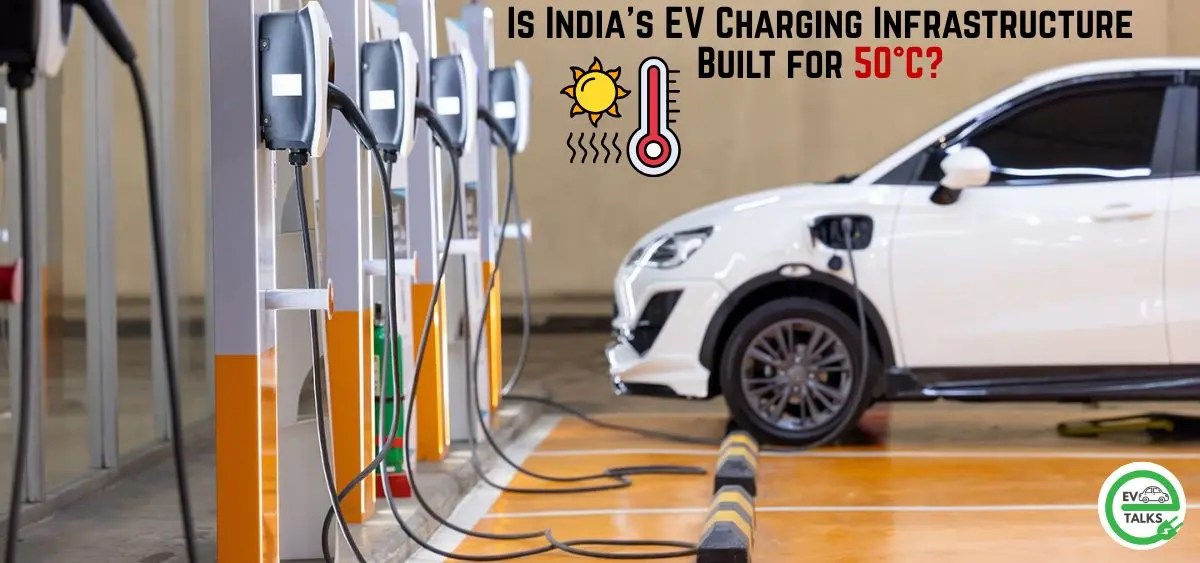

India’s electric vehicle (EV) revolution appears to be accelerating at an impressive pace. Public charging stations have expanded nearly sixfold in under three years, while EV sales have surged by 19% year-on-year. Backed by a government commitment of ₹10,900 crore under the PM E-DRIVE initiative, the transition to electric mobility is clearly gaining momentum. But beneath this rapid growth lies a critical question: Is India’s EV Charging Infrastructure Built for 50°C?
Rapid Growth, But Reliability Concerns Persist
Despite the expansion, significant gaps remain. India’s EV-to-charger ratio currently stands at 1:235, far behind the global benchmark of 6 to 20. More concerning is that 38% of EV users still report unreliable charging as a key barrier. These figures highlight a crucial issue—India may not have an EV adoption problem, but it certainly has a charging reliability challenge. This brings us back to the pressing concern: Is India’s EV Charging Infrastructure Built for 50°C?
The Hidden Performance Gap in Extreme Heat
One of the least discussed issues in India’s EV ecosystem is charger performance during extreme temperatures. A fast charger rated at 60 kW often delivers only 38–42 kW during peak summer afternoons when temperatures soar to 46°C or higher.
This drop in output is caused by thermal derating, a built-in safety mechanism that reduces power to prevent overheating. While the charger remains operational, its efficiency drops significantly—without users even realizing it. This raises a critical performance question: Is India’s EV Charging Infrastructure Built for 50°C?
A Design Limitation, Not a Maintenance Issue
Most chargers in India rely on silicon IGBT (Insulated Gate Bipolar Transistor) technology, designed primarily for regions where temperatures rarely exceed 35°C. In India’s harsh summers, where temperatures frequently reach 45–50°C, these systems hit their thermal limits quickly.
This is not a failure of maintenance but a fundamental design mismatch. As temperatures rise, internal heat generation increases, forcing the system to throttle performance to protect its components.
The Case for Advanced Technology: SiC MOSFETs
A more climate-suitable alternative lies in Silicon Carbide (SiC) MOSFET technology. With efficiency levels of up to 98.5%, compared to around 96% for IGBT systems, SiC chargers generate significantly less internal heat.
In practical terms, a 60 kW IGBT charger can lose around 2.4 kW as heat, whereas a SiC-based system loses less than 900 W. This 60% reduction in heat allows chargers to maintain rated output even at ambient temperatures of up to 55°C, making them far better suited for Indian conditions.
What Climate-Ready Infrastructure Really Means?
To address these challenges, India must shift from rapid deployment to performance-focused deployment. This includes:
- Specifying charger performance at 45°C and 50°C, not just lab conditions
- Incorporating thermal performance into business and operational models
- Distinguishing between uptime and actual power delivery
A charger operating at reduced capacity may be technically “online,” but functionally underperforming.
The Road Ahead
India’s EV ambitions are among the most ambitious globally, targeting 30% private car electrification and 80% adoption in two- and three-wheelers by 2030. Achieving these goals requires not just more chargers but better ones.
The focus must now shift from quantity to quality—ensuring chargers perform consistently in real-world Indian conditions, from the peak heat of Rajasthan highways to urban centers.
Ultimately, the success of India’s EV transition hinges on answering one critical question: Is India’s EV Charging Infrastructure Built for 50°C?

Related Articles:









