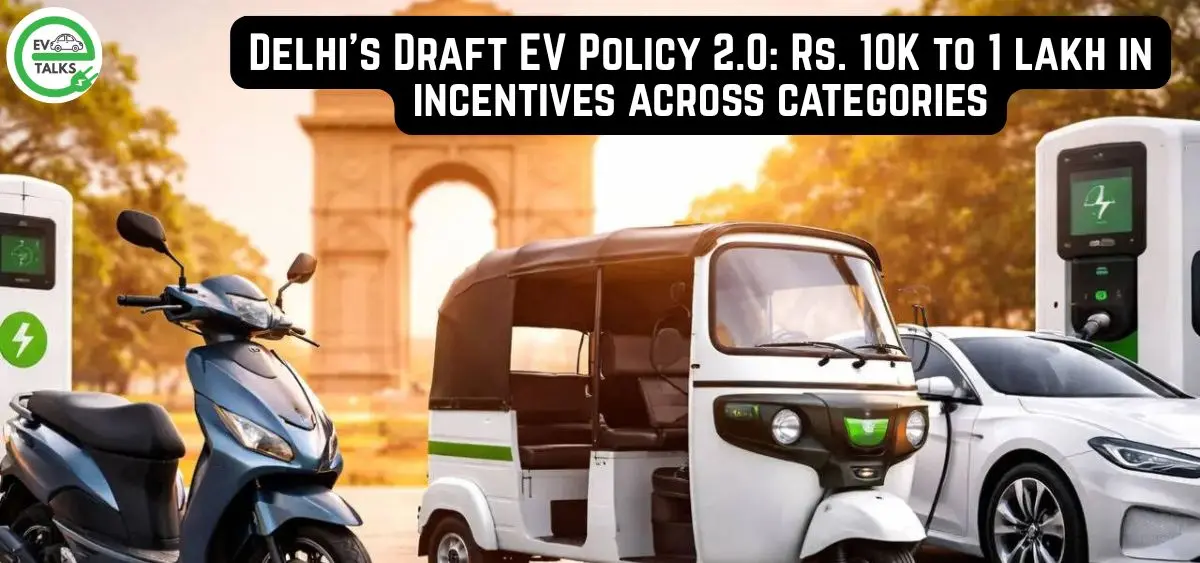

The Delhi government has released Delhi’s Draft EV Policy 2.0, formally titled the Electric Vehicle Policy 2026–2030, aiming to accelerate the shift to cleaner transport in the national capital. Issued by the Transport Department’s EV Cell on April 11, 2026, the draft is open for public feedback for 30 days before final implementation. The policy is designed to tackle rising air pollution while boosting electric mobility adoption.
Strict Timelines for Petrol-Vehicle Phase-Out
A major highlight of Delhi’s Draft EV Policy 2.0 is its aggressive timeline for phasing out petrol and diesel vehicles. Two-wheelers, which account for nearly 67% of Delhi’s vehicle population, will face a ban on new petrol registrations from April 1, 2028. Additionally, electric three-wheelers will become mandatory from January 1, 2027.
For commercial operators, the rules are even stricter. Aggregators will not be allowed to add new petrol or diesel two-wheelers or light goods vehicles (up to 3.5 tonnes) from January 1, 2026, although existing BS-VI vehicles can continue operating until the end of that year.

Incentives Up to ₹1 Lakh for EV Buyers
The policy introduces a phased incentive structure over three years. For electric two-wheelers priced up to ₹2.25 lakh:
- Year 1: ₹10,000 per kWh (max ₹30,000)
- Year 2: ₹6,600 per kWh (max ₹20,000)
- Year 3: ₹3,300 per kWh (max ₹10,000)
Electric three-wheelers will receive the following:
- ₹50,000 in the first year
- ₹40,000 in the second year
- ₹30,000 in the third year
For N1 category goods vehicles (up to 3.5 tonnes), incentives start at ₹1 lakh in the first year, reducing to ₹75,000 in the second and ₹50,000 in the third year. These benefits under Delhi’s Draft EV Policy 2.0 aim to encourage early adoption.
Scrappage Benefits for Cleaner Transition
Instead of direct purchase subsidies for private electric cars, Delhi’s Draft EV Policy 2.0 focuses on scrappage incentives. Buyers of EV cars priced up to ₹30 lakh can receive ₹1 lakh if they scrap an old BS-IV or older vehicle within six months. This benefit is limited to the first 1 lakh applicants.
Additional scrappage incentives include:
- ₹10,000 for two-wheelers
- ₹25,000 for three-wheelers
- ₹50,000 for N1 goods vehicles
Tax Exemptions and Direct Transfers
The policy offers 100% exemption on road tax and registration fees for EVs until March 31, 2030. While cars up to ₹30 lakh get full waivers, strong hybrids receive 50% benefits, and luxury EVs above ₹30 lakh are excluded.
All incentives will be disbursed via direct bank transfers after online claims, in line with the PM E-DRIVE scheme guidelines.
Driving Delhi Toward a Greener Future
With a mix of strict regulations, financial incentives, and infrastructure push, Delhi’s Draft EV Policy 2.0 represents a significant step toward reducing emissions and transforming urban mobility. The final policy is expected to shape Delhi’s clean transport future for the rest of the decade.

Related Articles: