
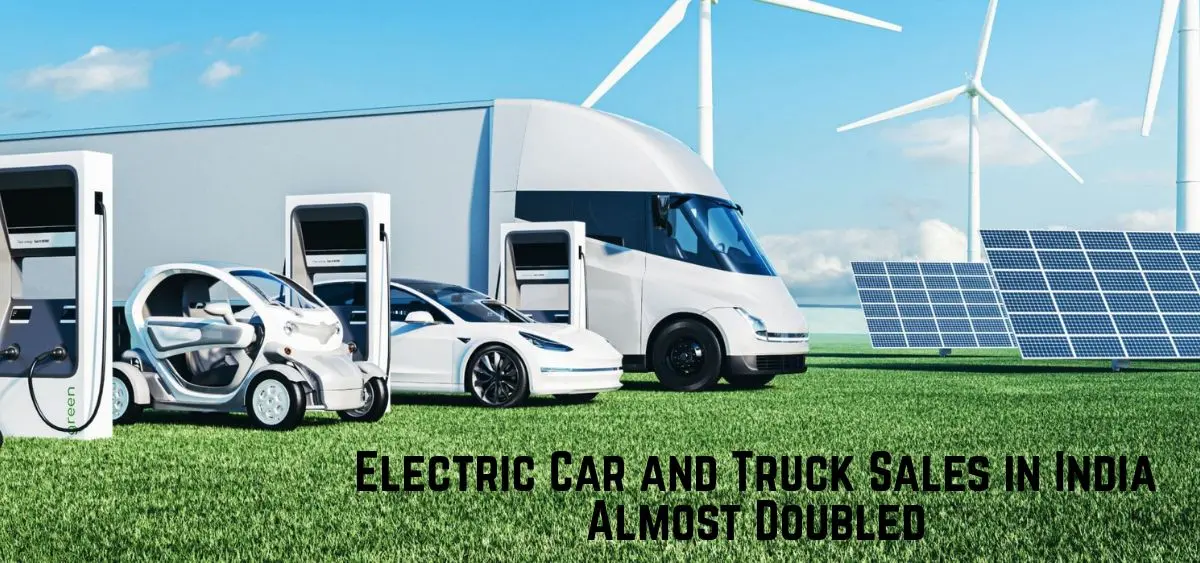

India’s electric vehicle (EV) revolution reached a significant milestone in 2025. The year marked a turning point as Electric Car and Truck Sales in India surged dramatically, reflecting growing consumer confidence, supportive policies, and expanding model choices. According to recent industry data, sales of battery-operated cars and small trucks nearly doubled, pushing overall EV growth up by 17% year-on-year.
Passenger EVs Near the Tipping Point
Annual electric car sales almost doubled to around 210,000 units in 2025. EVs now account for 4.6% of total passenger car sales — just shy of the critical 5% threshold often seen as the tipping point for mainstream adoption.
Among leading players, Tata Motors retained its dominance with a 38% share of EV car sales. MG Motor’s Windsor emerged as the best-selling passenger EV, followed by Mahindra & Mahindra’s electric SUV XEV 9E.

The strong performance was driven largely by compact electric SUVs — a high-demand category. However, the hatchback segment still offers limited electric options. Falling battery prices, stricter fuel-efficiency norms, and tighter emission standards are expected to further boost Electric Car and Truck Sales in India in 2026.
Meanwhile, compressed natural gas (CNG) vehicles also gained traction. CNG car sales rose 24% to nearly 957,000 units, surpassing diesel for the first time. Maruti Suzuki leads this segment with a commanding 70% market share.
Two-Wheelers and Three-Wheelers: Volume Leaders
Electric scooters accounted for 6.3% of the 21.2 million two-wheelers sold in 2025. TVS Motor and Bajaj Auto led the segment, while Ola Electric saw its annual sales halve to 200,000 units, dropping to fourth place. Electric motorcycle adoption remains slow, with just 16,000 units sold last year.
Three-wheelers continue to show the strongest EV penetration. In 2025, EVs accounted for 61% of total three-wheeler sales, up from 46% in 2020. Bajaj Auto dominated this segment, doubling its electric three-wheeler sales to nearly 79,000 units.
Commercial Vehicles Drive Growth
A major highlight of 2025 was the sharp rise in Electric Car and Truck Sales in India, particularly in the commercial segment. Electric commercial vehicle sales nearly doubled to over 11,300 units. Light commercial vehicles (LCVs) or small trucks made up 10,800 of these sales, largely driven by logistics providers.
Tata Motors led the electric LCV category with over 4,500 units sold, followed by Mahindra, Euler Motors, and Switch Mobility. The heavy commercial vehicle (HCV) segment is gradually electrifying, though current usage remains limited to ports and mining operations.
Electric bus sales also grew 21% to 4,506 units, driven mainly by government procurement programs. In comparison, over 6,000 CNG buses were sold, marking a 28% increase year-on-year.
Battery Manufacturing: The Missing Link
Despite rising Electric Car and Truck Sales in India, domestic battery cell production remains limited. India currently has about 3 GWh of commissioned battery cell manufacturing capacity. Major commitments from Adani Group and Reliance Industries aim to build over 170 GWh capacity in the coming years.
As 2026 approaches, expanding model portfolios, policy support, and climate goals are expected to sustain the strong momentum in Electric Car and Truck Sales in India, positioning the country firmly on the path to electrified mobility.

Related Articles:-









