

In a rapidly shifting global energy landscape, a new alliance is quietly reshaping the future of clean technology and manufacturing. As nations race to secure critical minerals and dominate EV battery supply chains, a strategic collaboration has taken center stage. India and Canada move to a partnership with a shared vision for sustainable growth, resilient supply chains, and next-generation manufacturing. This cooperation goes beyond diplomacy—unlocking opportunities that could redefine clean mobility, energy security, and industrial leadership for decades to come.
High-Level Talks Set the Direction
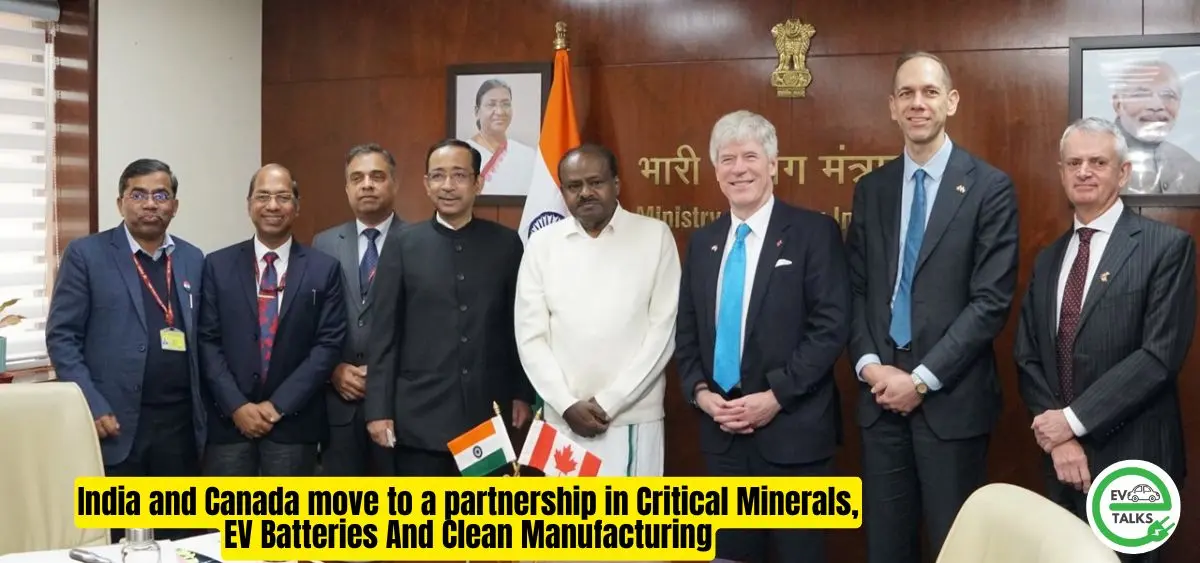
The momentum was reinforced during high-level bilateral talks in New Delhi between India’s Union Minister for Heavy Industries and Steel, H.D. Kumaraswamy, and Canada’s Minister of Natural Resources, Tim Hodgson. The discussions were firmly anchored in India’s Viksit Bharat@2047 vision and its Net Zero by 2070 commitment. Minister Kumaraswamy highlighted India’s rapid emergence as a global manufacturing hub, especially in automobiles and electric mobility, while Canada acknowledged India’s leadership in battery technologies and EV solutions. This marked a clear moment where India and Canada moved to a partnership with shared long-term goals.

Securing Critical Minerals for the Energy Transition
A core pillar of the collaboration is critical minerals. Canada reiterated its readiness to support India’s growing demand for lithium, cobalt, graphite, and rare earth elements—materials essential for EV batteries and clean energy technologies. India, in turn, is exploring direct investments in Canadian mining assets to secure long-term supplies. Both nations agreed to formalize institutional frameworks for critical mineral cooperation in early 2026, reflecting how India and Canada move to a partnership to strengthen supply chain security.
EV Batteries, Technology Sharing, and Manufacturing
The partnership also places strong emphasis on EV batteries and clean mobility. Canada has expressed willingness to share advanced battery technologies and technical expertise with Indian partners. Discussions aligned closely with India’s $2-billion incentive programme for Advanced Chemistry Cells (ACC), focusing on indigenous capacity building. Joint efforts will include next-generation battery R&D, battery cells and components, testing and certification infrastructure, and sustainable manufacturing processes—another area where India and Canada move to Partnership in a practical and industry-driven manner.
Relaunch of the Ministerial Energy Dialogue
Beyond minerals and batteries, the bilateral engagement has widened its scope. The India-Canada Ministerial Energy Dialogue was officially relaunched at India Energy Week 2026 in Goa, covering green hydrogen, biofuels, sustainable aviation fuel, and the use of AI in energy systems. This strategic shift follows directives from both Prime Ministers at the 2025 G7 Summit, underlining how India and Canada move to Partnership across the entire clean energy ecosystem.
What Lies Ahead?
The upcoming Canada-India Critical Minerals Annual Dialogue at the PDAC Convention in Toronto in March 2026 will be a key milestone. With senior officials and industry leaders actively involved, this collaboration positions both countries as trusted partners in shaping a secure, sustainable, and future-ready clean manufacturing and energy landscape.

Related Articles:-









