


India is taking a major step towards strengthening its electric vehicle battery supply chain by restricting the overseas shipment of valuable battery recycling materials. In a significant policy decision, India Bans Li-Ion Battery Black Mass Exports to retain critical minerals such as lithium, cobalt, nickel, and manganese for domestic processing.
Announced on November 10, 2026, the restriction aims to support Indian battery recyclers, reduce dependence on imported raw materials, and encourage local mineral recovery.
The move could reshape India’s growing EV recycling industry while creating new opportunities for battery manufacturers, refining companies, and sustainable energy businesses nationwide in the coming years.
Why Has India Banned Lithium-Ion Battery Black Mass Exports?
India has prohibited exports of lithium-ion battery black mass to ensure valuable battery minerals are recovered and refined domestically. Effective November 10, 2026, the DGFT restriction aims to improve raw material availability for Indian recyclers, reduce critical mineral import dependence, and strengthen the country’s EV battery manufacturing ecosystem.
Key Highlights of India’s Battery Black Mass Export Ban
- Effective Date: November 10, 2026, with immediate implementation.
- Government Authority: Directorate General of Foreign Trade (DGFT).
- Notification: No. 49/2026-27.
- Export Classification: Changed from “Free” to “Prohibited.”
- ITC (HS) Code: 85491400.
- Key Minerals: Lithium, nickel, cobalt, manganese, and graphite.
- Policy Duration: Until further notice.
- Main Objective: Promote domestic battery recycling, mineral refining, and EV battery manufacturing.

What Is Lithium-Ion Battery Black Mass?
Black mass is a dark, powder-like material produced during the recycling of used lithium-ion batteries and battery manufacturing scrap. It is generated when batteries are shredded and processed to separate their valuable components.
Although black mass may look like ordinary industrial waste, it contains several valuable minerals used in electric vehicles, energy storage systems, and modern battery manufacturing.
These materials can be recovered through advanced refining processes and reused in new battery production.
Which Critical Minerals Can Be Recovered From Black Mass?
| Critical mineral | Importance in battery manufacturing |
|---|---|
| Lithium | Essential material used in lithium-ion battery cells |
| Nickel | Helps improve energy density in certain battery chemistries |
| Cobalt | Supports stability and performance in some battery cathodes |
| Manganese | Used in several cathode materials |
| Graphite | Commonly used in lithium-ion battery anodes |
Black mass is not a finished battery-grade product. It requires additional processing to separate, purify, and convert its mineral content into materials suitable for battery production.
This process is an important part of urban mining, which involves recovering valuable resources from discarded products rather than relying entirely on newly mined minerals.
What Does the DGFT Notification Actually Ban?
The Directorate General of Foreign Trade issued Notification No. 49/2026-27 on November 10, 2026, changing the export policy for specified battery waste and black mass.
Under ITC (HS) Code 85491400, the export classification has been revised from “Free” to “Prohibited.”
The classification covers unsorted waste and scrap of primary cells, primary batteries, and electric accumulators, including spent batteries that do not contain lead, cadmium, or mercury. The notification specifically identifies lithium-ion battery black mass.
The restriction takes effect immediately and will remain applicable until the government issues further orders.
However, this is not a blanket ban on exports of finished batteries or every refined critical mineral product.
Are There Any Exceptions to the Export Restriction?
The notification includes transitional provisions under Paragraph 1.05 of the Foreign Trade Policy 2023.
Certain export commitments supported by irrevocable commercial letters of credit issued before the restriction may qualify for transitional relief.
Eligible exporters must meet prescribed conditions, including registration with the relevant DGFT regional authority within 15 days.
These provisions are intended to address qualifying pre-existing commercial commitments rather than create a general exemption from the new prohibition.
Why Has India Banned Lithium-Ion Battery Black Mass Exports?
The decision comes at a time when India’s electric vehicle industry is expanding and demand for battery materials is expected to increase.
Despite growing domestic recycling infrastructure, Indian companies continue to face challenges in securing sufficient raw materials for mineral recovery.
India Bans Li-Ion Battery Black Mass Exports as part of a broader effort to address these supply chain gaps and support domestic value addition.
1. Addressing the Raw Material Shortage
India has expanded its battery recycling and mineral refining infrastructure, but some facilities are operating below their potential capacity because of limited feedstock availability.
Feedstock refers to the raw material required by recycling and refining plants.
Previously, some black mass generated in India was being exported for processing overseas. Meanwhile, certain domestic recyclers had to import similar materials to maintain operations.
The new restriction is intended to correct this mismatch by keeping more domestically generated black mass available for Indian processing facilities.
2. Reducing Dependence on Imported Critical Minerals
India remains heavily dependent on international suppliers for several critical minerals and their refined intermediates.
The supplied industry assessment places this dependence at over 80%, although reliance varies across individual minerals and products.
Recovering lithium, nickel, cobalt, and other materials from used batteries could help reduce this dependence over time.
Domestic recycling can also lower exposure to international supply disruptions and reduce reliance on major overseas mineral-processing centres, including China.
3. Preventing Future Outflows of Battery Materials
According to the Global Trade Research Initiative (GTRI), officially recorded exports under the specified HS classification were negligible during the previous financial year.
This suggests the restriction is partly preventive rather than simply a response to large recorded export volumes.
As more electric vehicles reach the end of their useful lives, the volume of discarded lithium-ion batteries is expected to increase.
Retaining their recyclable materials could help India build a stronger domestic mineral recovery industry.
4. Encouraging Domestic Value Addition
Battery shredding is only the first stage of the recycling process.
Higher-value activities involve extracting, purifying, and converting recovered minerals into compounds that battery manufacturers can use.
Previously, overseas refiners could capture much of this value by processing black mass exported from India.
The restriction aims to encourage more of these activities to take place within the country, supporting domestic technology development and industrial investment.
How Will the Export Ban Impact India’s EV Battery Recycling Industry?
The policy could benefit India’s battery recycling industry by improving access to valuable raw materials.
However, its long-term success will depend on whether companies can efficiently recover minerals at the quality and scale required by battery manufacturers.
Major Benefits for Domestic Recyclers
- Better raw material availability: More locally generated black mass may become available to Indian refining companies.
- Higher plant utilization: Reliable feedstock supplies could help existing facilities operate closer to their designed capacity.
- Improved investment opportunities: Domestic mineral recovery projects may become more commercially attractive.
- Stronger battery supply chains: Locally recovered minerals could support India’s growing battery manufacturing industry.
- Greater resource security: Recycling can create an additional domestic source of critical minerals.
Support for Recycled Material Requirements in EV Batteries
The restriction also comes ahead of reported regulatory requirements for new EV batteries in India to incorporate at least 5% recycled material.
Retaining black mass could help domestic companies develop supplies of recycled battery materials needed to meet such requirements.
However, access to black mass alone does not establish compliance. Manufacturers must still obtain suitable recovered materials that meet applicable quality, sourcing, and regulatory standards.
Can India’s Recycling Industry Process All the Retained Black Mass?
India has developed considerable lithium-ion battery recycling capacity, but a significant gap remains between general battery processing and advanced mineral recovery.
According to the industry figures provided, 57 lithium-ion battery recyclers registered on the Central Pollution Control Board’s Battery Waste Extended Producer Responsibility portal have a combined annual processing capacity of approximately 5.17 lakh metric tonnes.
However, the estimated annual input capacity of companies specifically processing lithium-ion battery black mass is around 75,500 metric tons.
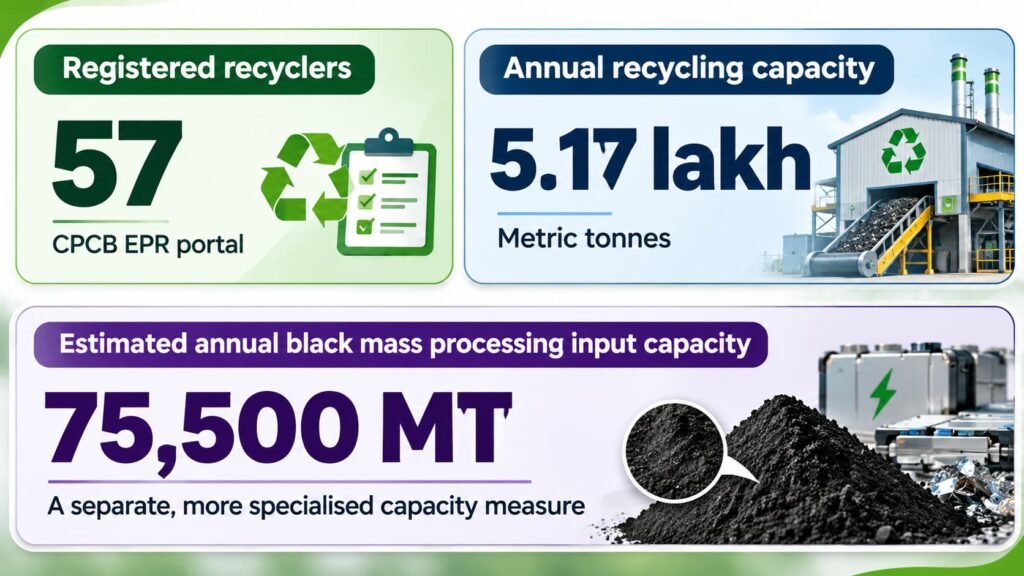
These two capacity figures should not be treated as directly equivalent.
The larger figure represents registered lithium-ion battery recycling capacity, while the smaller figure relates specifically to facilities processing black mass.
This distinction highlights an important challenge: India needs advanced refining capacity, not just battery collection and shredding facilities.
Key Challenges Facing Indian Battery Recyclers
Recovering minerals from black mass requires specialized equipment, chemical processing expertise, and substantial investment.
Companies must address several challenges:
- Producing lithium, nickel, and cobalt compounds with battery-grade purity.
- Expanding advanced hydrometallurgical processing facilities.
- Maintaining commercially viable mineral recovery costs.
- Securing reliable buyers for recovered materials.
- Developing efficient and environmentally responsible recycling operations.
If companies cannot process the retained black mass efficiently, the restriction alone may not deliver the expected economic benefits.
Government Announces ₹1,500 Crore Critical Mineral Recycling Incentive Scheme
The export restriction forms part of India’s wider strategy to strengthen its critical mineral supply chain.
In September 2025, the Union Cabinet approved a ₹1,500 crore Incentive Scheme for Promotion of Critical Mineral Recycling under the National Critical Mineral Mission.
The scheme is designed to encourage recovery of critical minerals from secondary sources, including spent lithium-ion batteries, electronic waste, and other recyclable scrap.
It aims to support businesses that extract valuable minerals and develop domestic recycling capabilities.
This approach encourages companies to move beyond basic battery dismantling and shredding towards higher-value mineral recovery.
Government Also Approves ₹2,814 Crore for Critical Mineral Processing
On November 4, 2026, the Union Cabinet approved a separate ₹2,814 crore capital expenditure support scheme to strengthen domestic critical mineral processing.
The scheme is scheduled to operate from FY2026-27 to FY2030-31.
It provides a 30% capital subsidy to support four proposed processing plants.
| Proposed facilities | Minimum capacity per plant |
|---|---|
| 2 lithium processing plants | 30,000 tonnes |
| 2 nickel processing plants | 50,000 tonnes |
The initiative focuses on processing lithium and nickel ores or intermediary products into high-purity materials.
Cobalt is also expected to be recovered as a by-product of nickel processing.
Importantly, this ₹2,814 crore initiative is separate from the ₹1,500 crore recycling incentive scheme.
While the recycling scheme focuses on recovering minerals from discarded materials, the newer initiative supports broader critical mineral processing infrastructure.
Together, these programmes could help India develop a more integrated domestic mineral supply chain.
How Does Black Mass Recycling Work?
The recycling of lithium-ion batteries involves several stages, from collecting used batteries to producing refined materials suitable for manufacturing new cells.
From used EV batteries to reusable minerals
1. Battery collection → Used EV batteries and manufacturing scrap
2. Dismantling and shredding → Safe processing and separation of components
3. Black mass recovery → Collection of mineral-rich intermediate material
4. Mineral extraction and refining → Separation and purification of valuable materials
5. New battery material production → Recovered minerals enter the battery supply chain
The process can help reduce dependence on newly mined minerals while recovering valuable resources from battery waste.
However, the environmental and economic benefits depend on recycling efficiency, energy use, recovery rates, and responsible handling of processing waste.
What Does the Export Ban Mean for EV Manufacturers and Battery Companies?
For India’s electric vehicle industry, the restriction represents an attempt to build a more secure and locally integrated battery supply chain.
Battery manufacturers require reliable access to high-quality materials, including lithium compounds, nickel, cobalt, and graphite.
By retaining recyclable battery waste within India, the government hopes to support domestic recovery of these resources.
In the longer term, this could provide several advantages.
- For EV manufacturers: A stronger domestic battery material supply chain could reduce exposure to international mineral supply disruptions.
- For battery cell manufacturers: Locally refined recycled materials could provide an additional source of manufacturing inputs.
- For recycling companies: Greater access to black mass could encourage investment in advanced refining and recovery technologies.
- For the wider EV ecosystem: Improved material recovery could support circular manufacturing and reduce the need to rely entirely on newly mined resources.
However, the policy does not guarantee an immediate reduction in EV battery prices or electric vehicle costs. Any cost benefits would depend on processing economics, recovered material quality, and manufacturing scale.
Will the Export Ban Make India More Self-Reliant in EV Battery Materials?
India’s growing EV industry will require substantial quantities of critical minerals in the coming years.
Recycling offers a way to recover part of this demand from batteries that have already been manufactured and used.
Nevertheless, recycling cannot completely eliminate dependence on imported minerals, particularly while India’s domestic supply of end-of-life EV batteries remains limited relative to future manufacturing requirements.
The restriction is therefore best understood as one part of a broader strategy involving mineral processing, recycling incentives, technology development, and battery manufacturing investment.
Its effectiveness will depend on the country’s ability to turn retained black mass into commercially usable battery materials.
FAQs about India Bans Li-Ion Battery Black Mass Exports
1. What is lithium-ion battery black mass?
Black mass is a mineral-rich powder obtained during lithium-ion battery recycling. It contains recoverable materials such as lithium, nickel, cobalt, manganese, and graphite.
2. When did India ban lithium-ion battery black mass exports?
The DGFT introduced the restriction on November 10, 2026, through Notification No. 49/2026-27, with immediate effect.
3. Why did India restrict black mass exports?
The government aims to improve domestic feedstock availability, support battery recycling companies, encourage local mineral refining, and reduce dependence on imported critical minerals.
4. Does the ban apply to all lithium-ion batteries?
No. The restriction applies to the specified battery waste and black mass classification under ITC (HS) Code 85491400. It is not a blanket prohibition on finished battery exports.
5. How will the ban benefit India’s EV industry?
It could strengthen domestic battery recycling, support mineral recovery, and help battery manufacturers access locally refined recycled materials.
6. Can India recover lithium and cobalt from used EV batteries?
Yes. Advanced recycling technologies can recover valuable minerals from used lithium-ion batteries, although the recovered materials must undergo further processing to meet battery manufacturing standards.
Conclusion: India Bans Li-Ion Battery Black Mass Exports
India Bans Li-Ion Battery Black Mass Exports at a crucial stage in the country’s electric mobility transition. The decision could strengthen domestic recycling, improve critical mineral availability, and encourage greater investment in battery refining technologies.
Combined with the ₹1,500 crore recycling incentive scheme and the ₹2,814 crore critical mineral processing initiative, the restriction reflects India’s ambition to develop a stronger and more self-reliant battery supply chain.
However, retaining black mass is only the beginning. The real challenge will be converting battery waste into high-purity, commercially viable materials that can support India’s next generation of electric vehicles.

Related Articles:









