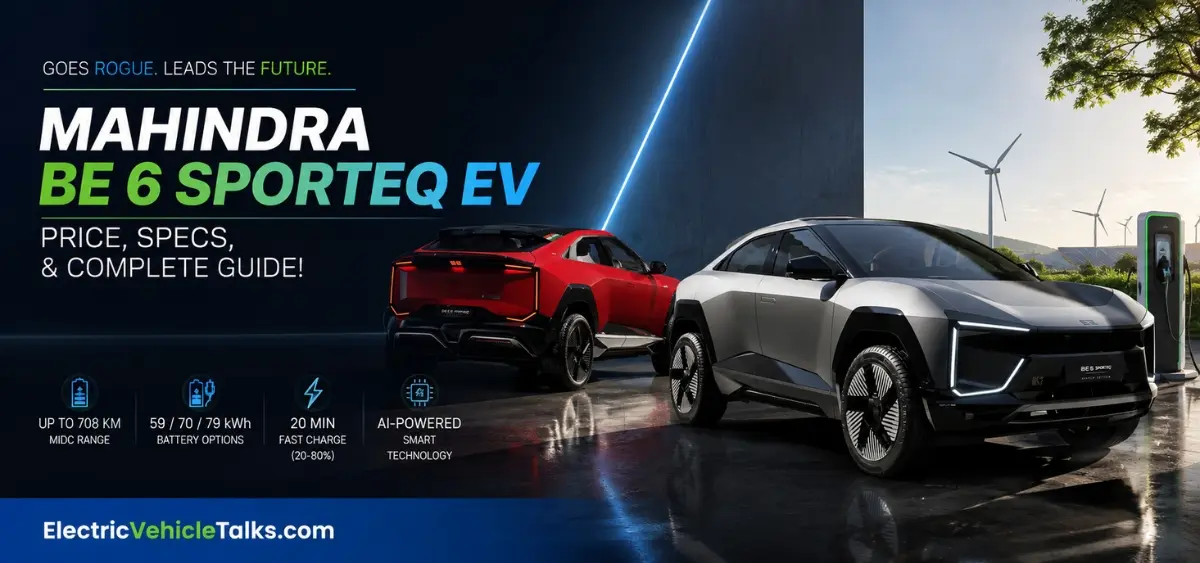

The Mahindra BE 6 SportEQ EV is the next evolution of Mahindra’s BE 6 electric SUV, combining up to a claimed 708 km MIDC range, 59 kWh, 70 kWh, and 79 kWh battery choices, rear-wheel drive, and a much more software-focused cabin. Prices start at ₹11.45 lakh under Battery as a Service (BaaS) or ₹19.45 lakh when the 59 kWh battery is included in the vehicle price.
Mahindra officially introduced the SportEQ range on August 15, 2026, with eight variants—ONE, TWO, THREE, THREE+, FOUR, FE, FE FOUR, and Launch Edition. Customer deliveries are scheduled to begin on August 26, 2026.
This is more than a cosmetic update. SportEQ introduces a coast-to-coast triple-screen cockpit on most variants, Google Gemini-powered conversational AI, new TEQ software suites, enhanced connected-car functionality, a new 70 kWh battery option, and the Formula E-inspired Freedom Edition.
For Indian buyers considering a premium electric SUV, the result is one of Mahindra’s most technically ambitious EV packages yet.

Mahindra BE 6 SportEQ EV Price in India
The Mahindra BE 6 EV price list is unusually broad because buyers can choose between outright battery ownership and BaaS on selected entry variants.
| Variant | 59 kWh BaaS | 59 kWh | 70 kWh | 79 kWh |
|---|---|---|---|---|
| ONE | ₹11.45 lakh | ₹19.45 lakh | — | — |
| TWO | ₹12.95 lakh | ₹20.95 lakh | — | — |
| THREE | — | ₹21.95 lakh | ₹22.95 lakh | — |
| THREE+ | — | — | ₹23.95 lakh | ₹24.95 lakh |
| FOUR | — | — | — | ₹26.95 lakh |
| Launch Edition | — | — | — | ₹26.95 lakh |
| FE | — | — | — | ₹24.45 lakh |
| FE FOUR | — | — | — | ₹26.95 lakh |
These are ex-showroom prices and exclude the wall charger and installation. Under the announced BaaS structure, the battery charge is ₹3.75 per km, calculated on an assumed usage of 60 km per day.
Is the ₹11.45 lakh SportEQ really a ₹11.45 lakh EV?
Not in the conventional sense.
The ₹11.45 lakh figure is the vehicle price under BaaS. Instead of paying for the battery upfront as part of the car, the customer pays for battery usage separately.
At Mahindra’s stated ₹3.75/km:
| Monthly driving | Approximate BaaS battery charge* |
|---|---|
| 600 km | ₹2,250 |
| 1,000 km | ₹3,750 |
| 1,500 km | ₹5,625 |
| 1,800 km | ₹6,750 |
| 2,000 km | ₹7,500 |
*Simple distance × ₹3.75 illustration. Actual contractual billing, minimum usage conditions, financing, taxes, and other BaaS terms should be checked before purchase.
BaaS can dramatically reduce the upfront entry cost, but buyers should compare the total cost over their expected ownership period, not just the headline price. BAAS in Electric Vehicles
Mahindra BE6 SportEQ Variant Lineup Explained
With eight versions and three battery capacities, choosing a SportEQ may initially look complicated.
The easiest way to understand the lineup is by separating affordability, battery size, and technology.
1. ONE and TWO
Both use the 59 kWh battery.
ONE is the entry point and retains dual 31.24 cm Super HD screens. TWO introduces the coast-to-coast three-screen layout and adds equipment such as the 16-speaker Harman Kardon system with Dolby Atmos, NFC compatibility, a 540-degree camera, dual-zone climate control, and user-profile functionality depending on the feature specification.
2. THREE
THREE is particularly interesting because buyers can choose 59 kWh or 70 kWh batteries.
It also adds the panoramic Infinity Roof, sequential indicators, and other comfort upgrades. The 70 kWh option provides a useful middle ground between affordability and long-distance capability.
3. THREE+
Available with 70 kWh or 79 kWh, THREE+ introduces more advanced equipment, including L2 ADAS, animated C-shaped lighting, a powered tailgate with gesture control, and additional convenience features.
4. FOUR
FOUR is a 79 kWh high-specification version and adds technologies such as intelligent adaptive suspension, Google Gemini-powered TEQ_Talk, in-car gaming, Private Audio, Dolby Vision, a StraightAhead AR display, HandsFree Park, Qualcomm 8295 processing, and L2+ ADAS.
5. Formula E Freedom Edition — FE and FE FOUR
These are the enthusiast-focused versions.
The Formula E Freedom Edition brings back the original race-inspired dual-screen cockpit and signature halo design. Mahindra says its Acceleration Boost can deliver 0–100 km/h in 6.44 seconds.
6. Launch Edition
Sitting at the top of the visual hierarchy, the Launch Edition combines a unique Graphite Storm exterior with full Racing Tan leatherette interiors and the 79 kWh battery.
Mahindra BE 6 SportEQ EV Specifications
The basic engineering remains serious enough to make the SportEQ more than a gadget-heavy electric crossover.
| Specification | Mahindra BE 6 SportEQ |
|---|---|
| Battery options | 59 kWh / 70 kWh / 79 kWh |
| Motor power | 170 / 180 / 210 kW |
| Maximum torque | 360 Nm |
| Drivetrain | Rear-wheel drive |
| MIDC range | 573 / 651 / 708 km |
| Length | 4,371 mm |
| Width | 1,907 mm |
| Height | 1,627 mm |
| Wheelbase | 2,775 mm |
| Ground clearance | 207 mm unladen; 222 mm at battery |
| Boot | 455 litres |
| Frunk | 45 litres |
| Turning circle diameter | 10 metres |
| DC 20–80% charging | 20 minutes under specified conditions |
| AC charger options | 7.2 kW / 11.2 kW |
| Drive | RWD |
Mahindra’s brochure specifies 170 kW for 59 kWh, 180 kW for 70 kWh and 210 kW for 79 kWh, while all three deliver 360 Nm.
One important omission is worth highlighting: the official material reviewed for this guide does not specify a certified Mahindra BE 6 SPORTEQ EV top speed. Rather than quote an unofficial figure, buyers should wait for Mahindra’s confirmed specification or homologation data.
What Is the Mahindra BE 6 SPORTEQ EV Range?
Official MIDC P1+P2 figures are:
- 59 kWh: 573 km
- 70 kWh: 651 km
- 79 kWh: 708 km
Mahindra additionally claims 500+ km of real-world range under its internal testing conditions involving moderate ambient temperatures, city driving, low HVAC usage, dry roads, and Optimal Drive Mode.
That distinction matters.
A certified laboratory-cycle figure should never automatically be interpreted as the distance every owner will achieve between charges.
Highway speed, aggressive acceleration, air-conditioning, payload, terrain, ambient temperature, tire pressure, and driving style can all change actual consumption.
For Indian highway touring, the 79 kWh version offers the strongest range buffer. Urban users who have reliable home charging may find the 59 kWh version more economical.
Mahindra BE 6 SPORTEQ EV Battery Capacity and Performance
The arrival of the 70 kWh battery is one of the most strategically important SportEQ changes.
Previously, choosing between a smaller pack and a much larger pack could force buyers into a bigger price jump. The 70 kWh configuration creates a useful middle tier.
| Battery | Power | Torque | MIDC Range |
|---|---|---|---|
| 59 kWh | 170 kW | 360 Nm | 573 km |
| 70 kWh | 180 kW | 360 Nm | 651 km |
| 79 kWh | 210 kW | 360 Nm | 708 km |
All versions are rear-wheel drive, giving the SportEQ a more enthusiast-oriented architecture than many mainstream front-wheel-drive electric SUVs.
The chassis uses independent suspension at both ends: an i-Link McPherson-strut arrangement at the front and five-link independent rear suspension. Higher versions add intelligent adaptive suspension.
How Fast Does the Mahindra BE 6 SportEQ Charge?
All three batteries can go from 20% to 80% in a claimed 20 minutes, provided an appropriately powerful compatible DC charger is available.
| Battery | Required DC input for claimed time | 20–80% |
|---|---|---|
| 59 kWh | 140 kW / 400A | 20 min |
| 70 kWh | 160 kW / 400A | 20 min |
| 79 kWh | 180 kW / 400A | 20 min |
For AC charging:
| Battery | 11.2 kW AC | 7.2 kW AC |
|---|---|---|
| 59 kWh | 6 hours | 8.7 hours |
| 70 kWh | 7 hours | 10.2 hours |
| 79 kWh | 8 hours | 11.7 hours |
These are Mahindra’s 0–100% AC and 20–80% DC figures.
Which home charger makes sense?
For overnight charging, 7.2 kW can be adequate for many households. Frequent highway travelers, high-mileage users, or owners of the 79 kWh version may appreciate the faster 11.2 kW setup, provided the property’s sanctioned electrical load and installation support it.
Remember that SportEQ prices quoted by Mahindra exclude the wall charger and installation.
What Are the Best Mahindra BE 6 SPORTEQ EV Features?
SportEQ’s biggest leap is arguably inside the cabin.
1. Coast-to-Coast Triple-Screen Cockpit
From TWO onwards, mainstream SportEQ variants receive three 31.24 cm HD displays spanning the dashboard. The Launch Edition pairs this arrangement with Racing Tan interiors and a straight instrument panel.
The Formula E versions deliberately go in the opposite direction, using a more driver-centric dual-screen cockpit and halo-style instrument panel.
2. TEQ_Talk with Google Gemini
Mahindra’s MAIA architecture now powers TEQ_Talk, built with Google Gemini.
According to Mahindra, the system uses 17 specialized AI agents and supports more than 100 core functions and 48 apps covering areas such as navigation, entertainment, and vehicle controls.
That is significant because it moves voice interaction beyond basic commands such as changing temperature or calling a contact.
3. Six TEQ Suites
Mahindra Group’s SportEQ software is divided into six suites:
TEQ_Talk handles conversational AI.
TEQ_Play includes gaming, karaoke, Dolby Vision/Atmos, GrooveMe Party, and Private Audio.
TEQ_Drive covers Custom Drive Mode, Drift Mode, Tribe Drive, and Revive functionality.
TEQ_Me creates personalized driver profiles.
TEQ_Secure incorporates security monitoring, NFC access, and Digital Car Key functionality.
TEQ_xting enables personalized tailgate messaging.
Mahindra says its digital-key implementation extends across iPhone, Apple Watch, Android, and Samsung smartphones as well as NFC key cards and is CCC-compliant.
Revive, Drift Mode and Custom Mode Explained
These are among SportEQ’s most unusual technologies.
a) Revive and Revive SOS
Revive is designed to provide additional usable range after the displayed charge reaches 0%, helping the driver reach a charger.
Revive SOS provides emergency additional range, with Mahindra specifying five uses over the vehicle’s lifetime. Importantly, Mahindra explicitly says Revive is not a substitute for charging.
b) Drift Mode
Drift Mode disables ESP to allow controlled drifting.
This is clearly not intended for public-road experimentation. Mahindra itself states that the function is for controlled driving environments and should be used responsibly.
c) Custom Drive Mode
Drivers can adjust parameters including power, steering, climate, and suspension settings to personalize the vehicle’s character.
Safety and Driver Assistance
SportEQ equipment varies considerably by trim.
Core equipment includes six airbags, all-wheel disc brakes, ESP, brake-by-wire, an intelligent electronic brake booster, an electronic parking brake, a rear camera, and parking sensors.
Higher trims add:
- 540-degree camera
- Front parking sensors
- Individual tyre-pressure monitoring
- L2 ADAS
- L2+ ADAS with five radars and one vision camera on higher variants
- Knee airbag
- Continuous DVR
- Secure360 Pro
- Intrusion alerts
- HandsFree Park
The detailed variant chart in Mahindra’s brochure shows how sharply ADAS and security capability increase as buyers move through the range.
Secure360 Pro and Connected Security
Secure360 Pro turns the vehicle’s external cameras into part of its connected security system.
Owners can access 360-degree exterior monitoring, live footage, and recordings; activate audio relay; and track the vehicle using Mahindra’s Me4U app.
For owners parking expensive EVs outdoors or in shared apartment parking, this type of remote visibility may prove more useful day-to-day than some headline entertainment features.
Entertainment: A Car That Doubles as a Digital Lounge
Mahindra is deliberately pushing beyond conventional infotainment.
SportEQ supports an in-car gaming experience with up to four Bluetooth game controllers, while karaoke and Private Audio expand what passengers can do while parked or charging.
Higher trims also feature a 1,400-watt, 16-speaker Harman Kardon audio system, while Dolby Vision and Dolby Atmos form part of the premium multimedia experience.
This is where long EV charging stops become part of the product experience rather than simply waiting time.
Software-Defined Vehicle: Why SportEQ Matters Beyond Hardware
One of the most important details in Mahindra’s announcement has nothing to do with battery capacity.
The company says new software and technology features introduced with SportEQ will be rolled out in phases to compatible existing BE6, XEV 9e, and XEV 9S vehicles beginning in January 2027, although availability will depend on model and variant.
That is the real promise of a software-defined vehicle: capability does not necessarily stop evolving when the car leaves the showroom.
For the Indian EV industry, this creates another competitive dimension. Buyers will increasingly compare manufacturers not only by battery size and range but also by processor capability, OTA support, connected services, and long-term software policy.
Practicality: Is SportEQ Suitable as a Family EV?
Despite its dramatic styling, the numbers suggest reasonable family usability.
A 2,775 mm wheelbase should help cabin packaging, while buyers get 455 liters of rear luggage volume plus a useful 45-liter frunk. Ground clearance is listed at 207 mm unladen, an important consideration for Indian roads.
Comfort equipment can include ventilated front seats, powered driver’s seat with memory, reclining rear seats, rear AC vents, cooled console storage, and multiple high-output USB-C ports depending on trim.
The panoramic Infinity Roof adds visual space, while upper trims integrate ambient lighting with a claimed 16 million colors into the cabin and roof.
Mahindra BE 6 SPORTEQ EV Available Colours
SportEQ has one of the more expressive palettes in India’s EV market.
The regular BE 6 SportEQ palette shown in the brochure includes the following:
- Ruby Velvet
- Firestorm Orange
- Stealth Black
- Tango Red
- Deep Forest
- Desert Myst
- Everest White
The Formula E Freedom Edition adds satin-finish choices including Rosso Impulso, Everest White, Firestorm Orange, and Stealth Black, while the Launch Edition is showcased in exclusive Graphite Storm.
Mahindra says the overall SportEQ family is offered in 12 colour options, including four new choices, though colour availability varies by variant.
Interior themes include Sage Green & Grey, Racing Tan & Black, Black & Firestorm Orange, and the Launch Edition’s Racing Tan treatment.
Formula E Freedom Edition: The Enthusiast’s SportEQ?
For drivers who believe EVs should deliver emotion as well as efficiency, the Freedom Edition may be the most interesting member of the range.
Mahindra connects it directly to its Formula E programme. The company points to recent race victories in Monaco and Tokyo and four pole positions for Edoardo Mortara as part of the motorsport story behind the edition.
It receives a more purposeful exterior, subtle Indian tricolor accents, satin paint choices, and the Black & Firestorm Orange cockpit.
Most importantly, Acceleration Boost enables a claimed 0–100 km/h time of 6.44 seconds.
That makes FE more than a sticker-and-color special edition.
What Does It Cost to Charge a BE 6 SportEQ at Home?
Charging costs vary by state electricity tariff and charging losses.
As a simple illustration, assuming ₹8 per kWh and ignoring charging losses:
| Battery | Approx. theoretical 0–100% energy cost |
|---|---|
| 59 kWh | ₹472 |
| 70 kWh | ₹560 |
| 79 kWh | ₹632 |
Real electricity drawn from the grid will be higher than nominal battery capacity because charging is not 100% efficient.
Public DC charging can also cost considerably more per kWh than residential electricity.
For frequent drivers, home charging therefore remains one of the strongest financial advantages of EV ownership.
India’s Charging Infrastructure: Is a 700 km EV Still Necessary?
India’s charging network is expanding quickly.
Government data published in July 2026 reported 52,718 public charging stations, including 16,561 stations equipped with fast EV chargers for cars. The government has also allocated ₹2,000 crore under PM E-DRIVE for public charging infrastructure.
That improves the ownership equation, but charger reliability, connector availability, queues, and highway distribution still matter.
For this reason, a larger battery is not only about maximum driving distance. It also gives owners greater flexibility over where they stop.
Does the Mahindra BE 6 SportEQ Get a FAME or PM E-DRIVE Subsidy?
Private electric passenger cars such as the BE 6 SportEQ are not a direct demand-incentive category under the current PM E-DRIVE framework.
The central scheme’s eligible vehicle categories focus on e-two-wheelers, e-three-wheelers, e-buses, e-ambulances, and e-trucks while also supporting charging infrastructure.
Buyers should instead check their state’s current EV policy for any applicable road tax or registration benefits. State rules can change, so eligibility should be verified at the time of registration rather than assumed when calculating the on-road price.
Benefits of the Mahindra BE 6 SportEQ EV
The SportEQ makes a strong case through its combination of hardware and software.
Key advantages include the following:
- Three battery sizes covering different budgets
- Up to 708 km claimed MIDC range
- 20–80% DC charging in 20 minutes under specified conditions
- Powerful rear-wheel-drive architecture
- Up to 210 kW and 360 Nm
- BaaS option lowering initial entry price
- Triple-screen digital cockpit
- Google Gemini integration
- OTA-based software development
- Strong connected-security ecosystem
- Advanced ADAS on higher trims
- Large boot plus frunk
- Distinct Formula E enthusiast versions
- Lifetime HV battery warranty for qualifying first registered private owners
Mahindra specifies that its lifetime HV-battery warranty applies to the first registered owner with private registration. After an ownership change, the HV battery warranty becomes 10 years or 200,000 km, whichever occurs earlier.
Challenges Buyers Should Consider
No EV should be evaluated purely from its brochure.
First, the 708 km figure is a MIDC-certified claim, not a guaranteed real-world range.
Second, the ₹11.45 lakh starting price requires BaaS, so comparing it directly with a conventional battery-inclusive EV price would be misleading.
Third, much of SportEQ’s most compelling equipment is variant-dependent.
Fourth, a 140–180 kW capable DC charger will not be available at every public charging location.
Finally, highly connected cars introduce another ownership consideration: some connected services may require registration, acceptance of terms, and potentially an active subscription. Mahindra’s brochure specifically notes this for Me4U connected services.
Common Mistakes to Avoid Before Buying
The biggest mistake is choosing the largest battery simply because it has the highest range.
A buyer covering 30–40 km daily with reliable home charging may not need 79 kWh.
Equally, a frequent interstate traveler should not select the smallest battery solely to save money upfront.
Also avoid:
- Comparing the BaaS price with battery-inclusive competitor prices.
- Treating the MIDC range as guaranteed highway range.
- Buying before confirming charger installation feasibility at home.
- Assuming every feature is standard on every SportEQ.
- Ignoring insurance and on-road pricing differences.
- Choosing a variant before comparing its exact ADAS and screen configuration.
- Assuming every software feature will work identically across trims.
Mahindra itself notes that not all brochure features are available on every variant and that real performance varies with driving conditions and other external factors.
Which Mahindra BE 6 SportEQ Variant Should You Buy?
For urban buyers prioritizing affordability, ONE 59 kWh deserves attention, particularly if the ownership economics of BaaS suit your mileage.
For buyers wanting the triple-screen experience without jumping to the top, TWO is the natural starting point.
For mixed city/highway use, THREE 70 kWh may be one of the lineup’s most balanced combinations: a 651 km MIDC range without requiring the most expensive 79 kWh configuration.
For technology-focused buyers, THREE+ or FOUR unlocks more of SportEQ’s advanced ADAS, AI, display, and suspension technology.
For performance enthusiasts, the Formula E Freedom Edition has the clearest emotional proposition.
And for customers who simply want the flagship presentation, the Launch Edition brings together the 79 kWh battery, Graphite Storm exterior, and Racing Tan cabin.
Expert Insight from Electric Vehicle Talks
The most significant thing about the Mahindra BE 6 SportEQ EV is not its 708 km range or even its three-screen dashboard. Mahindra attempts to turn the EV into an evolving digital product.
Battery capacity, charging speed, and motor output remain fundamental. But as EV powertrains mature, competitive differentiation is shifting toward software, personalization, connected security, infotainment, OTA updates, and intelligent energy management.
SportEQ illustrates that transition unusually clearly.
There is also a smart product-planning decision behind the 70 kWh battery. It fills the gap between the 59 kWh urban-friendly configuration and the 79 kWh long-distance flagship.
Our practical recommendation at Electric Vehicle Talks is simple: select the battery based on your real weekly driving pattern and charging access first, and select the technology package second. Paying for range you rarely use can reduce the financial advantage of going electric.
People Also Ask
What is the price of the Mahindra BE 6 SportEQ EV?
The Mahindra BE 6 SportEQ starts at ₹11.45 lakh ex-showroom under BaaS, with battery usage priced at ₹3.75/km under Mahindra’s announced structure. The battery-inclusive 59 kWh ONE starts at ₹19.45 lakh. The range extends to ₹26.95 lakh for FOUR, Launch Edition, and FE FOUR.
What is the Mahindra BE 6 SPORTEQ EV range?
The official MIDC P1+P2 range is 573 km for 59 kWh, 651 km for 70 kWh, and 708 km for 79 kWh. Actual driving range depends on speed, weather, HVAC use, terrain, and driving behavior.
What is the Mahindra BE 6 SPORTEQ EV battery capacity?
SportEQ offers 59 kWh, 70 kWh, and 79 kWh battery configurations depending on the variant.
How long does BE 6 SportEQ take to fast-charge?
Mahindra claims 20–80% in 20 minutes for all three battery sizes when connected to the specified compatible high-power DC charger.
Is the Mahindra BE 6 SportEQ rear-wheel drive?
Yes. The SportEQ specifications list a rear-wheel-drive (RWD) layout across the range, with 360 Nm of motor torque.
Does the Mahindra BE 6 SportEQ have Google Gemini?
Yes. Higher SportEQ variants feature TEQ_Talk built with Google Gemini, using 17 specialized AI agents and supporting more than 100 core functions and 48 apps.
What is the top speed of Mahindra BE 6 SportEQ?
Mahindra’s official SportEQ press release and brochure reviewed for this guide do not provide a certified top-speed figure. The Formula E Freedom Edition does, however, have a claimed 0–100 km/h time of 6.44 seconds with Acceleration Boost.
Mahindra BE 6 SportEQ EV: FAQs
1. When will Mahindra BE 6 SportEQ deliveries start?
Mahindra says customer deliveries will begin on August 26, 2026, coinciding with Onam.
2. How many Mahindra BE6 SportEQ variants are available?
There are eight announced variants: ONE, TWO, THREE, THREE+, FOUR, FE, FE FOUR, and Launch Edition.
3. Does the BE 6 SportEQ have one-pedal driving?
Yes. Mahindra lists Single Pedal Drive along with multi-level regenerative braking. Upper versions also support Auto Regen.
4. Does the Mahindra BE 6 SportEQ have ADAS?
Yes, but capability depends on the variant. THREE+ includes L2 ADAS using one radar and one vision camera, while higher versions add L2+ ADAS with five radars and one vision camera.
5. How much boot space does BE 6 SportEQ have?
The SUV provides 455 liters of boot capacity plus a 45-liter front storage compartment (frunk).
6. Does SportEQ have a digital key?
Yes. TEQ_Secure supports NFC Card and Digital Car Key functionality. Mahindra says its ecosystem extends across compatible Apple and Android devices as well as NFC cards.
7. Does the Mahindra BE 6 SportEQ have a battery warranty?
Mahindra advertises a lifetime HV-battery warranty for the first registered owner of a privately registered vehicle. Following an ownership change, the HV battery warranty is 10 years or 200,000 km, whichever comes first.
Final Verdict: Is the Mahindra BE 6 SportEQ Worth Considering?
The Mahindra BE 6 SportEQ EV represents an important shift in India’s premium electric SUV market.
Its headline numbers are already competitive: three battery capacities, up to 708 km MIDC range, as much as 210 kW, 360 Nm, rear-wheel drive, and 20–80% fast charging in a claimed 20 minutes.
But the deeper story is software.
Google Gemini integration, MAIA, six TEQ suites, OTA upgrades, personalized profiles, digital keys, connected security, gaming, advanced driver assistance, and an increasingly configurable driving experience suggest that Mahindra wants the car to evolve after purchase rather than remain frozen at its showroom specification.
The new 70 kWh battery also makes the range easier to recommend because customers no longer face a simple small-battery-versus-big-battery decision.
There are caveats. Buyers must understand the economics of BaaS, separate MIDC claims from real-world range, verify variant-specific equipment, and investigate home-charging installation before signing an order.
But viewed as a complete technology package, SportEQ demonstrates how rapidly Indian-built EVs are moving beyond the old conversation of simply “price versus range.”
The next battle is about how intelligently the vehicle uses its battery, computing power, cameras, displays, and software—and how much better it can become after you buy it.
For more practical EV buying guides, charging explainers, ownership analysis and electric-mobility updates, explore Electric Vehicle Talks.

Related Articles: